1971-08-06-The_Cleveland_Press
Who's on Top of the Rock Pile
The "Who Circus", complete with a new light show and breakable instruments, but minus the much promoted "Quadrosonic" sound system, arrives in town next week. Even with conventional sound, Ringling Bros. would be no competition.
In an era of pop musicians constantly grouping and regrouping, the Who have remained together for more than seven years. Through several periods of transition from "hard" to "soft", from acidic to country and blues, the Who's music has not radically changed since the beginning.
Within the framework of a polished, driving, almost insensitive structure, the material treated ranges from pure music with simple subject matter ("Summertime Blues") to incredibly abstract, sophisticated socio-philosphic concepts ("Tommy").
The Who is probably the perfect hard rock instrument. Peter Townshend approaches Frank Zappa as a composer-arranger and, differences in style and content notwithstanding, is a better guitar player.
DRUMMER Keith Moon is without equal. John Entwistle is as good a bass player as any, and Roger Daltrey's voice can cut through their playing like a blow torch, or ride on top of it, or blend in and become a part of it.
But it is the years of ensemble playing that makes the Who one of the finest in existence. They began as the "High Numbers" in the early 60's during the "Mods" and "Rockers" period in England, and played music which reflected the feeling of the young middle class.
A combination of poor packaging and production on the part of Decca Records, and the timid standards of British radio kept them from becoming "superstars" overnight. Instead they had to rely on personal appearances to sustain a following, the result being a highly well organized, professional group of live performers.
THEIR REPUTATION spread to he U.S. with the release of the hit singles "My Generation", "Happy Jack", I Can See For Miles", "Magic Bus," and one good L.P., "Sell Out," (Decca 74950). But in the U.S. as in England it was a live concert tours that attracted the most attention and built their following.
In July, 1969, "Tommy" was released in the U.S. (Decca DXS W74950). It was the product of two years work by the group. Townshend conceived the idea, wrote the libretto and most of the music, and helped produce the record. This time Decca did everything right.
"Pinball Wizzard", one of the best rock songs of the decade, was a hit on Top 40 radio, and the rest of the album was not just a collection of underproduced rejects from the can but rather the most stunning pop musical achievment since "Sgt. Pepper" – it was a rock opera."
MORE CONCERTS, Woodstock and its subsequent movie release, and another good LP, "Live at Leeds" (Decca 79175) firmly established the Who as one of the best and most commercially successful in the business.
Their new LP, "Who's Next" (Decca 79183), is the first studio record to be entirely produced by the group, and, excepting "Tommy", it is their most imaginative record.
A Who concert is a carefully programmed combination of gimmickry, (lights, smoke bombs) and "spontaneity" (the Nihilistic destruction of their instruments), all of which would amount to very little were it not for the real excitmnt generated by the group's enormous musical talent.
Next Thursday's Public Hall date was sold out 10 days ago. To those with tickets, congratulations. If this concert is anything like the last one, 10,000 people will be high and pleased.
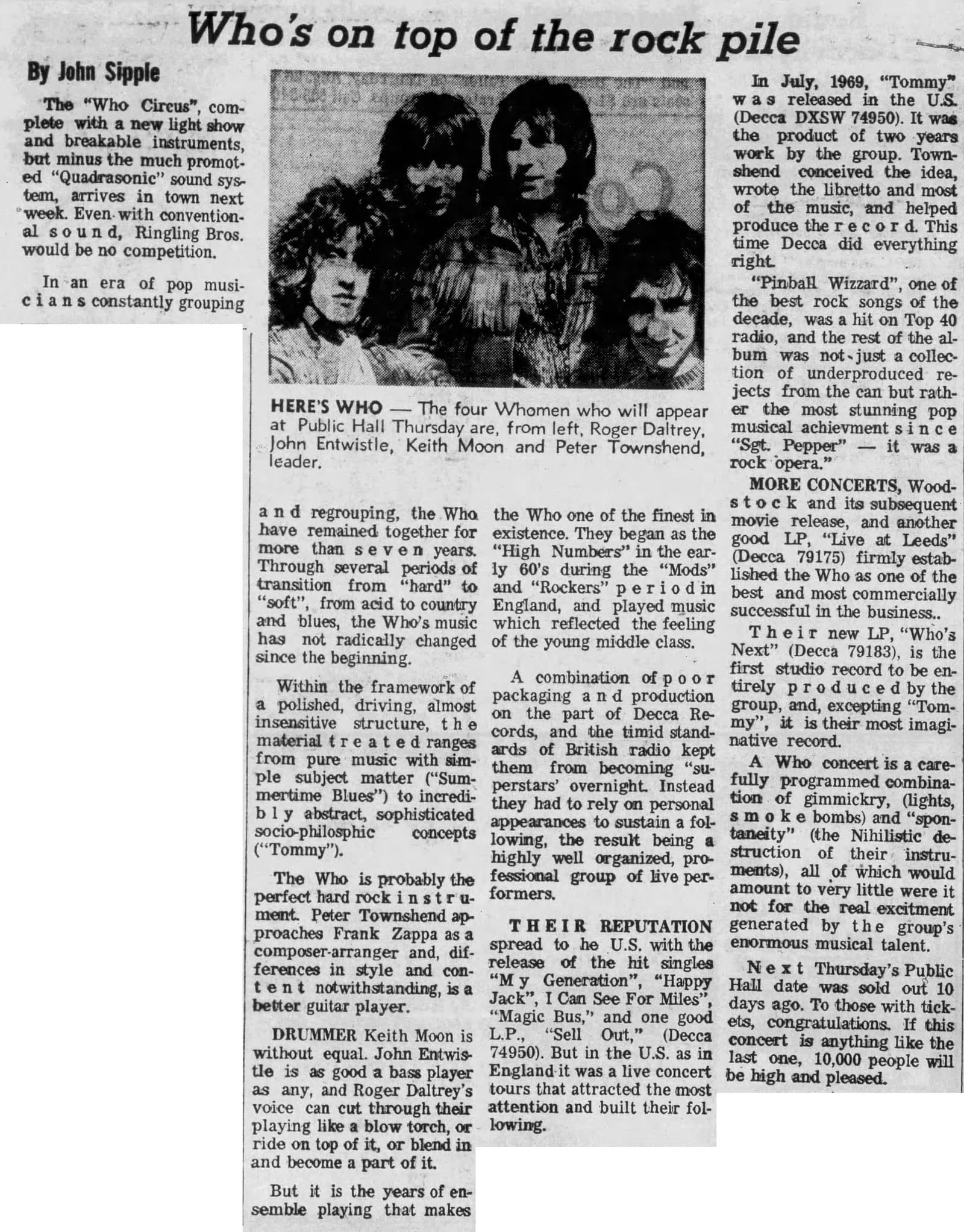
HERE'S WHO — The four Whomen who will appear at Public Hall Thursday are, from left, Roger Daltrey, John Entwistle, Keith Moon and Peter Townshend, leader.