2000-08-18-The_Olympian
THE OLYMPIAN
GEORGE — Roger Daltrey meant it when he first announced to the world: “I hope I die before I get old.”
Who bandmate Pete Townshend may have written the song, “My Generation,” but Daltrey backed it up with the threat that he would actually kill himself if he was still around to see 30.
Now 56 and very much not dead, Daltrey is on the road with the Who once again, 35 long years after “My Generation.”
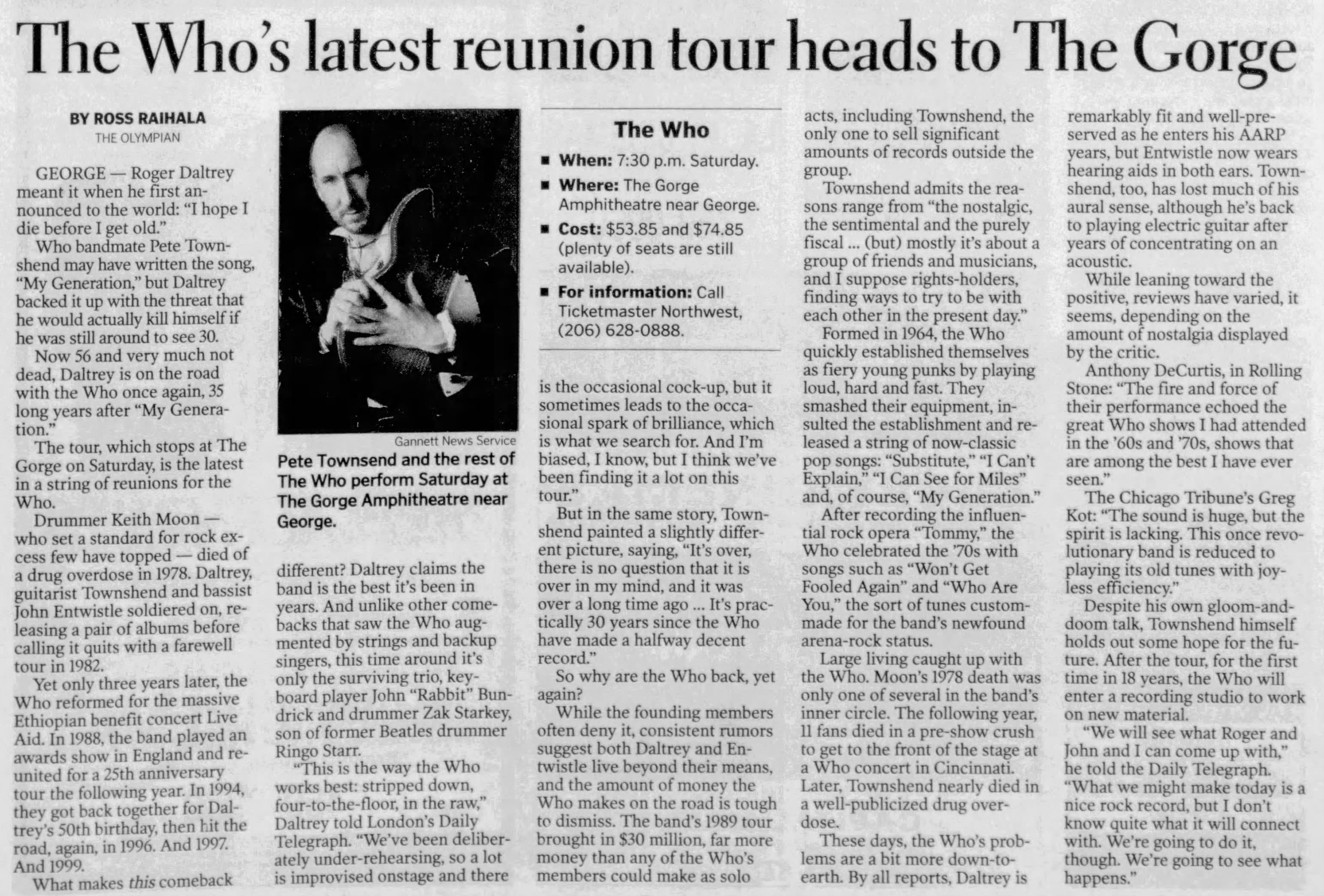
The tour, which stops at The Gorge on Saturday, is the latest in a string of reunions for the Who.
Drummer Keith Moon — who set a standard for rock excess few have topped — died of a drug overdose in 1978. Daltrey, guitarist Townshend and bassist John Entwistle soldiered on, releasing a pair of albums before calling it quits with a farewell tour in 1982.
Yet only three years later, the Who reformed for the massive Ethiopian benefit concert Live Aid. In 1988, the band played an awards show in England and reunited for a 25th anniversary tour the following year. In 1994, they got back together for Daltrey's 50th birthday, then hit the road again, in 1996. And 1997. And 1999.
What makes this comeback different? Daltrey claims the band is the best it's been in years. And unlike other comebacks that saw the Who augmented by strings and backup singers, this time around it's only the surviving trio, keyboard player John "Rabbit" Bundrick and drummer Zak Starkey, son of former Beatles drummer Ringo Starr.
“This is the way the Who works best: stripped down, four-to-the-floor, in the raw,” Daltrey told London's Daily Telegraph. “We've been deliberately under-rehearsing, so a lot is improvised onstage and there
The Who ■ When: 7:30 p.m. Saturday. ■ Where: The Gorge Amphitheatre near George. ■ Cost: $53.85 and $74.85 (plenty of seats are still available). ■ For information: Call Ticketmaster Northwest, (206) 628-0888.
is the occasional cock-up, but it sometimes leads to the occasional spark of brilliance, which is what we search for. And I'm biased, I know, but I think we've been finding it a lot on this tour.”
But in the same story, Townshend painted a slightly different picture, saying, “It's over, there is no question that it is over in my mind, and it was over a long time ago … It's practically 30 years since the Who have made a halfway decent record.”
So why are the Who back, yet again?
While the founding members often deny it, consistent rumors suggest both Daltrey and Entwistle live beyond their means, and the amount of money the Who makes on the road is tough to dismiss. The band's 1989 tour brought in $30 million, far more money than any of the Who's members could make as solo acts, including Townshend, the only one to sell significant amounts of records outside the group.
Townshend admits the reasons range from "the nostalgic, the sentimental and the purely fiscal … (but) mostly it's about a group of friends and musicians, and I suppose rights-holders, finding ways to try to be with each other in the present day.”
Formed in 1964, the Who quickly established themselves as fiery young punks by playing loud, hard and fast. They smashed their equipment, insulted the establishment and released a string of now-classic pop songs: “Substitute,” “I Can't Explain,” “I Can See for Miles” and, of course, “My Generation.”
After recording the influential rock opera “Tommy,” the Who celebrated the ‘70s with songs such as “Won't Get Fooled Again” and “Who Are You,” the sort of tunes custom-made for the band's newfound arena-rock status.
Large living caught up with the Who. Moon's 1978 death was only one of several in the band's inner circle. The following year, 11 fans died in a pre-show crush to get to the front of the stage at a Who concert in Cincinnati. Later, Townshend nearly died in a well-publicized drug overdose.
These days, the Who's problems are a bit more down-to-earth. By all reports, Daltrey is remarkably fit and well-preserved as he enters his AARP years, but Entwistle now wears hearing aids in both ears. Townshend, too, has lost much of his aural sense, although he's back to playing electric guitar after years of concentrating on an acoustic.
While leaning toward the positive, reviews have varied, it seems, depending on the amount of nostalgia displayed by the critic.
Anthony DeCurtis, in Rolling Stone: "The fire and force of their performance echoed the great Who shows I had attended in the '60s and '70s, shows that are among the best I have ever seen.”
The Chicago Tribune's Greg Kot: “The sound is huge, but the spirit is lacking. This once revolutionary band is reduced to playing its old tunes with joyless efficiency.”
Despite his own gloom-and-doom talk, Townshend himself holds out some hope for the future. After the tour, for the first time in 18 years, the Who will enter a recording studio to work on new material.
"We will see what Roger and John and I can come up with,” he told the Daily Telegraph. “What we might make today is a nice rock record, but I don't know quite what it will connect with. We're going to do it, though. We're going to see what happens.”