2002-08-25-The_Grand_Rapids_Press_2
AP PHOTO
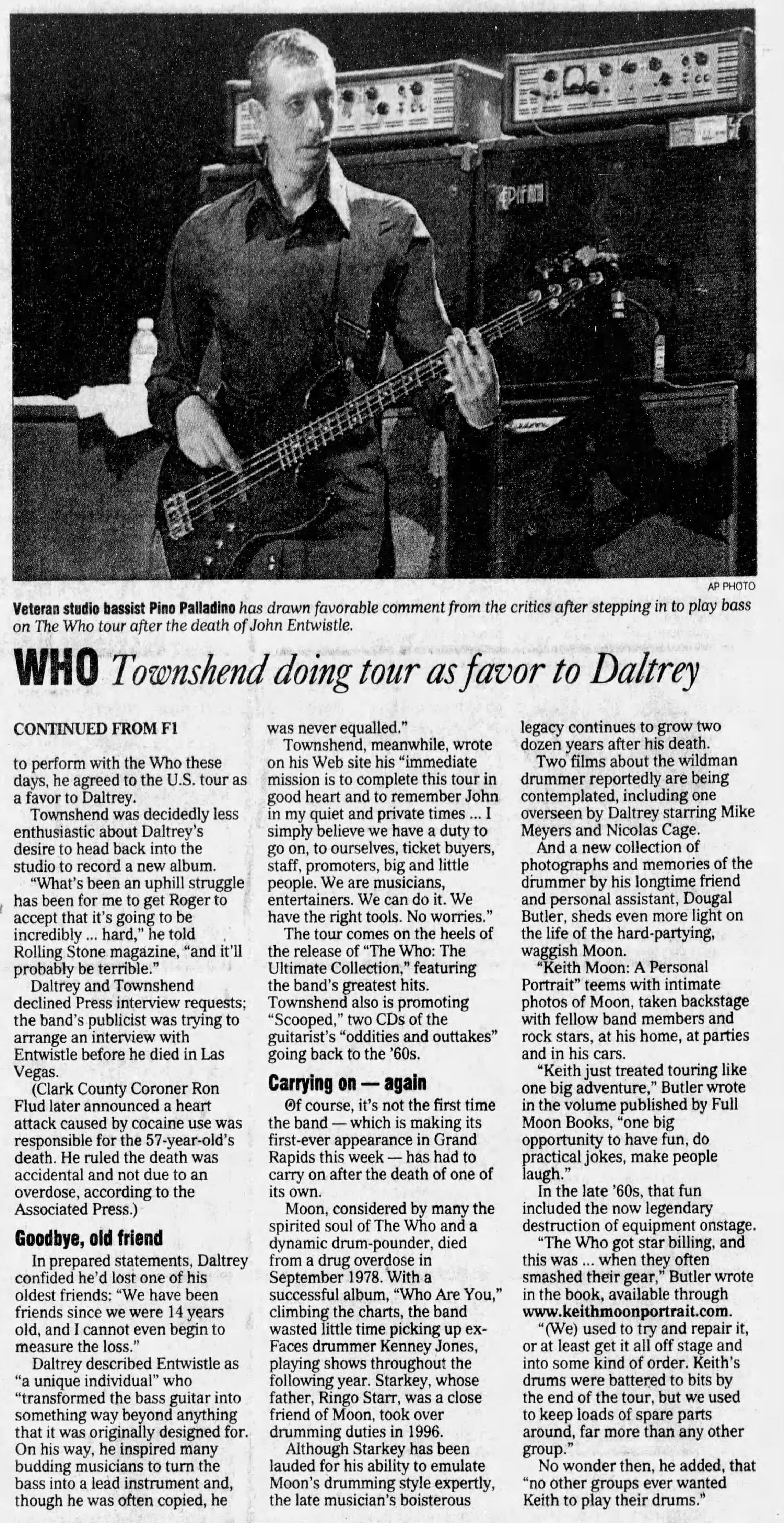
Veteran studio bassist Pino Palladino has drawn favorable comment from the critics after stepping in to play bass on The Who tour after the death of John Entwistle.
WHO Townshend doing tour as favor to Daltrey
CONTINUED FROM F1
to perform with the Who these days, he agreed to the U.S. tour as a favor to Daltrey.
Townshend was decidedly less enthusiastic about Daltrey's desire to head back into the studio to record a new album.
"What's been an uphill struggle has been for me to get Roger to accept that it's going to be incredibly … hard," he told Rolling Stone magazine, "and it'll probably be terrible."
Daltrey and Townshend declined Press interview requests; the band's publicist was trying to arrange an interview with Entwistle before he died in Las Vegas.
(Clark County Coroner Ron Flud later announced a heart attack caused by cocaine use was responsible for the 57-year-old's death. He ruled the death was accidental and not due to an overdose, according to the Associated Press.)
Goodbye, old friend
In prepared statements, Daltrey confided he'd lost one of his oldest friends: "We have been friends since we were 14 years old, and I cannot even begin to measure the loss."
Daltrey described Entwistle as "a unique individual" who "transformed the bass guitar into something way beyond anything that it was originally designed for. On his way, he inspired many budding musicians to turn the bass into a lead instrument and, though he was often copied, he
was never equalled."
Townshend, meanwhile, wrote on his Web site his "immediate mission is to complete this tour in good heart and to remember John in my quiet and private times … I simply believe we have a duty to go on, to ourselves, ticket buyers, staff, promoters, big and little people. We are musicians, entertainers. We can do it. We have the right tools. No worries."
The tour comes on the heels of the release of "The Who: The Ultimate Collection," featuring the band's greatest hits. Townshend also is promoting "Scooped," two CDs of the guitarist's "oddities and outtakes" going back to the '60s.
Carrying on — again
Of course, it's not the first time the band — which is making its first-ever appearance in Grand Rapids this week — has had to carry on after the death of one of its own.
Moon, considered by many the spirited soul of The Who and a dynamic drum-pounder, died from a drug overdose in September 1978. With a successful album, "Who Are You," climbing the charts, the band wasted little time picking up ex-Faces drummer Kenney Jones, playing shows throughout the following year. Starkey, whose father, Ringo Starr, was a close friend of Moon, took over drumming duties in 1996.
Although Starkey has been lauded for his ability to emulate Moon's drumming style expertly, the late musician's boisterous
legacy continues to grow two dozen years after his death.
Two films about the wildman drummer reportedly are being contemplated, including one overseen by Daltrey starring Mike Meyers and Nicolas Cage.
And a new collection of photographs and memories of the drummer by his longtime friend and personal assistant, Dougal Butler, sheds even more light on the life of the hard-partying, waggish Moon.
"Keith Moon: A Personal Portrait" teems with intimate photos of Moon, taken backstage with fellow band members and rock stars, at his home, at parties and in his cars.
"Keith just treated touring like one big adventure," Butler wrote in the volume published by Full Moon Books, "one big opportunity to have fun, do practical jokes, make people laugh."
In the late '60s, that fun included the now legendary destruction of equipment onstage.
"The Who got star billing, and this was … when they often smashed their gear," Butler wrote in the book, available through www.keithmoonportrait.com.
"(We) used to try and repair it, or at least get it all off stage and into some kind of order. Keith's drums were battered to bits by the end of the tour, but we used to keep loads of spare parts around, far more than any other group."
No wonder then, he added, that "no other groups ever wanted Keith to play their drums."