1969-09-02-Staffordshire Sentinel
A frail looking young man by the name of Robert Zimmerman gave a musical concert at the Isle of Wight on Sunday observed by 150,000 fans.
Some of them had chartered planes from far away places like Melbourne, New York and Darlington. The south coast, Portsmouth and the island itself, were invaded by the peaceful horde. There was no trouble.
Two people out of the 150,000, a young lady called Vivianne and an acquaintance, indulged in a little "extra-festival activity," the signal for some national newspapers to declare that the Isle of Wight Festival of Music was nothing more than a depraved orgy.
They seemed to ignore the fact that getting Bob Dylan to appear at all was a stroke of genius by the organisers, Fiery Creations Ltd. Asking Dylan was audacious, actually succeeding was miraculous.
The administration too, throughout the festival — with liberal help from British Rail — was a model for all future suchlike occasions.
And future occasions like this must come. What price a bill featuring Elvis Presley and The Beatles, five more people like Dylan in the upper echelon of pop.
It would also give the national press one more chance to comment for the thousandth time of "long-haired youngsters wearing strange clothes." The music presumably would once again be ignored.
Few people in the incredibly large crowd could have been disappointed with the Festival, The organisation, quality of sound reproduction and the quality of music were all exceptionally good.
Saturday's stage entertainment began with the powerful Edgar Broughton Band and, though the audience was warm, and noisily appreciative, it was only an inkling of what was to come. The show continued with the exuberant Marsha Hunt and
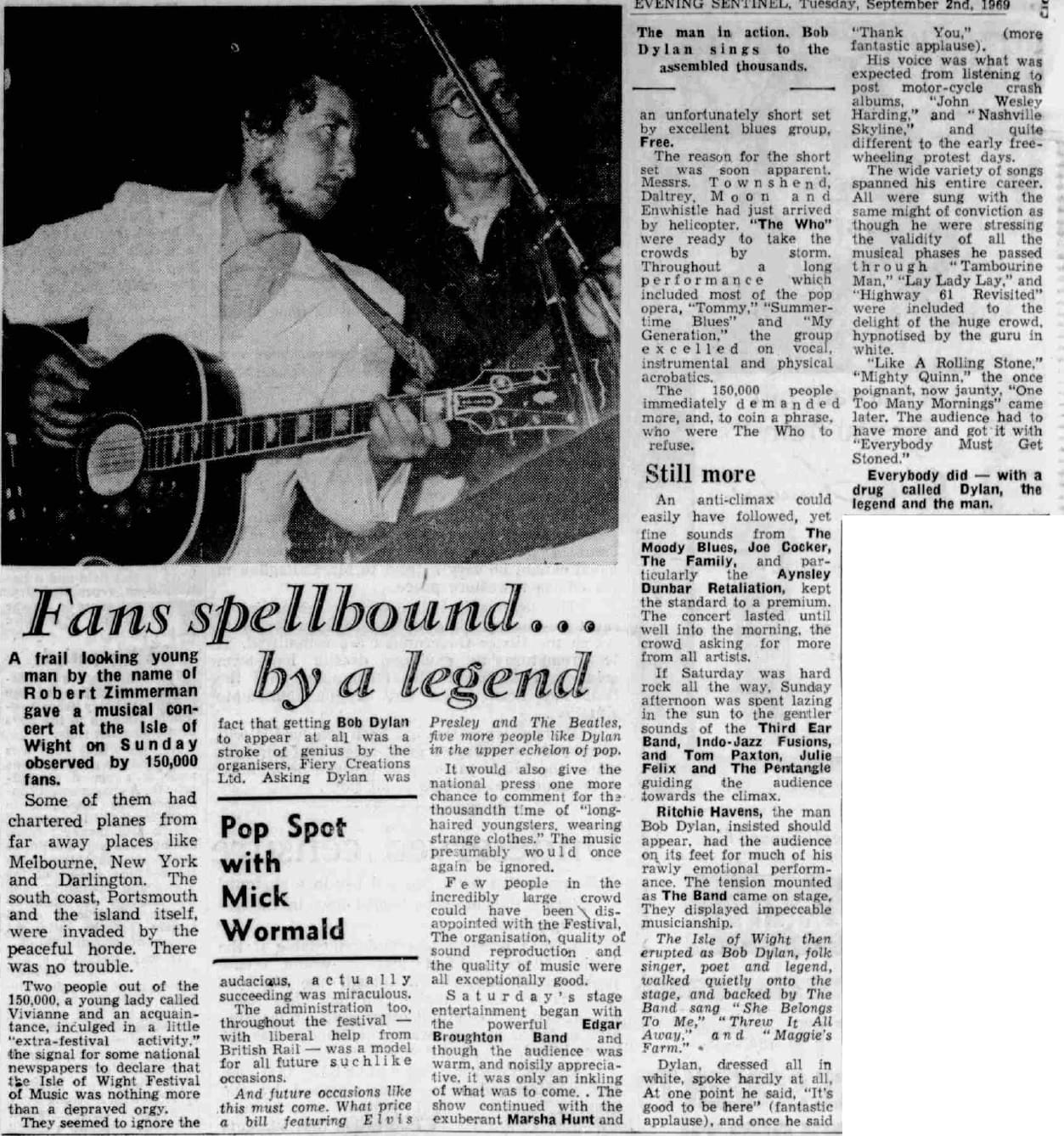
EVENING SENTINEL, Tuesday, September 2nd, 1969 The man in action. Bob Dylan sings to the assembled thousands.
an unfortunately short set by excellent blues group, Free.
The reason for the short set was soon apparent. Messers. Townshend, Daltrey, Moon and Entwistle had just arrived by helicopter. "The Who" were ready to take the crowds by storm. Throughout a long performance which included most of the pop opera, "Tommy," "Summertime Blues" and "My Generation," the group excelled on vocal, instrumental and physical acrobatics.
The 150,000 people immediately demanded more, and, to coin a phrase, who were The Who to refuse.
Still more
An anti-climax could easily have followed, yet fine sounds from The Moody Blues, Joe Cocker, The Family, and particularly the Aynsley Dunbar Retaliation, kept the standard to a premium.
The concert lasted until well into the morning, the crowd asking for more from all artists.
If Saturday was hard rock all the way, Sunday afternoon was spent lazing in the sun to the gentler sounds of the Third Ear Band, Indo-Jazz Fusions, and Tom Paxton, Julie Felix and The Pentangle guiding the audience towards the climax.
Ritchie Havens, the man Bob Dylan insisted should appear, had the audience on its feet for much of his rawly emotional performance. The tension mounted as The Band came on stage. They displayed impeccable musicianship.
The Isle of Wight then erupted as Bob Dylan, folk singer, poet and legend, walked quietly onto the stage, and backed by The Band sang "She Belongs To Me," "Threw It All Away," and "Maggie's Farm."
Dylan, dressed all in white, spoke hardly at all. At one point he said, "It's good to be here" (fantastic applause), and once he said "Thank You," (more fantastic applause).
His voice was what was expected from listening to post motor-cycle crash albums, "John Wesley Harding," and "Nashville Skyline," and quite different to the early free-wheeling protest days.
The wide variety of songs spanned his entire career. All were sung with the same might of conviction as though he were stressing the validity of all the musical phases he passed through. "Tambourine Man," "Lay Lady Lay," and "Highway 61 Revisited" were included to the delight of the huge crowd, hypnotised by the guru in white.
"Like A Rolling Stone," "Mighty Quinn," the once poignant, now jaunty, "One Too Many Mornings" came later. The audience had to have more and got it with "Everybody Must Get Stoned."
Everybody did — with a drug called Dylan, the legend and the man.