2002-09-22-Star_Tribune
Who are you?
Star Tribune Staff Writer
The Who is just two. Founding bassist John Entwistle died in June, so one of rock’s mightiest quartets is down to singer Roger Daltrey and guitarist/songwriter Pete Townshend, who are coming to St. Paul on Tuesday.
“It’s just Pete and me. We will be the Who,” said Daltrey, whose group lost drummer Keith Moon to a drug overdose in 1978. “I’m always there. I’ll always be there till the last man drops.”
On tour this summer, the revamped lineup with four sidemen has been gelling, Daltrey said.
“The shows have been fantastic. The days off have been hard. But when we get onstage and start playing the music, John is back with us, and so is Keith because they live within the music.”
But is it fair to bill Daltrey and Townshend as the Who?
When Robert Plant and Jimmy Page of Led Zeppelin got together to make new music in 1994 and play Zep classics in concert, they called themselves Page & Plant, not Zeppelin.
“Townshend & Daltrey? It’s ridiculous,” Daltrey said. “We spent 40 years being the bloody Who.”
When Daltrey toured with Entwistle, but not Townshend, in 1994, the tour was billed as Roger Daltrey Sings the Songs of Pete Townshend. Daltrey said Townshend had given him the green light to call it “the Who,” but the singer declined. Now he sees it differently.
“The Who is far bigger than the band was anyway. When I look out at young people — sort of 16-year-olds — dancing in the aisles and singing every word, they’re part of the Who, too.
“We were the catalysts, but the Who is under that vast umbrella that encompasses millions of people. That’s why the music lives on as well as it does.”
Business or music?
The original members of Grand Funk Railroad, a 1970s hard-rock trio best known for the hit “An American Band,” reunited in 1995 for three years. Now the original drummer and bassist are on tour without lead singer/guitarist Mark Farner.
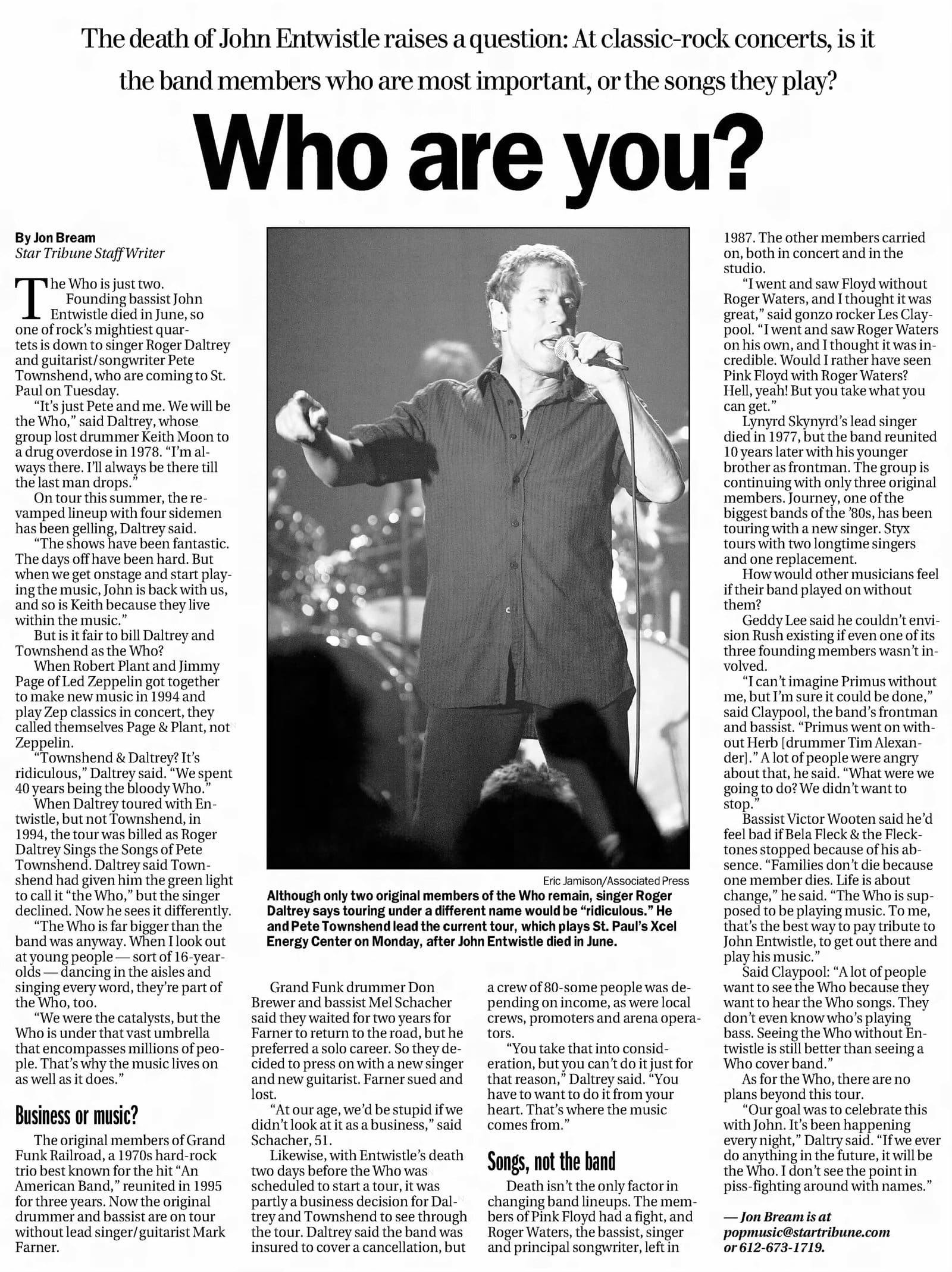
Eric Jamison/Associated Press Although only two original members of the Who remain, singer Roger Daltrey says touring under a different name would be “ridiculous.” He and Pete Townshend lead the current tour, which plays St. Paul’s Xcel Energy Center on Monday, after John Entwistle died in June.
Grand Funk drummer Don Brewer and bassist Mel Schacher said they waited for two years for Farner to return to the road, but he preferred a solo career. So they decided to press on with a new singer and new guitarist. Farner sued and lost.
“At our age, we’d be stupid if we didn’t look at it as a business,” said Schacher, 51.
Likewise, with Entwistle’s death two days before the Who was scheduled to start a tour, it was partly a business decision for Daltrey and Townshend to see through the tour. Daltrey said the band was insured to cover a cancellation, but a crew of 80-some people was depending on income, as were local crews, promoters and arena operators.
“You take that into consideration, but you can’t do it just for that reason,” Daltrey said. “You have to want to do it from your heart. That’s where the music comes from.”
Songs, not the band
Death isn’t the only factor in changing band lineups. The members of Pink Floyd had a fight, and Roger Waters, the bassist, singer and principal songwriter, left in 1987. The other members carried on, both in concert and in the studio.
“I went and saw Floyd without Roger Waters, and I thought it was great,” said gonzo rocker Les Claypool. “I went and saw Roger Waters on his own, and I thought it was incredible. Would I rather have seen Pink Floyd with Roger Waters? Hell, yeah! But you take what you can get.”
Lynyrd Skynyrd’s lead singer died in 1977, but the band reunited 10 years later with his younger brother as frontman. The group is continuing with only three original members. Journey, one of the biggest bands of the ’80s, has been touring with a new singer. Styx tours with two longtime singers and one replacement.
How would other musicians feel if their band played on without them?
Geddy Lee said he couldn’t envision Rush existing if even one of its three founding members wasn’t involved.
“I can’t imagine Primus without me, but I’m sure it could be done,” said Claypool, the band’s frontman and bassist. “Primus went on without Herb [drummer Tim Alexander].” A lot of people were angry about that, he said. “What were we going to do? We didn’t want to stop.”
Bassist Victor Wooten said he’d feel bad if Bela Fleck & the Flecktones stopped because of his absence. “Families don’t die because one member dies. Life is about change,” he said. “The Who is supposed to be playing music. To me, that’s the best way to pay tribute to John Entwistle, to get out there and play his music.”
Said Claypool: “A lot of people want to see the Who because they want to hear the Who songs. They don’t even know who’s playing bass. Seeing the Who without Entwistle is still better than seeing a Who cover band.”
As for the Who, there are no plans beyond this tour.
“Our goal was to celebrate this with John. It’s been happening every night,” Daltry said. “If we ever do anything in the future, it will be the Who. I don’t see the point in piss-fighting around with names.”
— Jon Bream is at popmusic@startribune.com or 612-673-1719.