2006-09-28-The_Flint_Journal_2
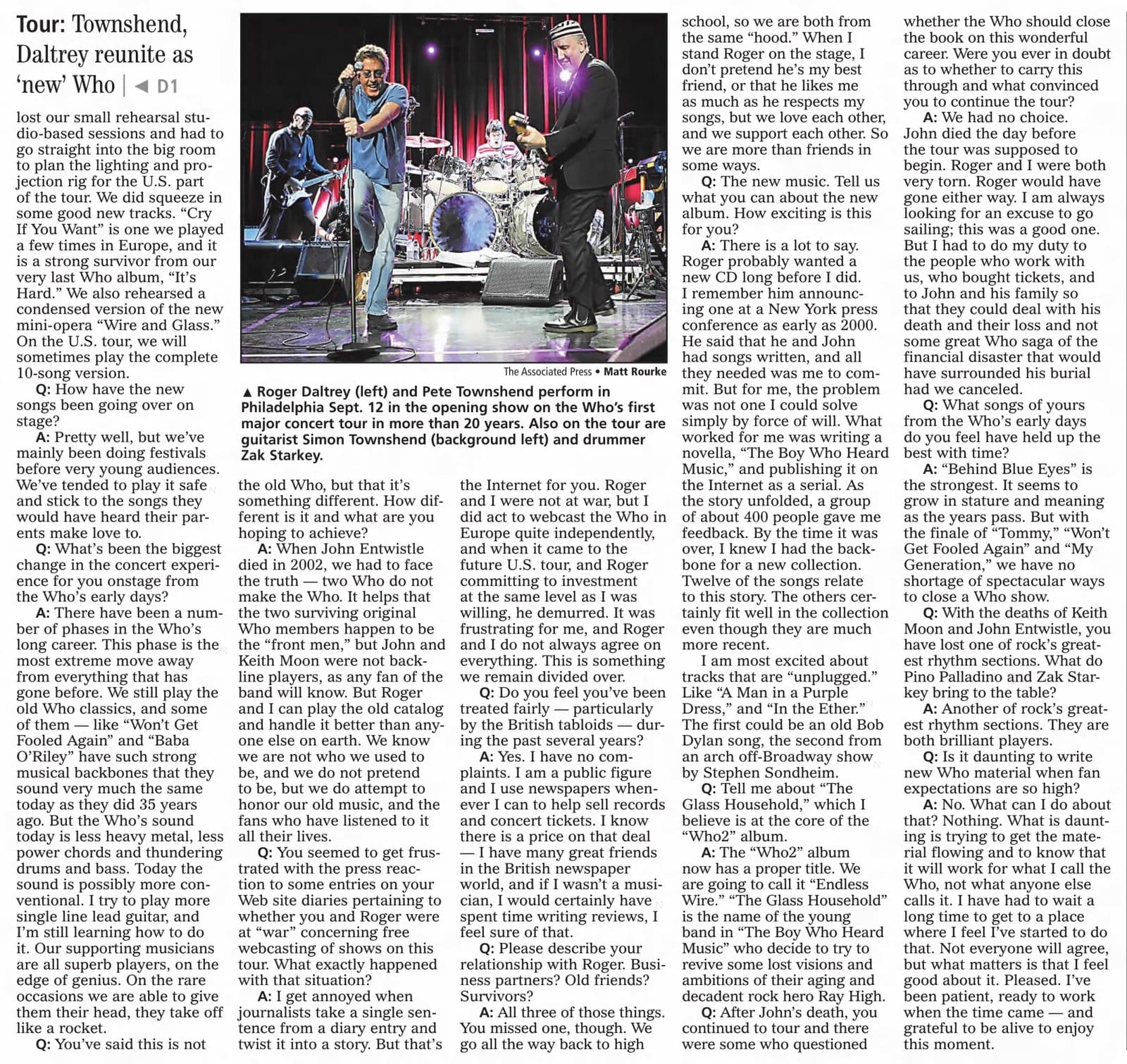
Roger Daltrey (left) and Pete Townshend perform in Philadelphia Sept. 12 in the opening show on the Who’s first major concert tour in more than 20 years. Also on the tour are guitarist Simon Townshend (background left) and drummer Zak Starkey.
Lost our small rehearsal studio-based sessions and had to go straight into the big room to plan the lighting and projection rig for the U.S. part of the tour. We did squeeze in some good new tracks. “Cry If You Want” is one we played a few times in Europe, and it is a strong survivor from our very last Who album, “It’s Hard.” We also rehearsed a condensed version of the new mini-opera “Wire and Glass.” On the U.S. tour, we will sometimes play the complete 10-song version.
Q: How have the new songs been going over on stage?
A: Pretty well, but we’ve mainly been doing festivals before very young audiences. We’ve tended to play it safe and stick to the songs they would have heard their parents make love to.
Q: What’s been the biggest change in the concert experience for you onstage from the Who’s early days?
A: There have been a number of phases in the Who’s long career. This phase is the most extreme move away from everything that has gone before. We still play the old Who classics, and some of them — like “Won’t Get Fooled Again” and “Baba O’Riley” have such strong musical backbones that they sound very much the same today as they did 35 years ago. But the Who’s sound today is less heavy metal, less power chords and thundering drums and bass. Today the sound is possibly more conventional. I try to play more single line lead guitar, and I’m still learning how to do it. Our supporting musicians are all superb players, on the edge of genius. On the rare occasions we are able to give them their head, they take off like a rocket.
Q: You’ve said this is not the old Who, but that it’s something different. How different is it and what are you hoping to achieve?
A: When John Entwistle died in 2002, we had to face the truth — two Who do not make the Who. It helps that the two surviving original Who members happen to be the “front men,” but John and Keith Moon were not backline players, as any fan of the band will know. But Roger and I can play the old catalog and handle it better than anyone else on earth. We know we are not who we used to be, and we do not pretend to be, but we do attempt to honor our old music, and the fans who have listened to it all their lives.
Q: You seemed to get frustrated with the press reaction to some entries on your Web site diaries pertaining to whether you and Roger were at “war” concerning free webcasting of shows on this tour. What exactly happened with that situation?
A: I get annoyed when journalists take a single sentence from a diary entry and twist it into a story. But that’s the Internet for you. Roger and I were not at war, but I did act to webcast the Who in Europe quite independently, and when it came to the future U.S. tour, and Roger committing to investment at the same level as I was willing, he demurred. It was frustrating for me, and Roger and I do not always agree on everything. This is something we remain divided over.
Q: Do you feel you’ve been treated fairly — particularly by the British tabloids — during the past several years?
A: Yes. I have no complaints. I am a public figure and I use newspapers whenever I can to help sell records and concert tickets. I know there is a price on that deal — I have many great friends in the British newspaper world, and if I wasn’t a musician, I would certainly have spent time writing reviews, I feel sure of that.
Q: Please describe your relationship with Roger. Business partners? Old friends? Survivors?
A: All three of those things. You missed one, though. We go all the way back to high school, so we are both from the same “hood.” When I stand Roger on the stage, I don’t pretend he’s my best friend, or that he likes me as much as he respects my songs, but we love each other, and we support each other. So we are more than friends in some ways.
Q: The new music. Tell us what you can about the new album. How exciting is this for you?
A: There is a lot to say. Roger probably wanted a new CD long before I did. I remember him announcing one at a New York press conference as early as 2000. He said that he and John had songs written, and all they needed was me to commit. But for me, the problem was not one I could solve simply by force of will. What worked for me was writing a novella, “The Boy Who Heard Music,” and publishing it on the Internet as a serial. As the story unfolded, a group of about 400 people gave me feedback. By the time it was over, I knew I had the backbone for a new collection. Twelve of the songs relate to this story. The others certainly fit well in the collection even though they are much more recent.
I am most excited about tracks that are “unplugged.” Like “A Man in a Purple Dress,” and “In the Ether.” The first could be an old Bob Dylan song, the second from an arch off-Broadway show by Stephen Sondheim.
Q: Tell me about “The Glass Household,” which I believe is at the core of the “Who2” album.
A: The “Who2” album now has a proper title. We are going to call it “Endless Wire.” “The Glass Household” is the name of the young band in “The Boy Who Heard Music” who decide to try to revive some lost visions and ambitions of their aging and decadent rock hero Ray High.
Q: After John’s death, you continued to tour and there were some who questioned whether the Who should close the book on this wonderful career. Were you ever in doubt as to whether to carry this through and what convinced you to continue the tour?
A: We had no choice. John died the day before the tour was supposed to begin. Roger and I were both very torn. Roger would have gone either way. I am always looking for an excuse to go sailing; this was a good one. But I had to do my duty to the people who work with us, who bought tickets, and to John and his family so that they could deal with his death and their loss and not some great Who saga of the financial disaster that would have surrounded his burial had we canceled.
Q: What songs of yours from the Who’s early days do you feel have held up the best with time?
A: “Behind Blue Eyes” is the strongest. It seems to grow in stature and meaning as the years pass. But with the finale of “Tommy,” “Won’t Get Fooled Again” and “My Generation,” we have no shortage of spectacular ways to close a Who show.
Q: With the deaths of Keith Moon and John Entwistle, you have lost one of rock’s greatest rhythm sections. What do Pino Palladino and Zak Starkey bring to the table?
A: Another of rock’s greatest rhythm sections. They are both brilliant players.
Q: Is it daunting to write new Who material when fan expectations are so high?
A: No. What can I do about that? Nothing. What is daunting is trying to get the material flowing and to know that it will work for what I call the Who, not what anyone else calls it. I have had to wait a long time to get to a place where I feel I’ve started to do that. Not everyone will agree, but what matters is that I feel good about it. Pleased. I’ve been patient, ready to work when the time came — and grateful to be alive to enjoy this moment.