1982-10-01-The_Saginaw_News
PONTIAC – The Who brought their “Farewell, America” tour to Detroit Wednesday, apparently to show more than 70,000 fans what they’re going to be missing when the band quits touring the U.S.
The fans found they are going to be missing very much indeed.
As on their bold, confident new album, The Who went out with strength and style — so much so that you would think the legendary British-invasion band was at the peak of its abilities rather than reaching the end of a distinguished 18-year line.
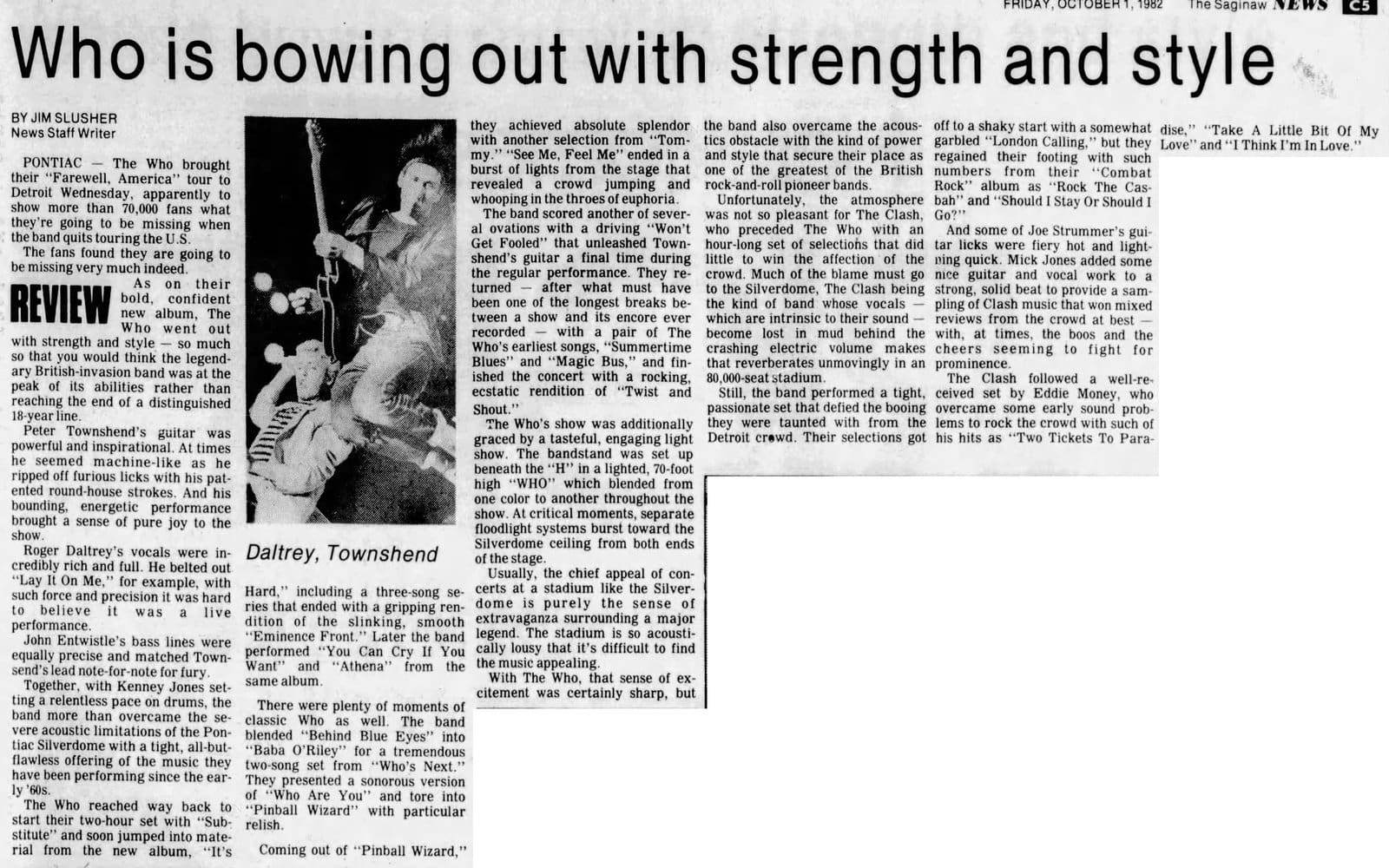
Peter Townshend’s guitar was powerful and inspirational. At times he seemed machine-like as he ripped off furious licks with his patented round-house strokes. And his bounding, energetic performance brought a sense of pure joy to the show.
Roger Daltrey’s vocals were incredibly rich and full. He belted out “Lay It On Me,” for example, with such force and precision it was hard to believe it was a live performance.
John Entwistle’s bass lines were equally precise and matched Townshend’s lead note-for-note for fury.
Together, with Kenney Jones setting a relentless pace on drums, the band more than overcame the severe acoustic limitations of the Pontiac Silverdome with a tight, all-but-flawless offering of the music they have been performing since the early '60s.
The Who reached way back to start their two-hour set with “Substitute” and soon jumped into material from the new album, “It’s Hard,” including a three-song series that ended with a gripping rendition of the slinking, smooth “Eminence Front.” Later the band performed “You Can Cry If You Want” and “Athena” from the same album.
There were plenty of moments of classic Who as well. The band blended “Behind Blue Eyes” into “Baba O’Riley” for a tremendous two-song set from “Who’s Next.” They presented a sonorous version of “Who Are You” and tore into “Pinball Wizard” with particular relish.
Coming out of “Pinball Wizard,” they achieved absolute splendor with another selection from “Tommy.” “See Me, Feel Me” ended in a burst of lights from the stage that revealed a crowd jumping and whooping in the throes of euphoria.
The band scored another of several ovations with a driving “Won’t Get Fooled” that unleashed Townshend’s guitar a final time during the regular performance. They returned — after what must have been one of the longest breaks between a show and its encore ever recorded — with a pair of The Who’s earliest songs, “Summertime Blues” and “Magic Bus,” and finished the concert with a rocking, ecstatic rendition of “Twist and Shout.”
The Who’s show was additionally graced by a tasteful, engaging light show. The bandstand was set up beneath the “H” in a lighted, 70-foot high “WHO” which blended from one color to another throughout the show. At critical moments, separate floodlight systems burst toward the Silverdome ceiling from both ends of the stage.
Usually, the chief appeal of concerts at a stadium like the Silverdome is purely the sense of extravaganza surrounding a major legend. The stadium is so acoustically lousy that it’s difficult to find the music appealing.
With The Who, that sense of excitement was certainly sharp, but the band also overcame the acoustics obstacle with the kind of power and style that secure their place as one of the greatest of the British rock-and-roll pioneer bands.
Unfortunately, the atmosphere was not so pleasant for The Clash, who preceded The Who with an hour-long set of selections that did little to win the affection of the crowd. Much of the blame must go to the Silverdome, The Clash being the kind of band whose vocals — which are intrinsic to their sound — become lost in mud behind the crashing electric volume makes that reverberates unmovingly in an 80,000-seat stadium.
Still, the band performed a tight, passionate set that defied the booing they were taunted with from the Detroit crowd. Their selections got off to a shaky start with a somewhat garbled “London Calling,” but they regained their footing with such numbers from their “Combat Rock” album as “Rock The Casbah” and “Should I Stay Or Should I Go?”
And some of Joe Strummer’s guitar licks were fiery hot and lightning quick. Mick Jones added some nice guitar and vocal work to a strong, solid beat to provide a sampling of Clash music that won mixed reviews from the crowd at best — with, at times, the boos and the cheers seeming to fight for prominence.
The Clash followed a well-received set by Eddie Money, who overcame some early sound problems to rock the crowd with such of his hits as “Two Tickets To Paradise,” “Take A Little Bit Of My Love” and “I Think I’m In Love.”