1982-10-01-Star_Tribune_2
Who Continued from page 1C
stage, which is what he yearns for. “I can’t see going on like the Beach Boys forever,” the bassist said. “It wouldn’t be fair to the Who fans if we did one or two event concerts a year. We’d be so rusty. Without the road thing, my creative juices would dry up.”
What is especially nagging to Entwistle is that the Who’s tour, which commenced last week in Largo, Md., has started extremely well. “We played twice as loud and had 10 times more energy than we had in rehearsals,” he noted.
“So far the tour has been sensationally good,” evaluated guitarist-singer Townshend, the creative force behind the band. “The shows have all been good musically, the crowds have been incredibly warm and the reviews have been good.
“There’s the feeling of no holds barred now because it’s the last major tour the band’s gonna do. Everybody in and around the band, and the audience, are all throwing themselves into it with a great feeling of who the hell cares what happens, let’s just have a good time. Now that is a great recipe for a good rock concert.”
Since 1965, the Who has known a recipe for great rock. The quartet has been rock’s most madcap performing group as well as enduring champions of adolescence. The band’s “My Generation” (’65) became a three-minute revolution that helped transform pop into rock. It was an ideal anthem for rebellious youth—“Hope I die before I get old,” screamed Daltrey in his amphetamine-induced stutter as the band pounded relentlessly behind him.
“We did sort of change the face of rock,” reflected Entwistle, the group’s stoic figure. “We made it louder and bigger.”
Unlike other British bands of the early ’60s, the Who’s music did not seem to be chiefly influenced by American blues and rhythm & blues. Instead, the quartet was inspired by white U.S. rockers such as Gene Vincent and Eddie Cochran, whose “Summertime Blues” would later become a Who staple. From them, Townshend adapted his own style of guitar playing, heavy on white noise rather than earthy blues.
And early on, quite by accident actually, the Who gained a reputation it would never shed. One night Townshend inadvertently stuck his guitar through a low ceiling in a pub, breaking the neck of the guitar. Furious, he proceeded to smash the instrument to pieces! And that’s the way the Who’s shows usually climaxed—with autodestruction—as Townshend decimated his guitar and Keith Moon either trashed or collapsed over his drum kit. (Moon also was notorious for his offstage behavior—excessive alcohol and drug abuse and trashing of hotel rooms.)
Not only did the Who set new standards onstage but also on record. In 1969, following a stirring performance at Woodstock, the group released the landmark “Tommy,” a 90-minute, two-record rock opera about a deaf, dumb and blind pinball wizard-turned-guru.
“In a way, that’s the part I most regret,” Entwistle said of “Tommy.” “We did sort of lighten up a bit (musically). It did become an albatross around our necks for a while. It also put the whole concept album idea in the back of our minds and slowed us down. It’s nice just to release an album of songs.”
That’s what the band did in ’71 with the classic “Who’s Next,” which introduced the synthesizer as an instrument of rock music, and again this year with the much-praised “It’s Hard.”
“I love it,” Townshend said of the new album. “It’s one of the first
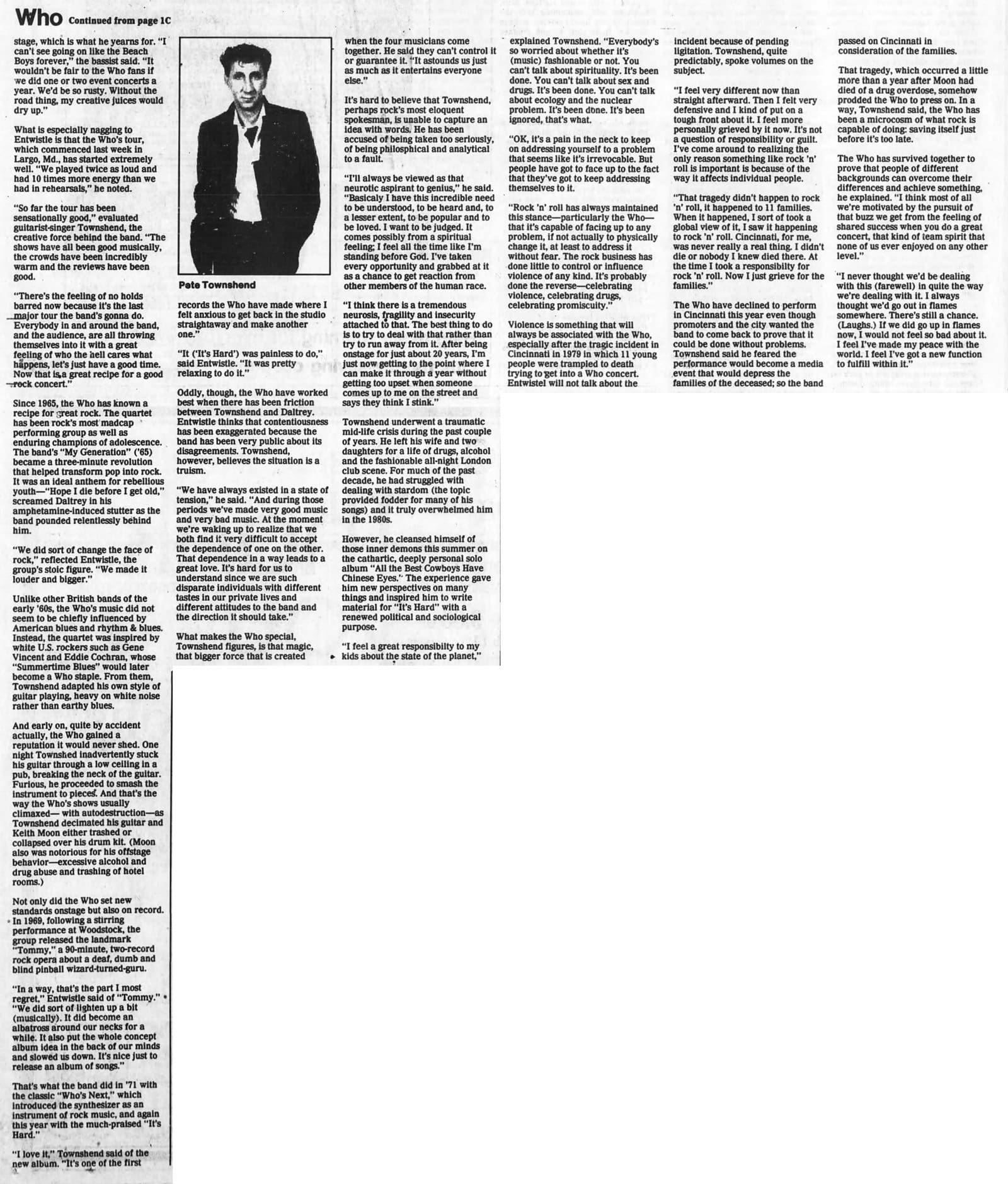
Pete Townshend
records the Who have made where I felt anxious to get back in the studio straightaway and make another one.”
“It (It’s Hard) was painless to do,” said Entwistle. “It was pretty relaxing to do it.”
Oddly, though, the Who have worked best when there has been friction between Townshend and Daltrey. Entwistle thinks that contentiousness has been exaggerated because the band has been very public about its disagreements. Townshend, however, believes the situation is a truism.
“We have always existed in a state of tension,” he said. “And during those periods we’ve made very good music and very bad music. At the moment we’re waking up to realize that we both find it very difficult to accept the dependence of one on the other. That dependence in a way leads to a great love. It’s hard for us to understand since we are such disparate individuals with different tastes in our private lives and different attitudes to the band and the direction it should take.”
What makes the Who special, Townshend figures, is that magic, that bigger force that is created
when the four musicians come together. He said they can’t control it or guarantee it. “It astounds us just as much as it entertains everyone else.”
It’s hard to believe that Townshend, perhaps rock’s most eloquent spokesman, is unable to capture an idea with words. He has been accused of being taken too seriously, of being philosophical and analytical to a fault.
“I’ll always be viewed as that neurotic aspirant to genius,” he said. “Basically I have this incredible need to be understood, to be heard and, to a lesser extent, to be popular and to be loved. I want to be judged. It comes possibly from a spiritual feeling; I feel all the time like I’m standing before God. I’ve taken every opportunity and grabbed at it as a chance to get reaction from other members of the human race.
“I think there is a tremendous neurosis, fragility and insecurity attached to that. The best thing to do is to try to deal with that rather than try to run away from it. After being onstage for just about 20 years, I’m just now getting to the point where I can make it through a year without getting too upset when someone comes up to me on the street and says they think I stink.”
Townshend underwent a traumatic mid-life crisis during the past couple of years. He left his wife and two daughters for a life of drugs, alcohol and the fashionable all-night London club scene. For much of the past decade, he had struggled with dealing with stardom (the topic provided fodder for many of his songs) and it truly overwhelmed him in the 1980s.
However, he cleansed himself of those inner demons this summer on the cathartic, deeply personal solo album “All the Best Cowboys Have Chinese Eyes.” The experience gave him new perspectives on many things and inspired him to write material for “It’s Hard” with a renewed political and sociological purpose.
“I feel a great responsibility to my kids about the state of the planet,”
explained Townshend. “Everybody’s so worried about whether it’s (music) fashionable or not. You can’t talk about spirituality. It’s been done. You can’t talk about sex and drugs. It’s been done. You can’t talk about ecology and the nuclear problem. It’s been done. It’s been ignored, that’s what.
“OK, it’s a pain in the neck to keep on addressing yourself to a problem that seems like it’s irrevocable. But people have got to face up to the fact that they’ve got to keep addressing themselves to it.
“Rock ’n’ roll has always maintained this stance—particularly the Who—that it’s capable of facing up to any problem, if not actually to physically change it, at least to address it without fear. The rock business has done little to control or influence violence of any kind. It’s probably done the reverse—celebrating violence, celebrating drugs, celebrating promiscuity.”
Violence is something that will always be associated with the Who, especially after the tragic incident in Cincinnati in 1979 in which 11 young people were trampled to death trying to get into a Who concert. Entwistle will not talk about the
incident because of pending litigation. Townshend, quite predictably, spoke volumes on the subject.
“I feel very different now than straight afterward. Then I felt very defensive and I kind of put on a tough front about it. I feel more personally grieved by it now. It’s not a question of responsibility or guilt. I’ve come around to realizing the only reason something like rock ’n’ roll is important is because of the way it affects individual people.
“That tragedy didn’t happen to rock ’n’ roll, it happened to 11 families. When it happened, I sort of took a global view of it, I saw it happening to rock ’n’ roll. Cincinnati, for me, was never really a real thing. I didn’t die or nobody I knew died there. At the time I took a responsibility for rock ’n’ roll. Now I just grieve for the families.”
The Who have declined to perform in Cincinnati this year even though promoters and the city wanted the band to come back to prove that it could be done without problems. Townshend said he feared the performance would become a media event that would depress the families of the deceased; so the band
passed on Cincinnati in consideration of the families.
That tragedy, which occurred a little more than a year after Moon had died of a drug overdose, somehow prodded the Who to press on. In a way, Townshend said, the Who has been a microcosm of what rock is capable of doing: saving itself just before it’s too late.
The Who has survived together to prove that people of different backgrounds can overcome their differences and achieve something, he explained. “I think most of all we’re motivated by the pursuit of that buzz we get from the feeling of shared success when you do a great concert, that kind of team spirit that none of us ever enjoyed on any other level.”
“I never thought we’d be dealing with this (farewell) in quite the way we’re dealing with it. I always thought we’d go out in flames somewhere. There’s still a chance. (Laughs.) If we did go up in flames now, I would not feel so bad about it. I feel I’ve made my peace with the world. I feel I’ve got a new function to fulfill within it.”