2006-10-08-The_Province_2
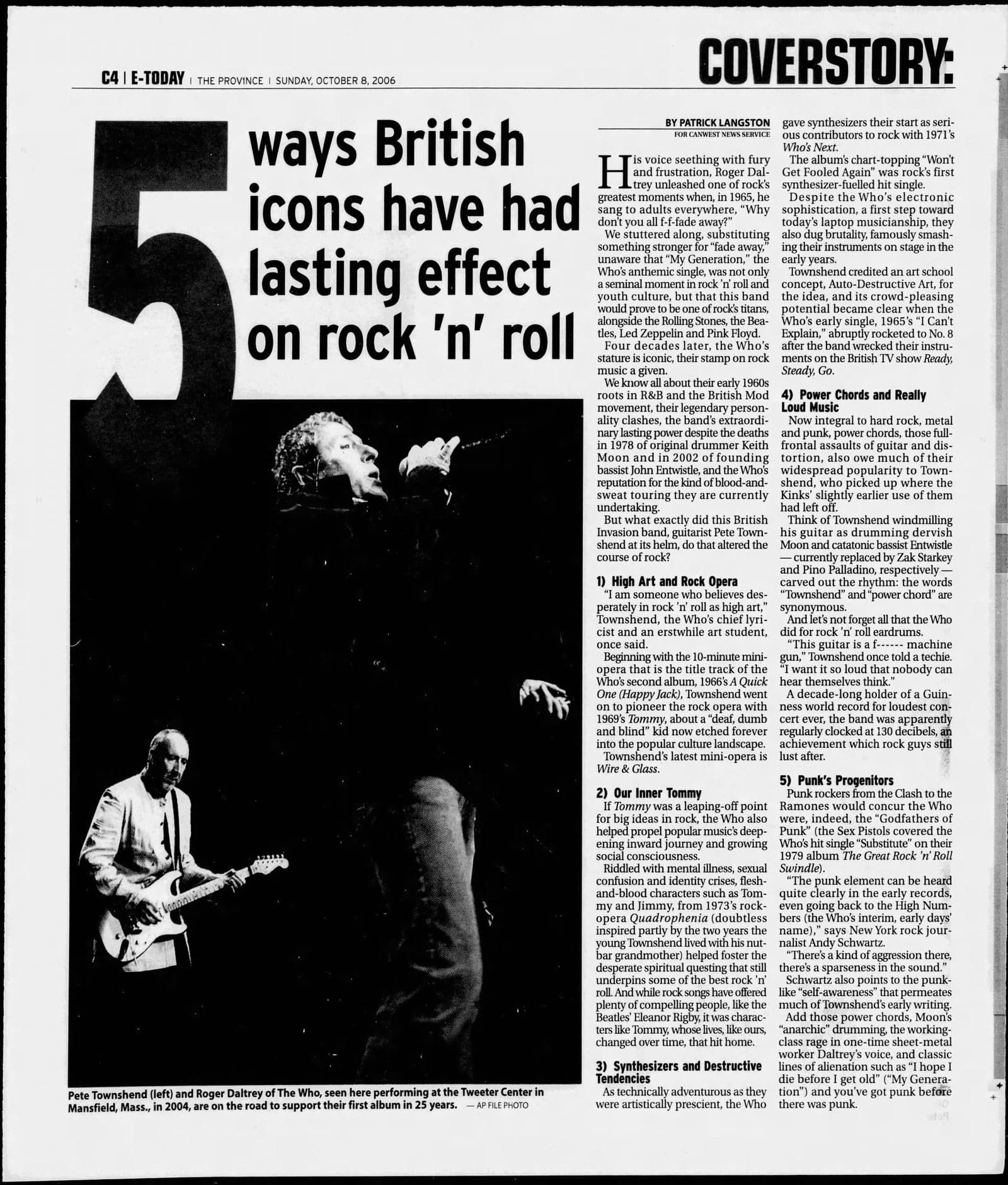
Pete Townshend (left) and Roger Daltrey of The Who, seen here performing at the Tweeter Center in Mansfield, Mass., in 2004, are on the road to support their first album in 25 years. — AP FILE PHOTO
His voice seething with fury and frustration, Roger Daltrey unleashed one of rock’s greatest moments when, in 1965, he sang to adults everywhere, “Why don’t you all f-f-fade away?”
We stuttered along, substituting something stronger for “fade away,” unaware that “My Generation,” the Who’s anthemic single, was not only a seminal moment in rock ’n’ roll and youth culture, but that this band would prove to be one of rock’s titans, alongside the Rolling Stones, the Beatles, Led Zeppelin and Pink Floyd.
Four decades later, the Who’s stature is iconic, their stamp on rock music a given.
We know all about their early 1960s roots in R&B and the British Mod movement, their legendary personality clashes, the band’s extraordinary lasting power despite the deaths in 1978 of original drummer Keith Moon and in 2002 of founding bassist John Entwistle, and the Who’s reputation for the kind of blood-and-sweat touring they are currently undertaking.
But what exactly did this British Invasion band, guitarist Pete Townshend at its helm, do that altered the course of rock?
1) High Art and Rock Opera
“I am someone who believes desperately in rock ’n’ roll as high art,” Townshend, the Who’s chief lyricist and an erstwhile art student, once said.
Beginning with the 10-minute mini-opera that is the title track of the Who’s second album, 1966’s A Quick One (Happy Jack), Townshend went on to pioneer the rock opera with 1969’s Tommy, about a “deaf, dumb and blind” kid now etched forever into the popular culture landscape.
Townshend’s latest mini-opera is Wire & Glass.
2) Our Inner Tommy
If Tommy was a leaping-off point for big ideas in rock, the Who also helped propel popular music’s deepening inward journey and growing social consciousness.
Riddled with mental illness, sexual confusion and identity crises, flesh-and-blood characters such as Tommy and Jimmy, from 1973’s rock-opera Quadrophenia (doubtless inspired partly by the two years the young Townshend lived with his nutbar grandmother) helped foster the desperate spiritual questing that still underpins some of the best rock ’n’ roll. And while rock songs have offered plenty of compelling people, like the Beatles’ Eleanor Rigby, it was characters like Tommy, whose lives, like ours, changed over time, that hit home.
3) Synthesizers and Destructive Tendencies
As technically adventurous as they were artistically prescient, the Who gave synthesizers their start as serious contributors to rock with 1971’s Who’s Next.
The album’s chart-topping “Won’t Get Fooled Again” was rock’s first synthesizer-fuelled hit single.
Despite the Who’s electronic sophistication, a first step toward today’s laptop musicianship, they also dug brutality, famously smashing their instruments on stage in the early years.
Townshend credited an art school concept, Auto-Destructive Art, for the idea, and its crowd-pleasing potential became clear when the Who’s early single, 1965’s “I Can’t Explain,” abruptly rocketed to No. 8 after the band wrecked their instruments on the British TV show Ready, Steady, Go.
4) Power Chords and Really Loud Music
Now integral to hard rock, metal and punk, power chords, those full-frontal assaults of guitar and distortion, also owe much of their widespread popularity to Townshend, who picked up where the Kinks’ slightly earlier use of them had left off.
Think of Townshend windmilling his guitar as drumming dervish Moon and catatonic bassist Entwistle — currently replaced by Zak Starkey and Pino Palladino, respectively — carved out the rhythm: the words “Townshend” and “power chord” are synonymous.
And let’s not forget all that the Who did for rock ’n’ roll eardrums.
“This guitar is a f— machine gun,” Townshend once told a techie. “I want it so loud that nobody can hear themselves think.”
A decade-long holder of a Guinness world record for loudest concert ever, the band was apparently regularly clocked at 130 decibels, an achievement which rock guys still lust after.
5) Punk’s Progenitors
Punk rockers from the Clash to the Ramones would concur the Who were, indeed, the “Godfathers of Punk” (the Sex Pistols covered the Who’s hit single “Substitute” on their 1979 album The Great Rock ’n’ Roll Swindle).
“The punk element can be heard quite clearly in the early records, even going back to the High Numbers (the Who’s interim, early days’ name),” says New York rock journalist Andy Schwartz.
“There’s a kind of aggression there, there’s a sparseness in the sound.”
Schwartz also points to the punklike “self-awareness” that permeates much of Townshend’s early writing.
Add those power chords, Moon’s “anarchic” drumming, the working-class rage in one-time sheet-metal worker Daltrey’s voice, and classic lines of alienation such as “I hope I die before I get old” (“My Generation”) and you’ve got punk before there was punk.