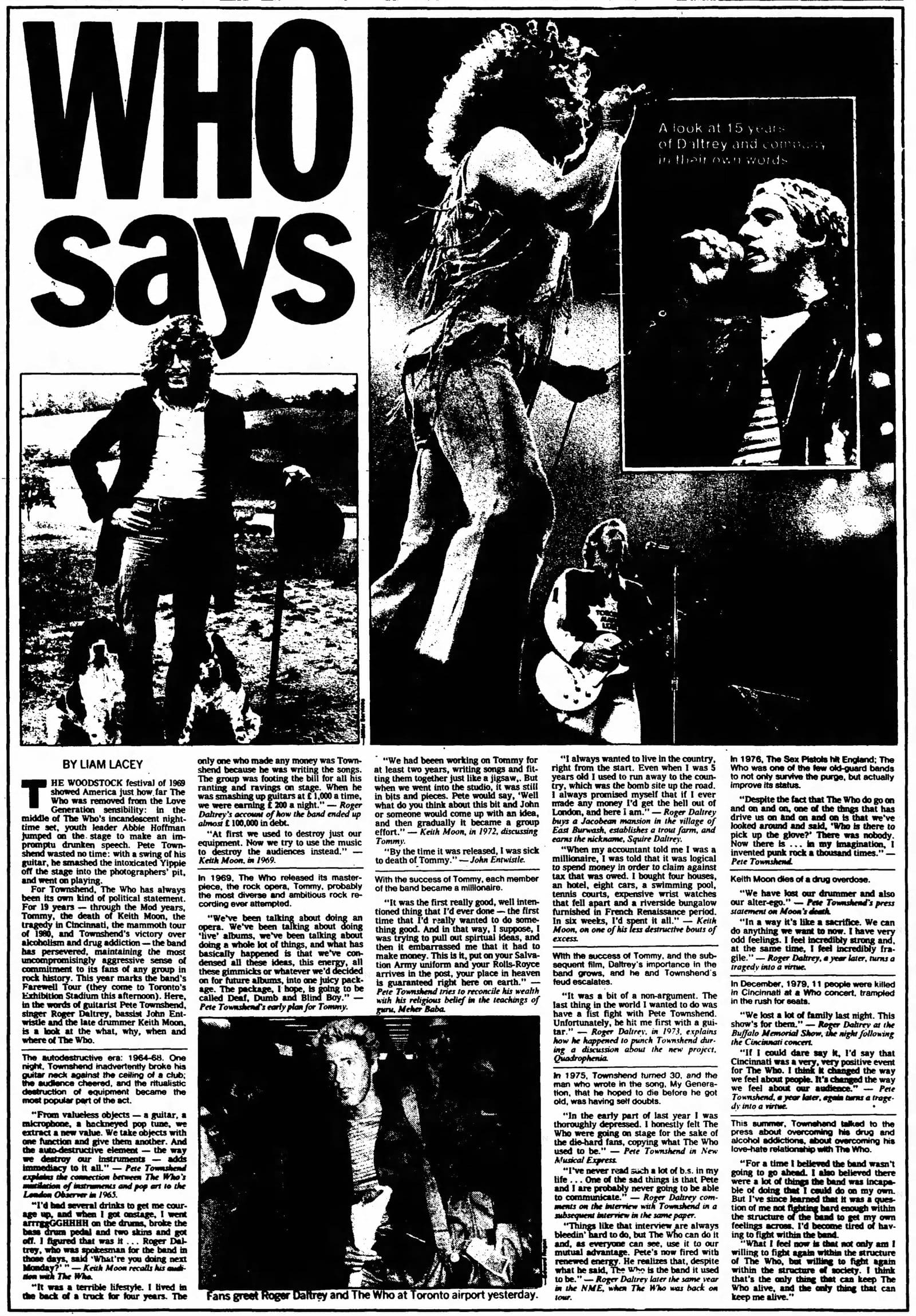
1982-10-09-The_Globe_and_Mail
THE WOODSTOCK festival of 1969 showed America just how far The Who was removed from the Love Generation sensibility: in the middle of The Who's incandescent nightmare set, youth leader Abbie Hoffmann jumped on the stage to make an impromptu drumtern speech. Pete Townshend wasted no time: with a swing of his guitar, he smashed the intoxicated Yippie off the stage into the photographers' pit, and went on playing.
For Townshend, The Who has always been its own kind of political statement. For 19 years — through the Mod years, Tommy, the death of Keith Moon, the tragedy in Cincinnati, the mammoth tour of 1980, and Townshend's victory over alcoholism and drug addiction — the band has persevered, maintaining the most uncompromisingly aggressive sense of commitment to its fans of any group in rock history. This year marks the band's Farewell Tour (they come to Toronto's Exhibition Stadium this afternoon). Here, in the words of guitarist Pete Townshend, singer Roger Daltrey, bassist John Entwistle and late drummer Keith Moon, is a look at the what, why, when and where of The Who.
The autodestructive era: 1964-68. One night, Townshend inadvertently broke his guitar neck against the ceiling of a club; the audience cheered, and the ritualistic destruction of equipment became the most popular part of the act.
"From valueless objects — a guitar, a microphone, a hackneyed pop tune, we extract a new value. We take objects with one function and give them another. And the auto-destructive element — the way we destroy our instruments — adds immediacy to it all." — Pete Townshend explains the connection between The Who's mutilation of instruments and pop art to the London Observer in 1965.
"I'd had several drinks to get me courage up, and when I got onstage, I went arrrrGGHHHH on the drums, broke the bass drum pedal and two skins and got off. I figured that was it … Roger Daltrey, who was spokesman for the band in those days, said: "What're you doing next Monday?" — Keith Moon recalls his awkward with The Who.
"It was a terrible lifestyle. I lived in the back of a truck for four years. The only one who made any money was Townshend because he was writing the songs. The group was footing the bill for all his ranting and ravings on stage. When he was smashing up guitars at £1,000 a time, we were earning £200 a night." — Roger Daltrey's account of how the band ended up almost £100,000 in debt.
"At first we used to destroy just our equipment. Now we try to use the music to destroy the audiences instead." — Keith Moon, in 1969.
In 1969, The Who released its masterpiece, the rock opera, Tommy, probably the most diverse and ambitious rock recording ever attempted.
"We've been talking about doing an opera. We've been talking about doing 'live' albums, we've been talking about doing a whole lot of things, and what has basically happened is that we've condensed all these ideas, this energy, all these gimmicks or whatever we'd decided on for future albums, into one juicy package. The package, I hope, is going to be called Deaf, Dumb and Blind Boy." — Pete Townshend's early plan for Tommy.
"We had been working on Tommy for at least two years, writing songs and fitting them together just like a jigsaw., But when we went into the studio, it was still in bits and pieces. Pete would say, 'Well what do you think about this bit and John or someone would come up with an idea, and then gradually it became a group effort." — Keith Moon, in 1972, discussing Tommy.
"By the time it was released, I was sick to death of Tommy." — John Entwistle.
With the success of Tommy, each member of the band became a millionaire.
"It was the first really good, well intentioned thing that I'd ever done — the first time that I'd really wanted to do something good. And in that way, I suppose, I was trying to pull out spiritual ideas, and then it embarrassed me that it had to make money. This is it, put on your Salvation Army uniform and your Rolls-Royce arrives in the post, your place in heaven is guaranteed right here on earth." — Pete Townshend tries to reconcile his wealth with his religious belief in the teachings of guru, Meher Baba.
"I always wanted to live in the country, right from the start. Even when I was 5 years old I used to run away to the country, which was the bonn site up the road. I always promised myself that if I ever made any money I'd get the hell out of London, and here I am." — Roger Daltrey buys a Jacobean mansion in the village of East Burwash, establishes a trout farm, and earns the nickname, Squire Daltrey.
"When my accountant told me I was a millionaire, I was told that it was logical to spend money in order to claim against tax that was owed. I bought four houses, an hotel, eight cars, a swimming pool, tennis courts, expensive wrist watches that fell apart and a riverside bungalow furnished in French Renaissance period. In six weeks, I'd spent it all." — Keith Moon, on one of his less destructive bouts of excess.
With the success of Tommy, and the subsequent film, Daltrey's importance in the band grows, and he and Townshend's feud escalates.
"It was a bit of a non-argument. The last thing in the world I wanted to do was have a fist fight with Pete Townshend. Unfortunately, he hit me first with a guitar." — Roger Daltrey, in 1973, explaining he happened to punch Townshend during a discussion about the new project, Quadrophenia.
In 1975, Townshend turned 30, and the man who wrote in the song, My Generation, that he hoped to die before he got old, was having self doubts.
"In the early part of last year I was thoroughly depressed. I honestly felt The Who were going on stage for the sake of the die-hard fans, copying what The Who used to be." — Pete Townshend in New Musical Express.
"I've never read such a lot of b.s. in my life … One of the sad things is that Pete and I are probably never going to be able to communicate." — Roger Daltrey comments on the interview with Townshend in a subsequent interview in the same paper.
"Things like that interview are always bleedin' hard to do, but The Who can do it and, as everyone can see, use it to our mutual advantage. Pete's now fired with renewed energy. He realizes that, despite what he said, The Who is the band it used to be." — Roger Daltrey later the same year in the NME, when The Who was back on tour.
In 1976, The Sex Pistols hit England; The Who was one of the few old-guard bands to not only survive the purge, but actually improve its status.
"Despite the fact that The Who do go on and on and on, one of the things that has drive us on and on and on is that we've looked around and said, 'Who is there to pick up the glove?' There was nobody. Now there is … in my imagination, I invented punk rock a thousand times." — Pete Townshend.
Keith Moon dies of a drug overdose.
"We have lost our drummer and also our alter-ego." — Pete Townshend's press statement on Moon's death.
"In a way it's like a sacrifice. We can do anything we want to now. I have very odd feelings. I feel incredibly strong and, at the same time, I feel incredibly fragile." — Roger Daltrey, a year later, turns a tragedy into a virtue.
In December, 1979, 11 people were killed in Cincinnati at a Who concert, trampled in the rush for seats.
"We lost a lot of family last night. This show's for them." — Roger Daltrey, at the Buffalo Memorial Show, the night following the Cincinnati concert.
"If I could dare say it, I'd say that Cincinnati was a very, very positive event for The Who. I think it changed the way we feel about people. It's changed the way we feel about our audience." — Pete Townshend, a year later, again turns a tragedy into a virtue.
This summer, Townshend talked to the press about overcoming his drug and alcohol addictions, about overcoming his love-hate relationship with The Who.
"For a time I believed the band wasn't going to go ahead. I also believed there were a lot of things the band was incapable of doing that I could do on my own. But I've since learned that it was a question of me not fighting hard enough within the structure of the band to get my own feelings across. I'd become tired of having to fight within the band.
"What I feel now is that not only am I willing to fight again within the structure of The Who, but willing to fight again within the structure of society. I think that's the only thing that can keep The Who alive, and the only thing that can keep me alive.
Fans greet Roger Daltrey and The Who at Toronto airport yesterday.