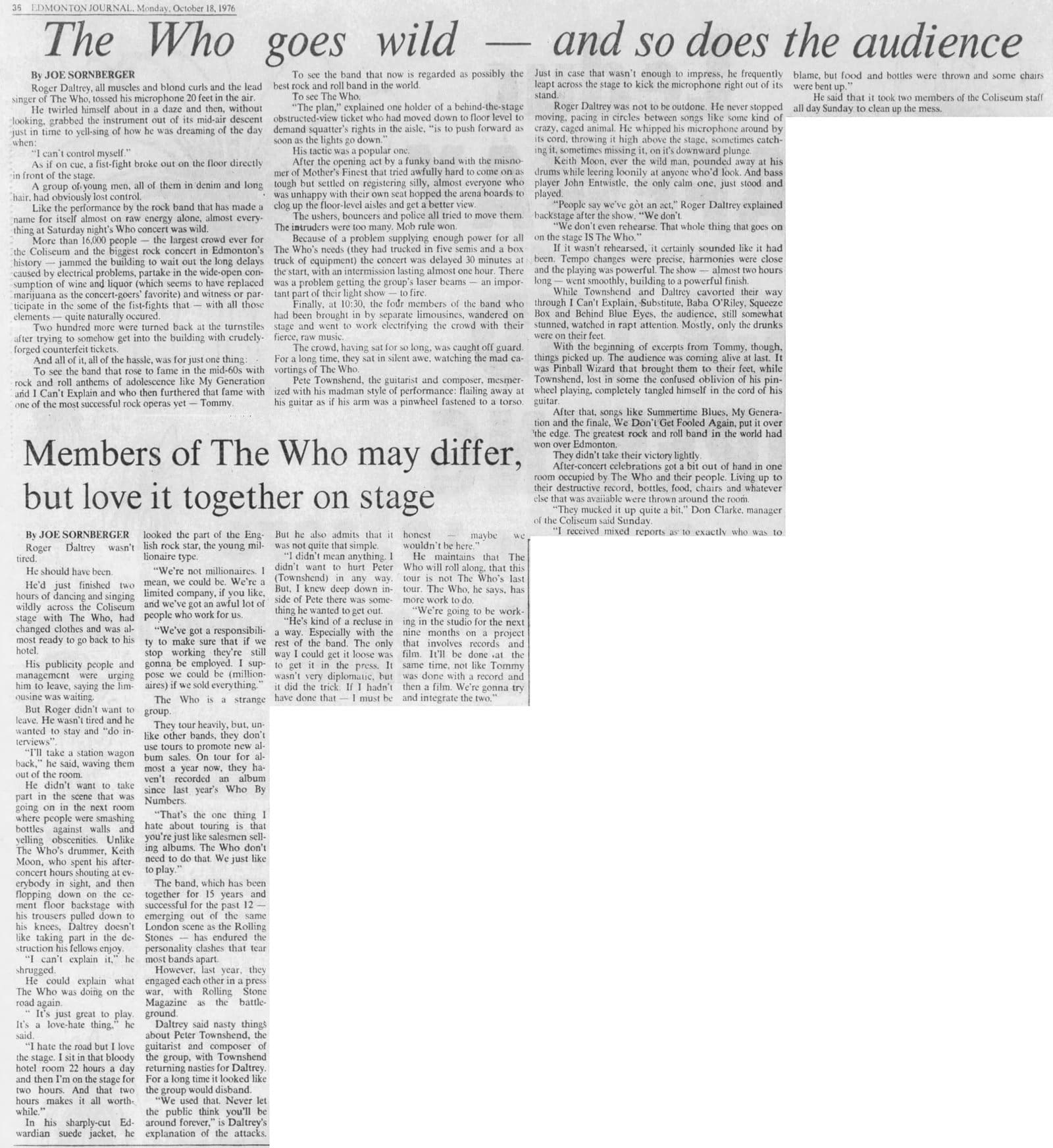
1976-10-18-Edmonton_Journal
The Who goes wild — and so does the audience
Roger Daltrey, all muscles and blond curls and the lead singer of The Who, tossed his microphone 20 feet in the air.
He twirled himself about in a daze and then, without looking, grabbed the instrument out of its mid-air descent just in time to yell-sing of how he was dreaming of the day when:
“I can’t control myself.”
As if on cue, a fist-fight broke out on the floor directly in front of the stage.
A group of young men, all of them in denim and long hair, had obviously lost control.
Like the performance by the rock band that has made a name for itself almost on raw energy alone, almost everything at Saturday night's Who concert was wild.
More than 16,000 people — the largest crowd ever for the Coliseum and the biggest rock concert in Edmonton's history — jammed the building to wait out the long delays caused by electrical problems, partake in the wide-open consumption of wine and liquor (which seems to have replaced marijuana as the concert-goers' favorite) and witness or participate in the some of the fist-fights that — with all those elements — quite naturally occured.
Two hundred more were turned back at the turnstiles after trying to somehow get into the building with crudely-forged counterfeit tickets.
And all of it, all of the hassle, was for just one thing:
To see the band that rose to fame in the mid-60s with rock and roll anthems of adolescence like My Generation and I Can't Explain and who then furthered that fame with one of the most successful rock operas yet — Tommy.
To see the band that now is regarded as possibly the best rock and roll band in the world.
To see The Who.
“The plan,” explained one holder of a behind-the-stage obstructed-view ticket who had moved down to floor level to demand squatter's rights in the aisle, “is to push forward as soon as the lights go down.”
His tactic was a popular one.
After the opening act by a funky band with the misnomer of Mother's Finest that tried awfully hard to come on as tough but settled on registering silly, almost everyone who was unhappy with their own seat hopped the arena boards to clog up the floor-level aisles and get a better view.
The ushers, bouncers and police all tried to move them.
The intruders were too many, Mob rule won.
Because of a problem supplying enough power for all The Who's needs (they had trucked in five semis and a box truck of equipment) the concert was delayed 30 minutes at the start, with an intermission lasting almost one hour. There was a problem getting the group's laser beams — an important part of their light show — to fire.
Finally, at 10:30, the four members of the band who had been brought in by separate limousines, wandered on stage and went to work electrifying the crowd with their fierce, raw music.
The crowd, having sat for so long, was caught off guard. For a long time, they sat in silent awe, watching the mad cavortings of The Who.
Pete Townshend, the guitarist and composer, mesmerized with his madman style of performance: flailing away at his guitar as if his arm was a pinwheel fastened to a torso.
Just in case that wasn't enough to impress, he frequently leapt across the stage to kick the microphone right out of its stand.
Roger Daltrey was not to be outdone. He never stopped moving, pacing in circles between songs like some kind of crazy, caged animal. He whipped his microphone around by its cord, throwing it high above the stage, sometimes catching it, sometimes missing it, on its downward plunge.
Keith Moon, ever the wild man, pounded away at his drums while leering loonily at anyone who'd look. And bass player John Entwistle, the only calm one, just stood and played.
“People say we've got an act,” Roger Daltrey explained backstage after the show. “We don't
“We don't even rehearse. That whole thing that goes on on the stage IS The Who.”
If it wasn't rehearsed, it certainly sounded like it had been. Tempo changes were precise, harmonies were close and the playing was powerful. The show — almost two hours long — went smoothly, building to a powerful finish.
While Townshend and Daltrey cavorted their way through I Can't Explain, Substitute, Baba O’Riley, Squeeze Box and Behind Blue Eyes, the audience, still somewhat stunned, watched in rapt attention. Mostly, only the drunks were on their feet.
With the beginning of excerpts from Tommy, though, things picked up. The audience was coming alive at last. It was Pinball Wizard that brought them to their feet, while Townshend, lost in some the confused oblivion of his pinwheel playing, completely tangled himself in the cord of his guitar.
After that, songs like Summertime Blues, My Generation and the finale, We Don't Get Fooled Again, put it over the edge. The greatest rock and roll band in the world had won over Edmonton.
They didn't take their victory lightly.
After-concert celebrations got a bit out of hand in one room occupied by The Who and their people. Living up to their destructive record, bottles, food, chairs and whatever else that was available were thrown around the room.
“They mucked it up quite a bit,” Don Clarke, manager of the Coliseum said Sunday.
“I received mixed reports as to exactly who was to blame, but food and bottles were thrown and some chairs were bent up.”
He said that it took two members of the Coliseum staff all day Sunday to clean up the mess.
Members of The Who may differ, but love it together on stage
Roger Daltrey wasn't tired.
He should have been.
He’d just finished two hours of dancing and singing wildly across the Coliseum stage with The Who, had changed clothes and was almost ready to go back to his hotel.
His publicity people and management were urging him to leave, saying the limousine was waiting.
But Roger didn't want to leave. He wasn't tired and he wanted to stay and "do interviews."
“I'll take a station wagon back,” he said, waving them out of the room.
He didn't want to take part in the scene that was going on in the next room where people were smashing bottles against walls and yelling obscenities. Unlike The Who's drummer, Keith Moon, who spent his after concert hours shouting at everybody in sight, and then flopping down on the cement floor backstage with his trousers pulled down to his knees, Daltrey doesn't like taking part in the destruction his fellows enjoy.
“I can't explain it," he shrugged.
He could explain what The Who was doing on the road again.
“It’s just great to play. It's a love-hate thing,” he said.
“I hate the road but I love the stage. I sit in that bloody hotel room 22 hours a day and then I'm on the stage for two hours. And that two hours makes it all worthwhile."
In his sharply-cut Edwardian suede jacket, he looked the part of the English rock star, the young millionaire type.
“We're not millionaires, I mean, we could be. We're a limited company, if you like, and we've got an awful lot of people who work for us.
“We've got a responsibility to make sure that if we stop working they're still gonna be employed. I suppose we could be (millionaires) if we sold everything.”
The Who is a strange group.
They tour heavily, but, unlike other bands, they don't use tours to promote new album sales. On tour for almost a year now, they haven't recorded an album since last year's Who By Numbers.
“That's the one thing I hate about touring is that you're just like salesmen selling albums. The Who don't need to do that. We just like to play.”
The band, which has been together for 15 years and successful for the past 12 — emerging out of the same London scene as the Rolling Stones — has endured the personality clashes that tear most bands apart.
However, last year, they engaged each other in a press war, with Rolling Stone Magazine as the battleground.
Daltrey said nasty things about Peter Townshend, the guitarist and composer of the group, with Townshend returning nasties for Daltrey. For a long time it looked like the group would disband.
“We used that. Never let the public think you'll be around forever,” is Daltrey's explanation of the attacks.
But he also admits that it was not quite that simple.
“I didn't mean anything. I didn't want to hurt Peter (Townshend) in any way. But, I knew deep down inside of Pete there was something he wanted to get out.
“He's kind of a recluse in a way. Especially with the rest of the band. The only way I could get it loose was to get it in the press. It wasn't very diplomatic, but it did the trick. If I hadn't have done that — I must be honest — maybe we wouldn't be here.”
He maintains that The Who will roll along, that this tour is not The Who's last tour. The Who, he says, has more work to do.
“We’re going to be working in the studio for the next nine months on a project that involves records and film. It'll be done at the same time, not like Tommy was done with a record and then a film. We're gonna try and integrate the two.”