1996-10-17-The_Province
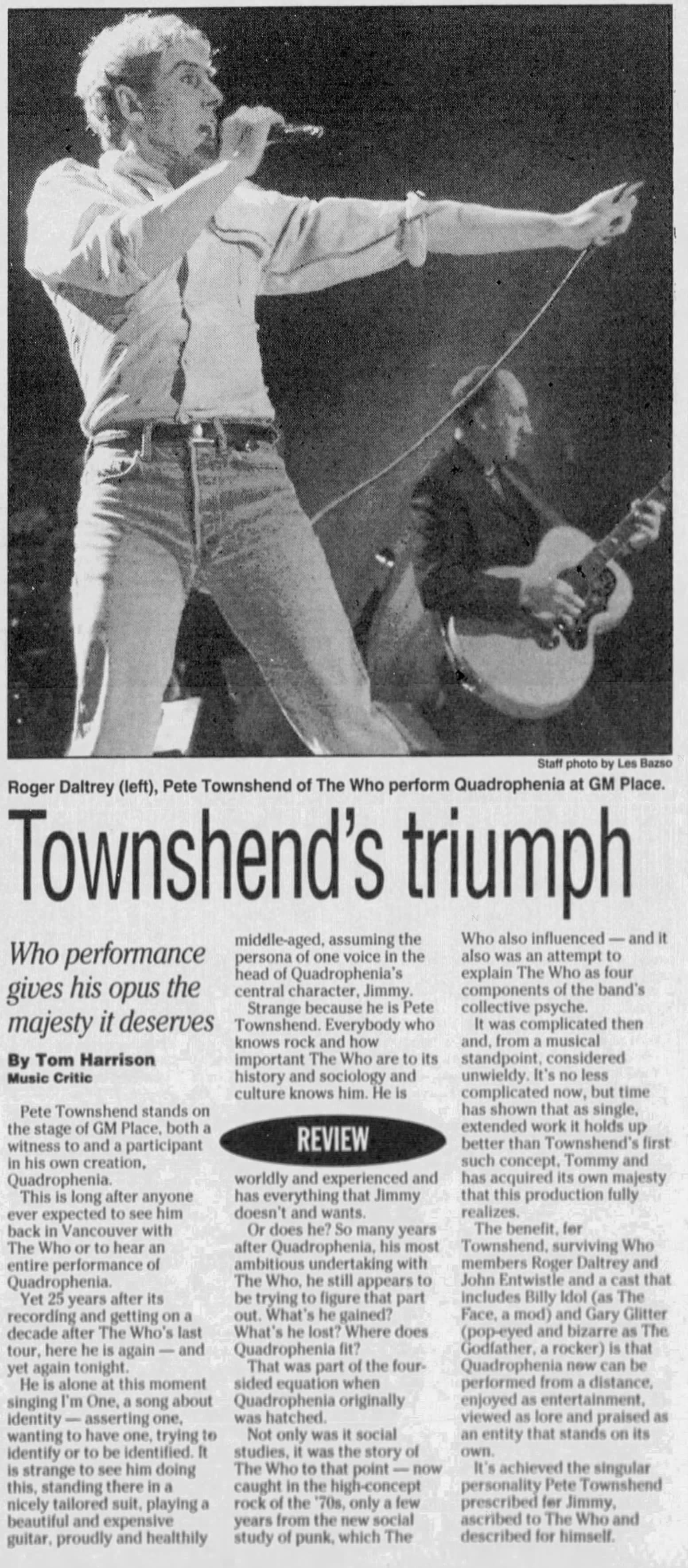
Pete Townshend stands on the stage of GM Place, both a witness to and a participant in his own creation, Quadrophenia.
This is long after anyone ever expected to see him back in Vancouver with The Who or to hear an entire performance of Quadrophenia.
Yet 25 years after its recording and getting on a decade after The Who’s last tour, here he is again — and yet again tonight.
He is alone at this moment singing I’m One, a song about identity — asserting one, wanting to have one, trying to identify or to be identified. It is strange to see him doing this, standing there in a nicely tailored suit, playing a beautiful and expensive guitar, proudly and healthily middle-aged, assuming the persona of one voice in the head of Quadrophenia’s central character, Jimmy.
Strange because he is Pete Townshend. Everybody who knows rock and how important The Who are to its history and sociology and culture knows him. He is
REVIEW
worldly and experienced and has everything that Jimmy doesn’t and wants.
Or does he? So many years after Quadrophenia, his most ambitious undertaking with The Who, he still appears to be trying to figure that part out. What’s he gained? What’s he lost? Where does Quadrophenia fit?
That was part of the four-sided equation when Quadrophenia originally was hatched.
Not only was it social studies, it was the story of The Who to that point — now caught in the high-concept rock of the ’70s, only a few years from the new social study of punk, which The Who also influenced — and it also was an attempt to explain The Who as four components of the band’s collective psyche.
It was complicated then and, from a musical standpoint, considered unwieldy. It’s no less complicated now, but time has shown that as single, extended work it holds up better than Townshend’s first such concept, Tommy and has acquired its own majesty that this production fully realizes.
The benefit, for Townshend, surviving Who members Roger Daltrey and John Entwistle and a cast that includes Billy Idol (as The Face, a mod) and Gary Glitter (pop-eyed and bizarre as The Godfather, a rocker) is that Quadrophenia now can be performed from a distance, enjoyed as entertainment, viewed as lore and praised as an entity that stands on its own.
It’s achieved the singular personality Pete Townshend prescribed for Jimmy, ascribed to The Who and described for himself.