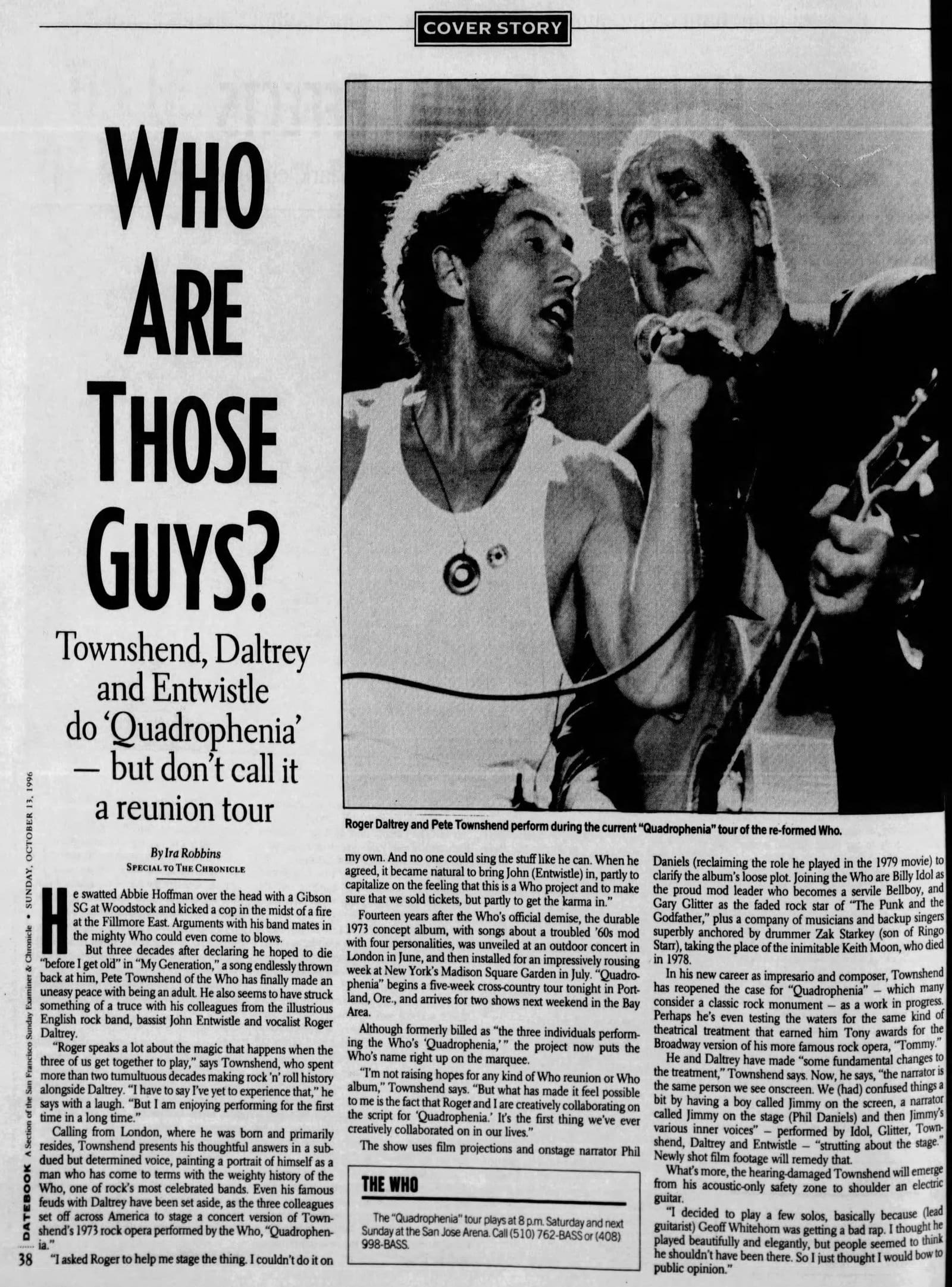
1996-10-13-The_San_Francisco_Examiner_1
He swatted Abbie Hoffman over the head with a Gibson G3 at Woodstock and kicked a cop in the midst of a fire at the Fillmore East. Arguments with his band mates in the mighty Who could even come to blows.
But three decades after declaring he hoped to die “before I get old" in “My Generation,” a song endlessly thrown back at him, Pete Townshend of the Who has finally made an uneasy peace with being an adult. He also seems to have struck something of a truce with his colleagues from the illustrious English rock band, bassist John Entwistle and vocalist Roger Daltrey.
“Roger speaks a lot about the magic that happens when the three of us get together to play,” says Townshend, who spent more than two tumultuous decades making rock ’n' roll history alongside Daltrey. “I have to say I’ve yet to experience that,” he says with a laugh. “But I am enjoying performing for the first time in a long time.”
Calling from London, where he was born and primarily resides, Townshend presents his thoughtful answers in a subdued but determined voice, painting a portrait of himself as a man who has come to terms with the weighty history of the Who, one of rock’s most celebrated bands. Even his famous feuds with Daltrey have been set aside, as the three colleagues set off across America to stage a concert version of Townshend’s 1973 rock opera performed by the Who, “Quadrophenia.”
“I asked Roger to help me stage the thing. I couldn’t do it on my own. And no one could sing the stuff like he can. When he agreed, it became natural to bring John (Entwistle) in, partly to capitalize on the feeling that this is a Who project and to make sure that we sold tickets, but partly to get the karma in.”
Fourteen years after the Who’s official demise, the durable 1973 concept album, with songs about a troubled ’60s mod with four personalities, was unveiled at an outdoor concert in London in June, and then installed for an impressively rousing week at New York’s Madison Square Garden in July. “Quadrophenia” begins a five-week cross-country tour tonight in Portland, Ore., and arrives for two shows next weekend in the Bay Area.
Although formerly billed as “the three individuals performing the Who’s ’Quadrophenia,'” the project now puts the Who’s name right up on the marquee.
“I’m not raising hopes for any kind of Who reunion or Who album,” Townshend says. “But what has made it feel possible to me is the fact that Roger and I are creatively collaborating on the script for ‘Quadrophenia.’ It’s the first thing we’ve ever creatively collaborated on in our lives.”
The show uses film projections and onstage narrator Phil
THE WHO
The “Quadrophenia” tour plays at 8 p.m. Saturday and next Sunday at the San Jose Arena. Call (510) 762-BASS or (408) 998-BASS.
Daniels (reclaiming the role he played in the 1979 movie) to clarify the album’s loose plot. Joining the Who are Billy Idol as the proud mod leader who becomes a servile Bellboy, and Gary Glitter as the faded rock star of “The Punk and the Godfather,” plus a company of musicians and backup singers superbly anchored by drummer Zak Starkey (son of Ringo Starr), taking the place of the inimitable Keith Moon, who died in 1978.
In his new career as impresario and composer, Townshend has reopened the case for “Quadrophenia” — which many consider a classic rock monument — as a work in progress. Perhaps he’s even testing the waters for the same kind of theatrical treatment that earned him Tony awards for the Broadway version of his more famous rock opera, “Tommy.”
He and Daltrey have made “some fundamental changes to the treatment,” Townshend says. Now, he says, “the narrator is the same person we see onscreen. We (had) confused things a bit by having a boy called Jimmy on the screen, a narrator called Jimmy on the stage (Phil Daniels) and then Jimmy’s various inner voices” — performed by Idol, Glitter, Townshend, Daltrey and Entwistle — “strutting about the stage.” Newly shot film footage will remedy that.
What’s more, the hearing-damaged Townshend will emerge from his acoustic-only safety zone to shoulder an electric guitar.
“I decided to play a few solos, basically because (lead guitarist) Geoff Whitehorn was getting a bad rap. I thought he played beautifully and elegantly, but people seemed to think he shouldn’t have been there. So I just thought I would bow to public opinion.”