1982-10-21-The_Daily_Herald.jpg
SEATTLE – By now, the Who – which is to say Roger Daltrey, John Entwistle, Peter Townshend, "Tommy," "Quadrophenia," "My Generation," "I Can See for Miles," "Magic Bus," rock opera, busted drum sets, smashed guitars, mods, rockers, adjectival confusion, postulated rebellion, lyrically articulated rage, etc. – needs no introduction.
It didn't get one Wednesday night at the Kingdome. The members of the group just walked onstage and started playing. So much the better.
The Who has been known more commonly for its work in concert than on records. Apparently, the group's sound has always been mysteriously compromised by reproduction. Live, it is as vibrant as any in rock – a remarkable thing considering that it is generated almost entirely by the numerically meager resources of guitarist Townshend, bassist Entwistle and drummer Kenney Jones. Nevertheless, it blasted out across the Kingdome's 50,000-or-so fans with startling harmonic clarity and supercharged emotionalism.
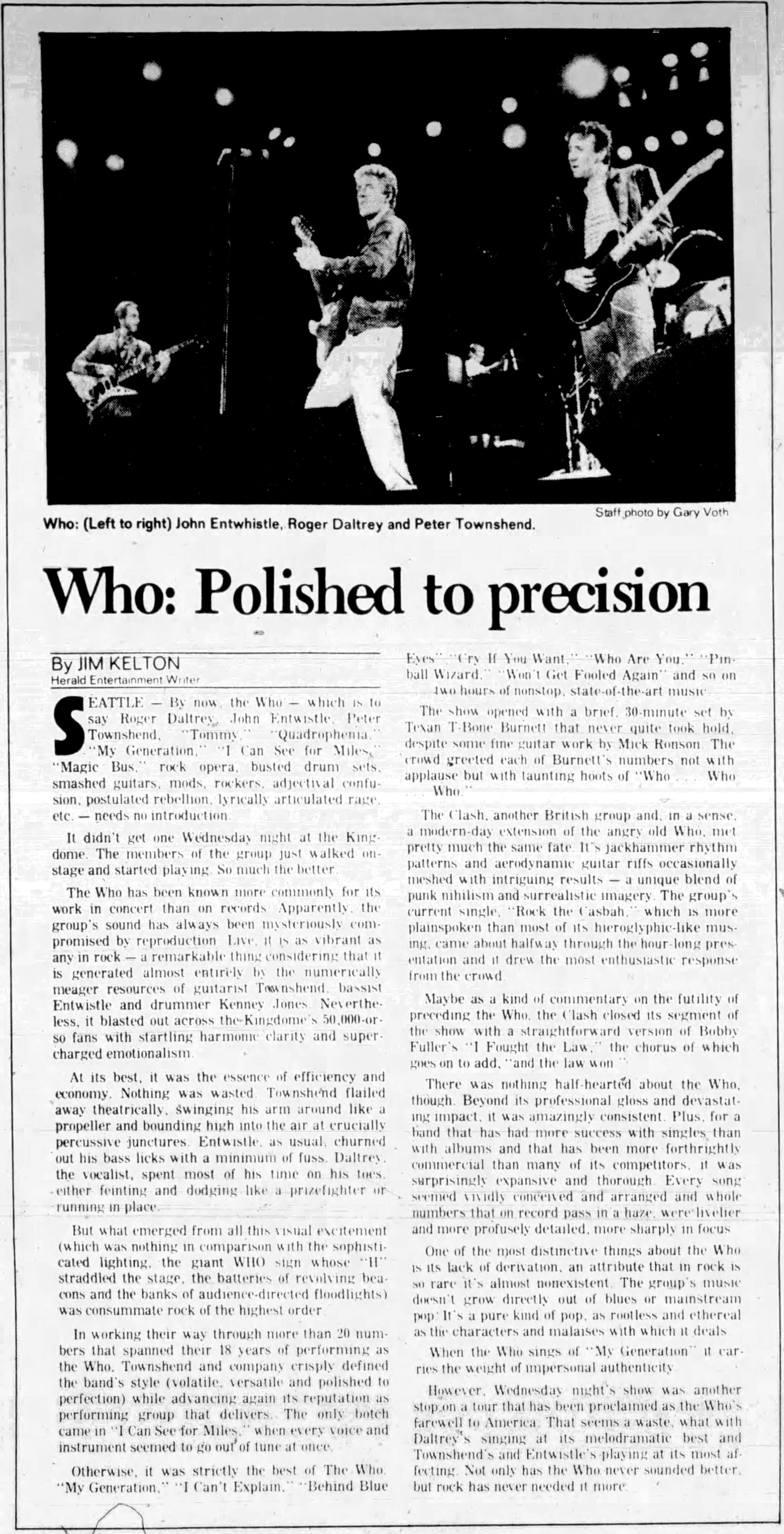
At its best, it was the essence of efficiency and economy. Nothing was wasted. Townshend flailed away theatrically, swinging his arm around like a propeller and bounding high into the air at crucially percussive junctures. Entwistle, as usual, churned out his bass licks with a minimum of fuss. Daltrey, the vocalist, spent most of his time on his toes, either feinting and dodging like a prizefighter or running in place.
But what emerged from all this visual excitement (which was nothing in comparison with the sophisticated lighting, the giant WHO sign whose "H" straddled the stage, the batteries of revolving beacons and the banks of audience-directed floodlights) was consummate rock of the highest order.
In working their way through more than 20 numbers that spanned their 18 years of performing as the Who, Townshend and company crisply defined the band's style (volatile, versatile and polished to perfection) while advancing again its reputation as performing group that delivers. The only botch came in "I Can See for Miles," when every voice and instrument seemed to go out of tune at once.
Otherwise, it was strictly the best of The Who, "My Generation," "I Can't Explain," "Behind Blue Eyes," "Cry If You Want," "Who Are You," "Pinball Wizard," "Won't Get Fooled Again" and so on two hours of nonstop, state-of-the-art music.
The show opened with a brief, 30-minute set by Texan T-Bone Burnett that never quite took hold, despite some fine guitar work by Mick Ronson. The crowd greeted each of Burnett's numbers not with applause but with taunting hoots of "Who … Who … Who…"
The Clash, another British group and, in a sense, a modern-day extension of the angry old Who, met pretty much the same fate. It's jackhammer rhythm patterns and aerodynamic guitar riffs occasionally meshed with intriguing results – a unique blend of punk nihilism and surrealistic imagery. The group's current single, "Rock the Casbah," which is more plainspoken than most of its hieroglyphic-like musings, came about halfway through the hour-long presentation and it drew the most enthusiastic response from the crowd.
Maybe as a kind of commentary on the futility of preceding the Who, the Clash closed its segment of the show with a straightforward version of Bobby Fuller's "I Fought the Law," the chorus of which goes on to add, "and the law won."
There was nothing half-hearted about the Who, though. Beyond its professional gloss and devastating impact, it was amazingly consistent. Plus, for a band that has had more success with singles than with albums and that has been more forthrightly commercial than many of its competitors, it was surprisingly expansive and thorough. Every song seemed vividly conceived and arranged and whole numbers that on record pass in a haze were livelier and more profusely detailed, more sharply in focus.
One of the most distinctive things about the Who is its lack of derivation, an attribute that in rock is so rare it's almost nonexistent. The group's music doesn't grow directly out of blues or mainstream pop. It's a pure kind of pop, as rootless and ethereal as the characters and maladies with which it deals.
When the Who sings of "My Generation" it carries the weight of impersonal authenticity.
However, Wednesday night's show was another stop on a tour that has been proclaimed as the Who's farewell to America. That seems a waste, what with Daltrey's singing, at its melodramatic best and Townshend's and Entwistle's playing at its most affecting. Not only has the Who never sounded better, but rock has never needed it more.