1982-10-21-The_News_Tribune
Who Rocked the Kingdome
‘British Invasion’ group belts out stunning farewell concert
Last night in the Kingdome The Who passed the torch of rock music to an eager, younger generation with the same raw, arrogant energy it was passed to them nearly two decades ago.
Playing to more than 50,000 ecstatic fans, the heavily amplified British quartet with a string of hits stretching back to 1964 performed for 2¼ hours in a concert billed as part of its “farewell” American tour.
Also featured in the Kingdome were a fairly unknown group led by T-Bone Burnett and the popular New Wave group, The Clash.
Comparing The Who with their co-musicians made it apparent that rock immortality must be earned over a long period of time.
From the second song through the end of the half-hour set, T-Bone Burnett was booed by the audience. The Clash, known for controversial political lyrics, performed in a basic rock format with repetitious guitar chord strummings in the style of New Wave. The group earned audience approval for its material, though the provocative lyrics could not be understood in the Kingdome.
The Clash played several of its best-known songs, such as “London Calling” and its biggest hit, “Rain in Vain.”
But the power and the glory that is rock was manifested by The Who and brought the crowd to a screaming frenzy.
The Who is one of the few remaining “British Invasion” groups from the mid-’60s to survive the changes in rock trends. The concert in effect was an overview of The Who’s repertoire of the last 18 years and included “I Can’t Explain,” “My Generation,” “Behind Blue Eyes,” “I Can See for Miles,” “Who Are You?”, melodies from the band’s rock opera Tommy, from the movie Quadrophenia and from their newest album It’s Hard.
According to press releases and statements offered by the group just before the beginning of the tour, the band decided to split and discontinue touring because of difficulties adapting to life on the road.
The Who earned a reputation for traveling wildly over the years and frequently paid thousands of dollars to innkeepers for repairing destroyed rooms resulting from post-concert revelry, especially at the mischievous hands of the late Keith Moon, the band’s first drummer.
It has also been speculated that the band’s enthusiasm for touring diminished after Moon’s untimely death in 1978 from a drug overdose. He was the clown and the most delightful drummer to observe when he was in his prime.
But whatever the reasons for the band’s break-up, The Who assured audiences they would give a 100-plus percent performance. And the promise was not broken.
Lean, blond, handsome Roger Daltrey has the best rock voice in the business, and he shared it generously in the Kingdome. He twitched his body in half-rotations and threw his microphone to the end of its cord, catching it in midair like a trick roper.
The band was observed by several video cameras which projected close-ups on a large screen above the stage. Daltrey could win an Oscar for his carefully choreographed movements and emotional facial expressions as they flashed on the screen.
Kenney Jones, the band’s new drummer, was seen on the screen as a competent successor to Moon. He hammered his equipment relentlessly, keeping the hard-driving rhythm.
Bassist John Entwistle, dressed in a conservative business suit, remained off to the side much of the time but maintained a thundering bass lead. He took several singing solos with a near-screaming conviction.
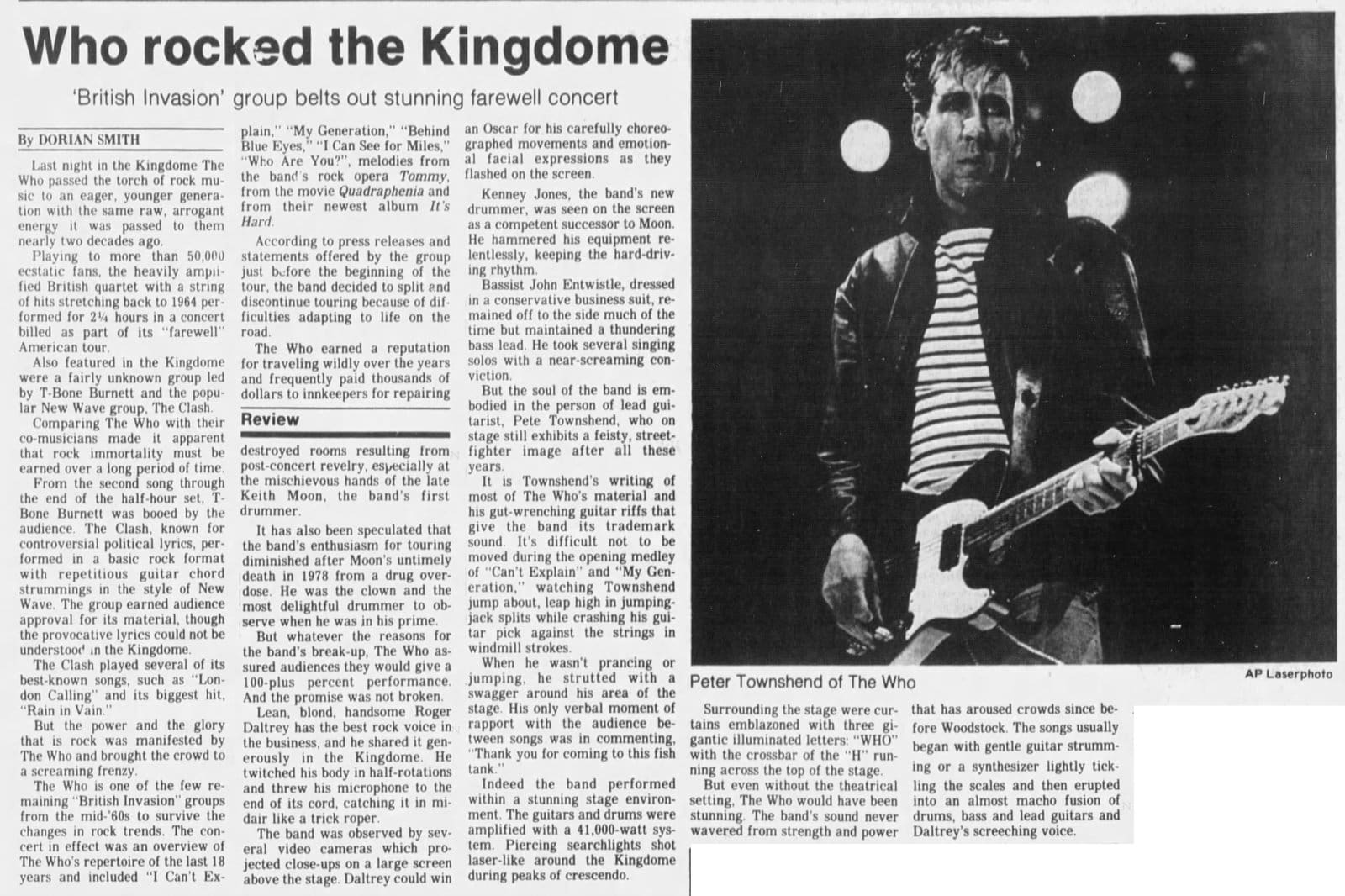
But the soul of the band is embodied in the person of lead guitarist, Pete Townshend, who on stage still exhibits a feisty, streetfighter image after all these years.
It is Townshend’s writing of most of The Who’s material and his gut-wrenching guitar riffs that give the band its trademark sound. It’s difficult not to be moved during the opening medley of “Can’t Explain” and “My Generation,” watching Townshend jump about, leap high in jumping-jack splits while crashing his guitar pick against the strings in windmill strokes.
When he wasn’t prancing or jumping, he strutted with a swagger around his area of the stage. His only verbal moment of rapport with the audience between songs was in commenting, “Thank you for coming to this fish tank.”
Indeed the band performed within a stunning stage environment. The guitars and drums were amplified with a 41,000-watt system. Piercing searchlights shot laser-like around the Kingdome during peaks of crescendo.
Surrounding the stage were curtains emblazoned with three gigantic illuminated letters: “WHO” with the crossbar of the “H” running across the top of the stage.
But even without the theatrical setting, The Who would have been stunning. The band’s sound never wavered from strength and power that has aroused crowds since before Woodstock. The songs usually began with gentle guitar strumming or a synthesizer lightly tickling the scales and then erupted into an almost macho fusion of drums, bass and lead guitars and Daltrey’s screeching voice.
AP Laserphoto