1969-11-15-The_Plain_Dealer
The Who quartet showed where it was at last last night.
A standing-room-only audience at Public Music Hall gave the English quartet a two-minute standing ovation at the finale of the group's rock opera, "Tommy."
For sheer power, imagination and intensity it surpassed any rock show in Greater Cleveland, except, perhaps, that in the Bluestone Quarries in 1910.
"TOMMY" ISN'T the first rock opera — The Pretty Things and the Small Faces have written them — but the Who's is the first successful one.
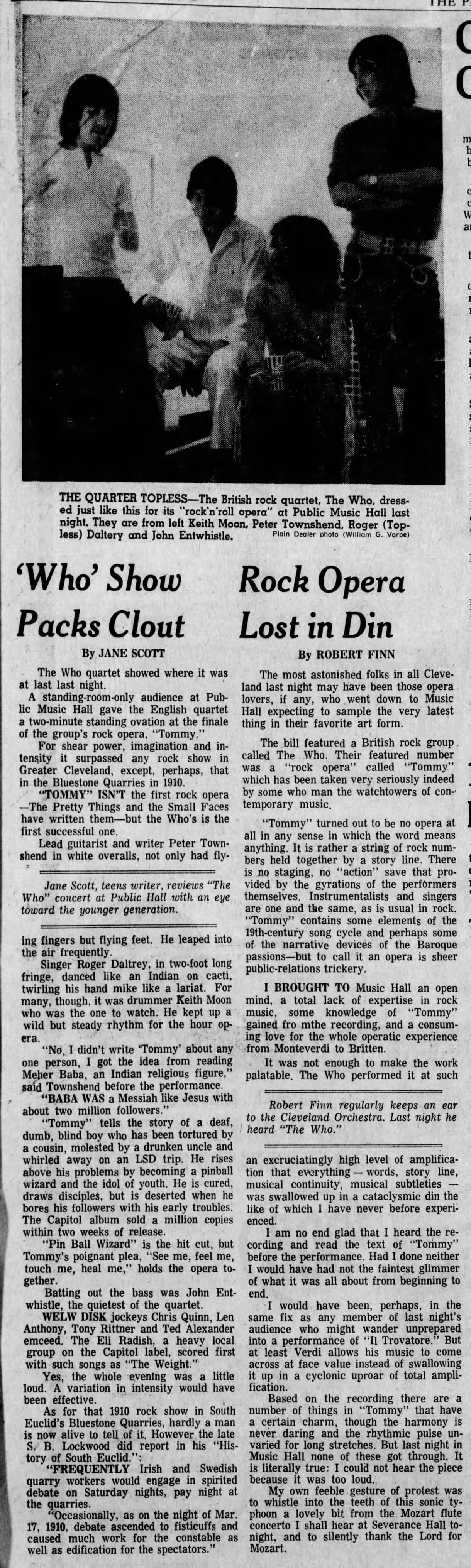
Lead guitarist and writer Peter Townshend in white overalls, not only had flying fingers but flying feet. He leaped into the air frequently.
Singer Roger Daltrey, in two-foot long fringe, danced like an Indian on cacti, twirling his hand mike like a lariat. For many, though, it was drummer Keith Moon who was the one to watch. He kept up a wild but steady rhythm for the hour opera.
"No, I didn't write 'Tommy' about any one person, I got the idea from reading Meher Baba, an Indian religious figure," said Townshend before the performance.
"BABA WAS a Messiah like Jesus with about two million followers."
"Tommy" tells the story of a deaf, dumb, blind boy who has been tortured by a cousin, molested by a drunken uncle and whirled away on an LSD trip. He rises above his problems by becoming a pinball wizard and the idol of youth. He is cured, draws disciples, but is deserted when he bores his followers with his early troubles. The Capitol album sold a million copies within two weeks of release.
"Pin Ball Wizard" is the hit cut, but Tommy's poignant plea, "See me, feel me, touch me, heal me," holds the opera together.
Batting out the bass was John Entwhistle, the quietest of the quartet.
WELW DISK jockeys Chris Quinn, Len Anthony, Tony Rittner and Ted Alexander emceed. The Eli Radish, a heavy local group on the Capitol label, scored first with such songs as "The Weight."
Yes, the whole evening was a little loud. A variation in intensity would have been effective.
As for that 1910 rock show in South Euclid's Bluestone Quarries, hardly a man is now alive to tell of it. However the late S. B. Lockwood did report in his "History of South Euclid:"
"FREQUENTLY Irish and Swedish quarry workers would engage in spirited debate on Saturday nights, pay night at the quarries.
"Occasionally, as on the night of Mar. 17, 1910, debate ascended to fisticuffs and caused much work for the constable as well as edification for the spectators."