2012-11-08-Pittsburgh_Post_Gazette_2
You could count on a couple of fingers the number of bands, at least known bands, that could sit around and weigh the question: "Which rock opera should we do?"
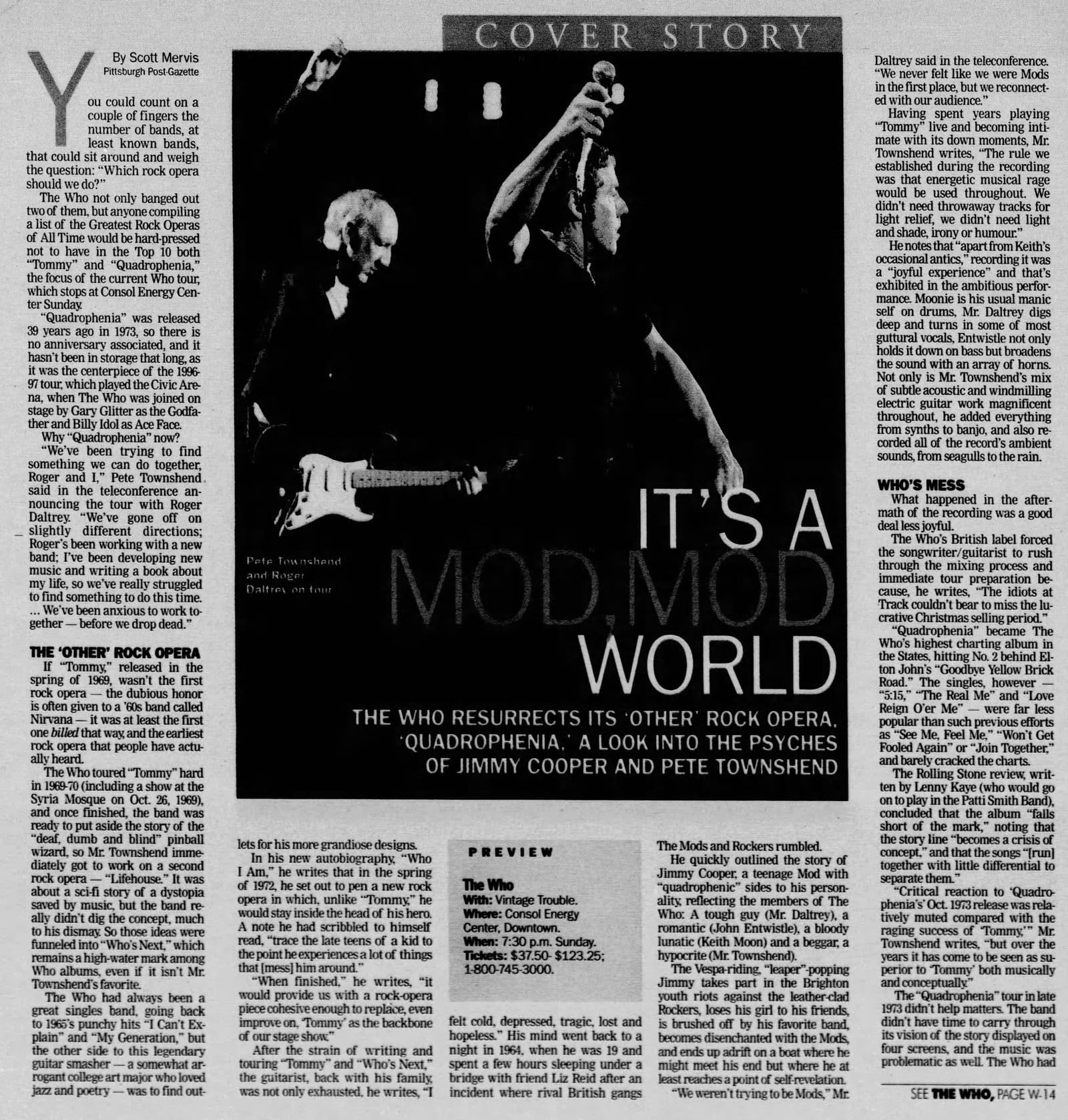
The Who not only banged out two of them, but anyone compiling a list of the Greatest Rock Operas of All Time would be hard-pressed not to have in the Top 10 both "Tommy" and "Quadrophenia," the focus of the current Who tour, which stops at Consol Energy Center Sunday.
"Quadrophenia" was released 39 years ago in 1973, so there is no anniversary associated, and it hasn't been in storage that long, as it was the centerpiece of the 1996-97 tour, which played the Civic Arena, when The Who was joined on stage by Gary Glitter as the Godfather and Billy Idol as Ace Face.
Why "Quadrophenia" now?
"We've been trying to find something we can do together, Roger and I," Pete Townshend said in the teleconference announcing the tour with Roger Daltrey. "We've gone off on slightly different directions; Roger's been working with a new band; I've been developing new music and writing a book about my life, so we've really struggled to find something to do this time. … We've been anxious to work together – before we drop dead."
THE 'OTHER' ROCK OPERA
If "Tommy," released in the spring of 1969, wasn't the first rock opera – the dubious honor is often given to a '60s band called Nirvana – it was at least the first one billed that way, and the earliest rock opera that people have actually heard.
The Who toured "Tommy" hard in 1969-70 (including a show at the Syria Mosque on Oct. 26, 1969), and once finished, the band was ready to put aside the story of the "deaf, dumb and blind" pinball wizard, so Mr. Townshend immediately got to work on a second rock opera – "Lifehouse." It was about a sci-fi story of a dystopia saved by music, but the band really didn't dig the concept, much to his dismay. So those ideas were funneled into "Who's Next," which remains a high-water mark among Who albums, even if it isn't Mr. Townshend's favorite.
The Who had always been a great singles band, going back to 1965's punchy hits "I Can't Explain" and "My Generation," but the other side to this legendary guitar smasher – a somewhat arrogant college art major who loved jazz and poetry – was to find out-
letters for his more grandiose designs.
In his new autobiography, "Who I Am," he writes that in the spring of 1972, he set out to pen a new rock opera in which, unlike "Tommy," he would stay inside the head of his hero. A note he had scribbled to himself read, "trace the late teens of a kid to the point he experiences a lot of things that [mess] him around."
"When finished," he writes, "it would provide us with a rock-opera piece cohesive enough to replace, even improve on, Tommy as the backbone of our stage show."
After the strain of writing and touring "Tommy" and "Who's Next," the guitarist, back with his family, was not only exhausted, he writes, "I
PREVIEW
The Who With: Vintage Trouble. Where: Consol Energy Center, Downtown. When: 7:30 p.m. Sunday. Tickets: $37.50- $123.25; 1-800-745-3000.
felt cold, depressed, tragic, lost and hopeless." His mind went back to a night in 1964, when he was 19 and spent a few hours sleeping under a bridge with friend Liz Reid after an incident where rival British gangs
The Mods and Rockers rumbled.
He quickly outlined the story of Jimmy Cooper, a teenage Mod with "quadrophenic" sides to his personality, reflecting the members of The Who: A tough guy (Mr. Daltrey), a romantic (John Entwistle), a bloody lunatic (Keith Moon) and a beggar, a hypocrite (Mr. Townshend).
The Vespa-riding "leaper"-popping Jimmy takes part in the Brighton youth riots against the leather-clad Rockers, loses his girl to his friends, is brushed off by his favorite band, becomes disenchanted with the Mods, and ends up adrift on a boat where he might meet his end but where he at least reaches a point of self-revelation.
"We weren't trying to be Mods," Mr.
Daltrey said in the teleconference. "We never felt like we were Mods in the first place, but we reconnected with our audience."
Having spent years playing "Tommy" live and becoming intimate with its down moments, Mr. Townshend writes, "The rule we established during the recording was that energetic musical rage would be used throughout. We didn't need throwaway tracks for light relief, we didn't need light and shade, irony or humour."
He notes that "apart from Keith's occasional antics," recording it was a "joyful experience" and that's exhibited in the ambitious performance. Moonie is his usual manic self on drums, Mr. Daltrey digs deep and turns in some of most guttural vocals, Entwistle not only holds it down on bass but broadens the sound with an array of horns. Not only is Mr. Townshend's mix of subtle acoustic and windmilling electric guitar work magnificent throughout, he added everything from synths to banjo, and also recorded all of the record's ambient sounds, from seagulls to the rain.
WHO'S MESS
What happened in the aftermath of the recording was a good deal less joyful.
The Who's British label forced the songwriter/guitarist to rush through the mixing process and immediate tour preparation because, he writes, "The idiots at Track couldn't bear to miss the lucrative Christmas selling period."
"Quadrophenia" became The Who's highest charting album in the States, hitting No. 2 behind Elton John's "Goodbye Yellow Brick Road." The singles, however – "5:15," "The Real Me" and "Love Reign O'er Me" – were far less popular than such previous efforts as "See Me, Feel Me," "Won't Get Fooled Again" or "Join Together," and barely cracked the charts.
The Rolling Stone review, written by Lenny Kaye (who would go on to play in the Patti Smith Band), concluded that the album "falls short of the mark," noting that the story line "becomes a crisis of concept," and that the songs "[run] together with little differential to separate them."
"Critical reaction to 'Quadrophenia's' Oct. 1973 release was relatively muted compared with the raging success of 'Tommy,'" Mr. Townshend writes, "but over the years it has come to be seen as superior to Tommy' both musically and conceptually."
The "Quadrophenia" tour in late 1973 didn't help matters. The band didn't have time to carry through its vision of the story displayed on four screens, and the music was problematic as well. The Who had
SEE THE WHO, PAGE W-14