1973-11-29-The_Atlanta_Journal
MASTER MIND OF THE WHO
Townshend Gets Souvenir of City
Peter Townshend, the mastermind of the Who, has a souvenir of Atlanta: A giant portrait of Jimi Hendrix, dead now, but at one time a friend of Townshend's and a musical competitor.
Townshend was given the huge painting during a party for Taj Mahal, the jazz star who was making a quick stopover in Atlanta at the same time as the Who.
The gift was undoubtedly prompted by the local showing of a documentary about Hendrix in which Townshend's reminiscences play a vital role.
Townshend says he remembers the film only too well. "I had to do my part over again." Something happened to the footage of his interview the first time it was shot, and the whole thing had to be repeated. "A number of bad things like that happened to that movie," he states.
The guitarist says he had difficulty doing right by memory of his friend. "It's very hard to do justice to Jimi Hendrix by talking about him. You need to be poetic because he lifted you off the everyday level."
As it happens, another friend, Eric Clapton, also takes part in the Hendrix movie. Clapton, who is one of the best known recluses in popular music, talks a good bit in the film about Hendrix.
Townshend regrets that his own album with Clapton did not turn out better than it did. Clapton had begun the album with his group, Derek and the Dominoes, but dropped the project when the band broke up. Townshend heard the material and suggested that Clapton pick up the pieces with Townshend's help. "His heart wasn't in it," Townshend reports.
Nevertheless, Townshend played a crucial role in getting Clapton back on the performing stage last year. Marc Bolan — "the T. Rex cat" — had helped circulate the story that Clapton would never perform again, but the introspective guitarist called Townshend and told him he would give a show if Townshend would do it with him. Townshend arranged the show, at the Rainbow in London, and it was a huge success.
Clapton is actually good company, contrary to the general impression. Townshend praises Clapton as a warm and intelligent human, with a number of surprising hobbies that involve manual labor. Townshend also reports with some glee that Clapton is a keen observer of musical polls, in which he has always been at or near the top.
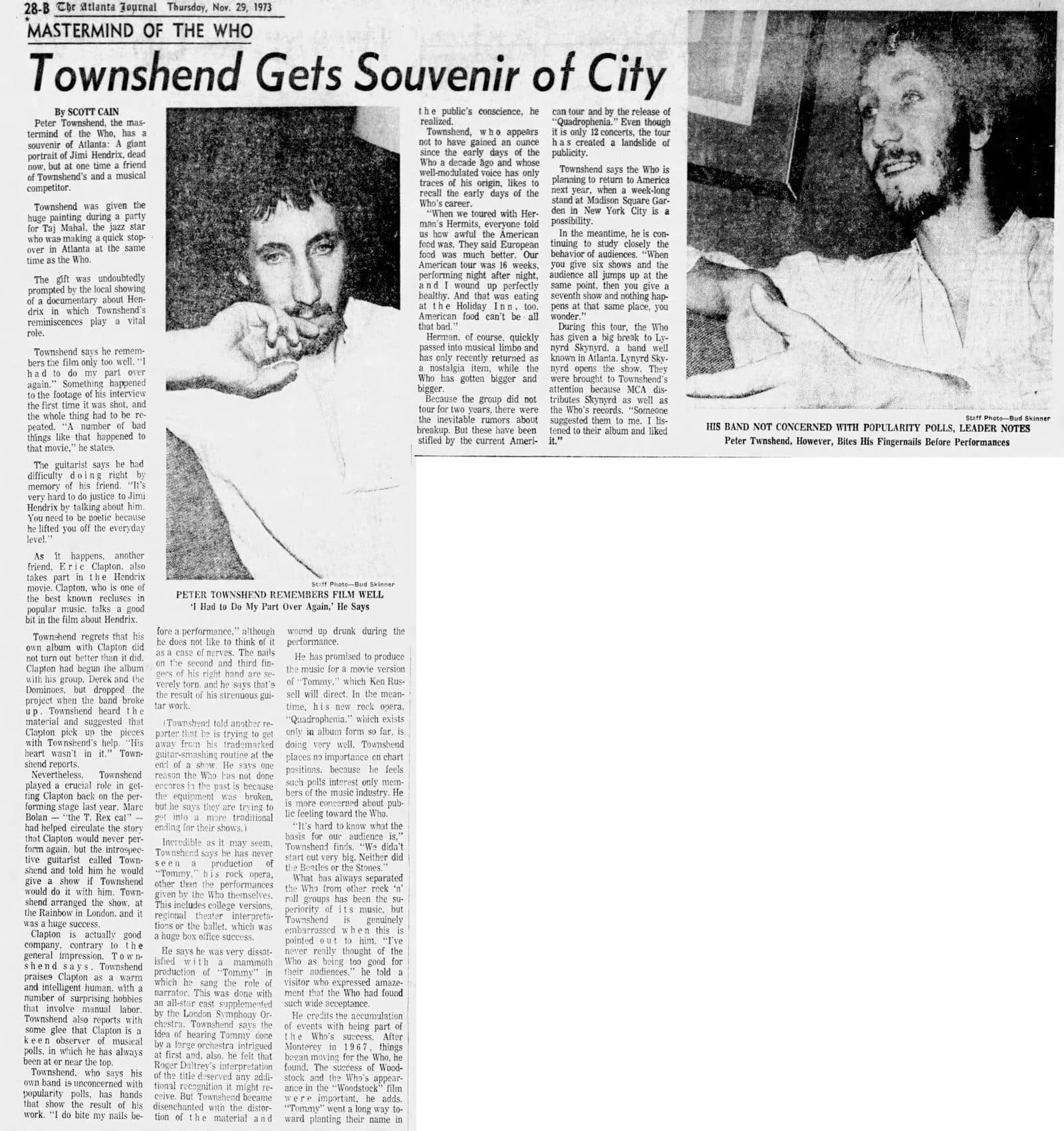
Townshend, who says his own band is unconcerned with popularity polls, has hands that show the result of his work. "I do bite my nails before a performance," although he does not like to think of it as a case of nerves. The nails on the second and third fingers of his right hand are severely torn, and he says that's the result of his strenuous guitar work.
(Townshend told another reporter that he is trying to get away from his trademarked guitar-smashing routine at the end of a show. He says one reason the Who has not done encores in the past is because the equipment was broken, but he says they are trying to get into a more traditional ending for their shows.)
Incredible as it may seem, Townshend says he has never seen a production of "Tommy," his rock opera, other than the performances given by the Who themselves. This includes college versions, regional theater interpretations or the ballet, which was a huge box office success.
He says he was very dissatisfied with a mammoth production of "Tommy" in which he sang the role of narrator. This was done with an all-star cast supplemented by the London Symphony Orchestra. Townshend says the idea of hearing Tommy done by a large orchestra intrigued at first and, also, he felt that Roger Daltrey's interpretation of the title deserved any additional recognition it might receive. But Townshend became disenchanted with the distortion of the material and wound up drunk during the performance.
He has promised to produce the music for a movie version of "Tommy," which Ken Russell will direct. In the meantime, his new rock opera, "Quadrophenia," which exists only in album form so far, is doing very well. Townshend places no importance on chart positions, because he feels such polls interest only members of the music industry. He is more concerned about public feeling toward the Who.
"It's hard to know what the basis for our audience is," Townshend finds. "We didn't start out very big. Neither did the Beatles or the Stones."
What has always separated the Who from other rock 'n' roll groups has been the superiority of its music, but Townshend is genuinely embarrassed when this is pointed out to him. "I've never really thought of the Who as being too good for their audiences," he told a visitor who expressed amazement that the Who had found such wide acceptance.
He credits the accumulation of events with being part of the Who's success. After Monterey in 1967, things began moving for the Who, he found. The success of Woodstock and the Who's appearance in the "Woodstock" film were important, he adds. "Tommy" went a long way toward planting their name in the public's conscience, he realized.
Townshend, who appears not to have gained an ounce since the early days of the Who a decade ago and whose well-modulated voice has only traces of his origin, likes to recall the early days of the Who's career.
"When we toured with Herman's Hermits, everyone told us how awful the American food was. They said European food was much better. Our American tour was 16 weeks, performing night after night, and I wound up perfectly healthy. And that was eating at the Holiday Inn, too. American food can't be all that bad."
Herman, of course, quickly passed into musical limbo and has only recently returned as a nostalgia item, while the Who has gotten bigger and bigger.
Because the group did not tour for two years, there were the inevitable rumors about breakup. But these have been stifled by the current American tour and by the release of "Quadrophenia." Even though it is only 12 concerts, the tour has created a landslide of publicity.
Townshend says the Who is planning to return to America next year, when a week-long stand at Madison Square Garden in New York City is a possibility.
In the meantime, he is continuing to study closely the behavior of audiences. "When you give six shows and the audience all jumps up at the same point, then you give a seventh show and nothing happens at the same place, you wonder."
During this tour, the Who has given a big break to Lynyrd Skynyrd, a band well known in Atlanta. Lynyrd Skynyrd opens the show. They were brought to Townshend's attention because MCA distributes Skynyrd as well as the Who's records. "Someone suggested them to me. I listened to their album and liked it."
PETER TOWNSHEND REMEMBERS FILM WELL "I Had to Do My Part Over Again," He Says
HIS BAND NOT CONCERNED WITH POPULARITY POLLS, LEADER NOTES Peter Townshend, However, Bites His Fingernails Before Performances