1979-12-09-News_Journal_2
I was smack in the middle of the large crowd when they finally opened the doors to let the mass of eager concert goers inside.
After standing at least an hour outside Cincinnati's Riverfront Coliseum, clutching precious tickets tightly in my hand, I, along with thousands of other rock music fans, wanted to get inside as quickly as possible to grab a good seat.
The group, one of the most popular acts in all of rockdom, had not played in the U.S. for several years, and everyone wanted up close for the rare occurence. All tickets were general admission, and seating was first-come first-served.
But after only a few of the several doors were swung open, what was a somewhat reasonable rush slowly turned into a chaotic stampede of humanity toward the portals. The latecomers on the outside of the crowd also wanted a chance at a good seat, and they pressed forward.
Meanwhile the folks at the front were all trying to get inside at once. Some who'd been faithfully standing outside doors that didn't open pushed toward entries that were open.
Even though I could see people flowing into the Coliseum, we weren't moving forward very swiftly. About the only motion resulted in being smashed into the backs of people in front of us.
But the harder the crowd shoved, the slower we seemed to go. And the slower we went, the more we were shoved.
Things were getting a bit scary; I tried to put my arms out to protect my wife from getting squashed, but we were both crushed between people.
The fit was so tight that I, at 6-foot plus and weighing more than 200 pounds, could lift my feet off the ground and still be carried forward by the human tide.
Finally we got near the doors. That turned out to be the worst part.
Thousands of people who'd earlier just been trying to get closer to the Coliseum now realized they might get swept away from the doors, so they applied force from the flanks. Now the pressure came not only from the rear but from the sides and front as well.
Several times riptides of human flesh and blood nearly knocked me — a former defensive lineman — off my feet.
As we were squirted through the doors we realized there was not time to hand over our "precious" tickets. People were shoved through the gate so fast the startled ushers and policemen could only stand with their mouths open. Anybody — with or without a ticket — could have gotten into the concert that night.
That's if they survived the stampede outside.
Thankfully, on that night in the spring of 1976, no one was killed. The people finally got inside and enjoyed a live concert by Paul McCartney and Wings.
But last week, 11 persons caught in a similar situation at the same place weren't so lucky. They were killed — trampled to death or suffocated — as a sea of people tried to fit through the bathtub-drain doors.
Perhaps I'm morbid, but my biggest surprise upon hearing of the tragedy was why it hadn't happened before — especially when I read that big concert were still being handled the same way in Cincinnati.
Authorities have blamed the deaths on the "festival-style" seating arrangement. That counterculture-sounding phrase simply means good ol' general admission, folks. Promoters don't have to set up and number chairs — just herd the people in like cattle and turn them loose to find a spot on the floor.
A big reason why the Cincinnati tragedy hasn't been repeated across the nation is because few areas offer general admission tickets. It doesn't matter how early or late you get to the show, you're still guaranteed a specific spot.
And most of the concert halls that do offer general admission seating open their gates a little ahead of time, especially at a crowd is building up.
I don't know exactly what happened last week at The Who concert, but at the '76 McCartney show the doors weren't opened until 15 minutes before the scheduled show time. By then most of the 20,000 or so concert goers already were waiting outside for the doors to open — and they all wanted that front row seat.
Imagine letting the crowd build up outside the stadium before the Ohio State-Michigan game. Further imagine general admission seating — there's your chance for that seat on the 50-yard line you've never had! Do it year after year, and too few many people are stomped to death.
The setup around Riverfront Coliseum offers a special problem. Entrance to the structure is gained from narrow, vaulted concrete plaza, which holds a limited — albeit large — number of people. That means you can't wait in your car for the doors to open like at the Richfield Coliseum.
Whoever is in charge of logistics for Cincinnati rock shows has done their job very badly — and I'm sure they'll realize what when they see their name printed at the top of a host of rage civil lawsuits in the near future.
(As of this writing, a $27 million suit already has been filed.)
Of course, the concert goers themselves cannot escape a good share of the blame.
Maybe at 24 I'm getting to be an old fogy, but I've felt the scene at rock concerts has been steadily deteriorating for several years now — although The Who audience at the Richfield Coliseum show last week was very good.
Blame it on the Age of Permissiveness, Lack of a Proper Childhood, Attempts to Emulate Woodstock, the Grip of the Me Decade (sign me up for that one) or Skin Complexion Problems — any scapegoat you choose is bond to be at least partly right.
The prevalent attitude at most concerts seems to be "Me first — the hell with everybody else."
I believe this attitude was reflected in the mob scene outside Riverfront Coliseum last week.
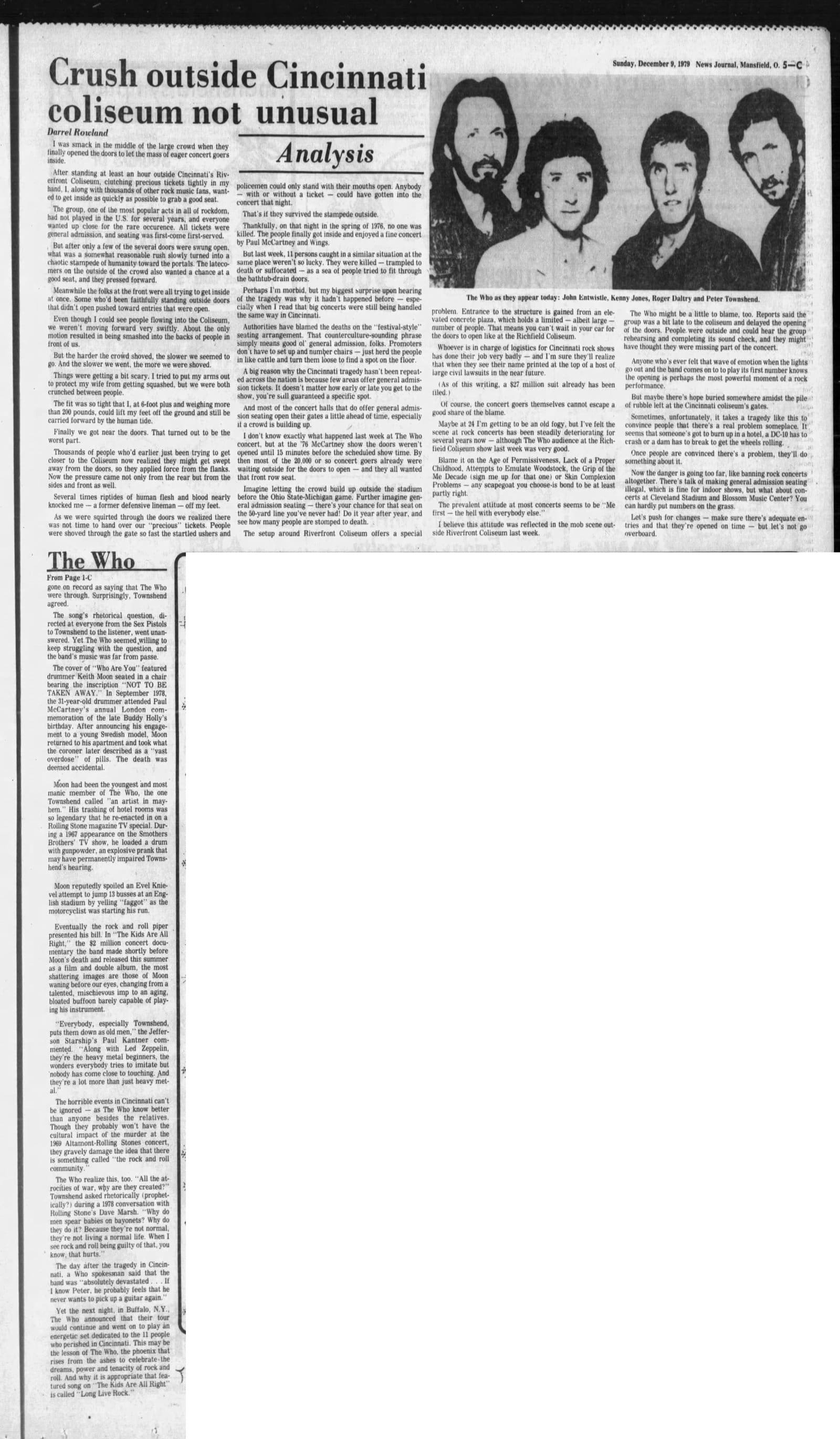
The Who as they appear today: John Entwistle, Kenny Jones, Roger Daltry and Peter Townshend.
The Who might be a little to blame, too. Reports said the group was a bit late to the coliseum and delayed the opening of the doors. People were outside and could hear the group rehearsing and completing its sound check, and they might have thought they were missing part of the concert.
Anyone who's ever felt that wave of emotion when the lights go out and the band comes on to to play its first number knows the opening is perhaps the most powerful moment of a rock performance.
But maybe there's hope buried somewhere amidst the pile of rubble left at the Cincinnati coliseum's gates.
Sometimes, unfortunately, it takes a tragedy like this to convince people that there's a real problem someplace. It's seems that someone's got to burn up in a hotel, a DC-10 has to crash or a dam has to break to get the wheels rolling.
Once people are convinced there's a problem, they'll do something about it.
Now the danger is going too far, like banning rock concerts altogether. There's talk of making general admission seating illegal, which is fine for indoor shows, but what about concerts at Cleveland Stadium and Blossom Music Center? You can hardly put numbers on the grass.
Let's push for changes — make sure there's adequate entries and that they're opened on time — but let's not go overboard.