1976-03-29-San_Francisco_Chronicle
"How do you follow that?" asked Roger Daltrey, after Keith Moon's lunatic verbal assault that passed as an introduction to "Behind Blue Eyes," the "quiet" song of the Who's set. Peter Townshend had no doubts.
"You follow that with serious music," he said.
That seemed to be the mood of the evening—serious music by the Who, one of the all-time great rock bands. The Who played Saturday and Sunday before sold out crowds at Winterland. Both instant sell outs, there had been virtually ten orders for every available ticket.
The Winterland concerts capped a successful five month American tour, to which make-up concerts in Denver and Boston will write a postscript. The 5400-seat hall is the smallest facility the Who played on this tour.
The selection of the intimate concert site may be intended as a kind of apology to San Francisco fans for the Who's last local performance—a 1973 Cow Palace debacle at which drummer Moon passed out twice before the band completed the concert with a substitute drummer drawn from the audience—but it is more accurately a testimonial to the influence and esteem of producer Bill Graham.
The performance Saturday itself was almost identical, as far as repertoire, to the band's 1971 Civic Auditorium show, the Who having dispensed entirely with material from the "Quadrophenia" LP, and replaced minor items from "The Who's Next," their 1971 release, with tunes taken from "The Who By Numbers," the band's latest album.
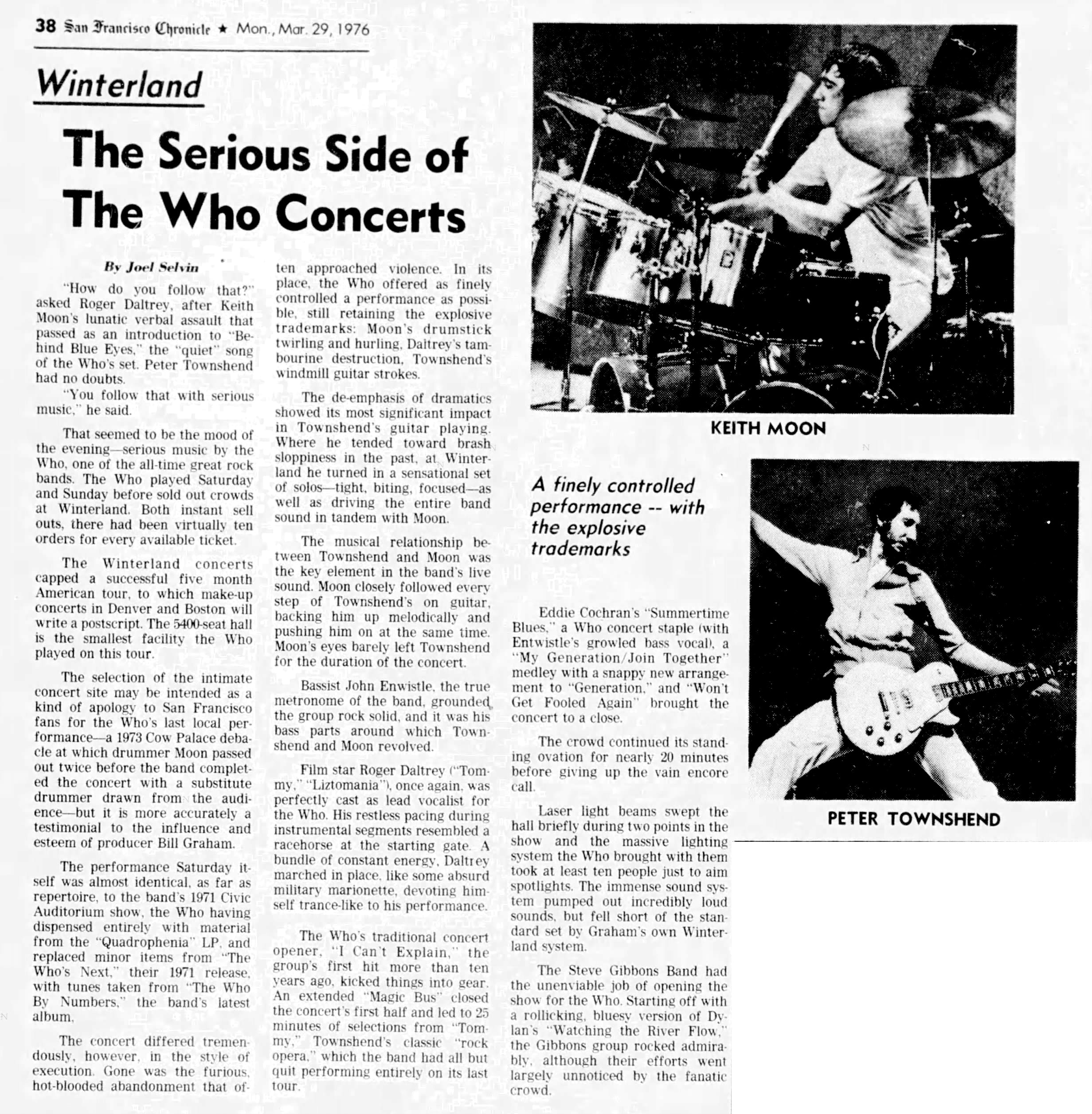
The concert differed tremendously, however, in the style of execution. Gone was the furious, hot-blooded abandonment that often approached violence. In its place, the Who offered as finely controlled a performance as possible, still retaining the explosive trademarks: Moon's drumstick twirling and hurling, Daltrey's tambourine destruction, Townshend's windmill guitar strokes.
The de-emphasis of dramatics showed its most significant impact in Townshend's guitar playing. Where he tended toward brash sloppiness in the past, at Winterland he turned in a sensational set of solos—tight, biting, focused—as well as driving the entire band sound in tandem with Moon.
The musical relationship between Townshend and Moon was the key element in the band's live sound. Moon closely followed every step of Townshend's on guitar, backing him up melodically and pushing him on at the same time. Moon's eyes barely left Townshend for the duration of the concert.
Bassist John Entwistle, the true metronome of the band, grounded the group rock solid, and it was his bass parts around which Townshend and Moon revolved.
Film star Roger Daltrey ("Tommy," "Lisztomania"), once again, was perfectly cast as lead vocalist for the Who. His restless pacing during instrumental segments resembled a racehorse at the starting gate. A bundle of constant energy, Daltrey marched in place, like some absurd military marionette, devoting himself trance-like to his performance.
The Who's traditional concert opener, "I Can't Explain," the group's first hit more than ten years ago, kicked things into gear. An extended "Magic Bus" closed the concert's first half and led to 25 minutes of selections from "Tommy." Townshend's classic "rock opera," which the band had all but quit performing entirely on its last tour.
KEITH MOON
A finely controlled performance — with the explosive trademarks
Eddie Cochran's "Summertime Blues," a Who concert staple (with Entwistle's growled bass vocal), a "My Generation/Join Together" medley with a snappy new arrangement to "Generation," and "Won't Get Fooled Again" brought the concert to a close.
The crowd continued its standing ovation for nearly 20 minutes before giving up the vain encore call.
Laser light beams swept the hall briefly during two points in the show and the massive lighting system the Who brought with them took at least ten people just to aim spotlights. The immense sound system pumped out incredibly loud sounds, but fell short of the standard set by Graham's own Winterland system.
The Steve Gibbons Band had the unenviable job of opening the show for the Who. Starting off with a rollicking, bluesy version of Dylan's "Watching the River Flow," the Gibbons group rocked admirably, although their efforts went largely unnoticed by the fanatic crowd.