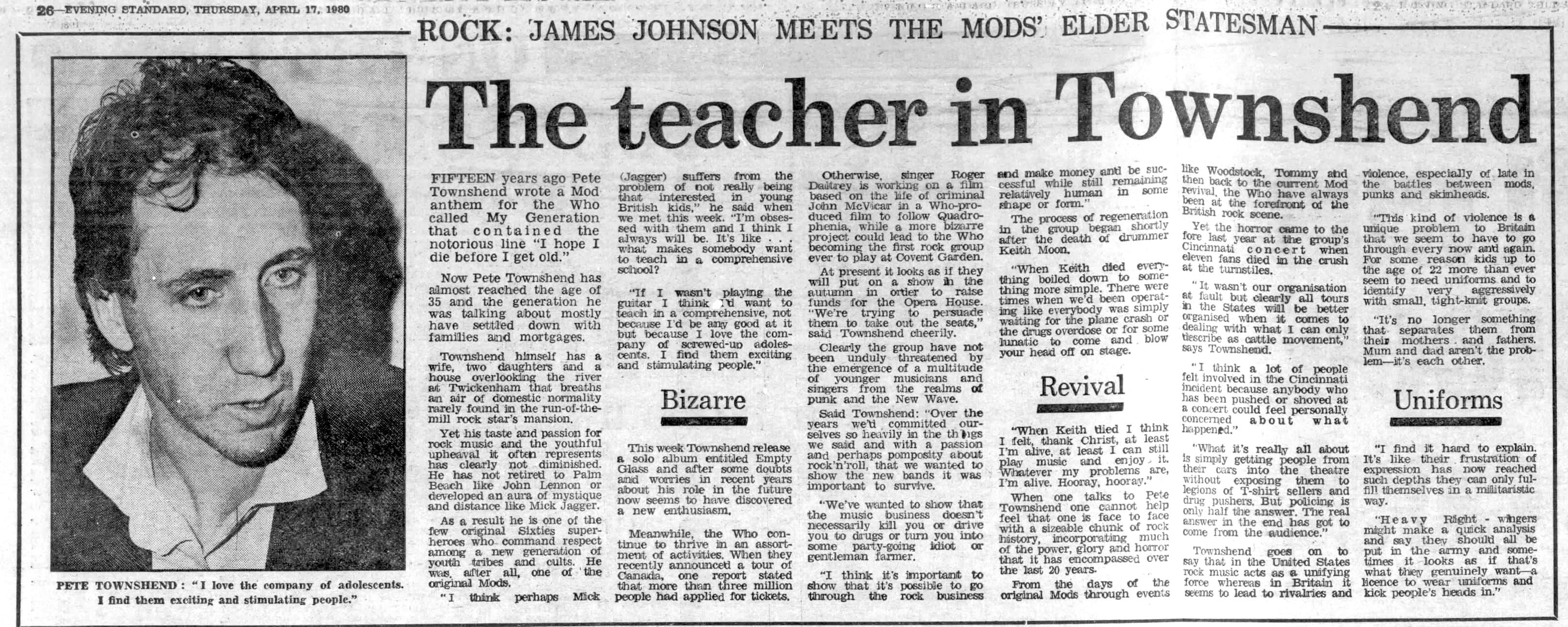
1980-04-17-Evening_Standard
The teacher in Townshend
PETE TOWNSHEND: “I love the company of adolescents. I find them exciting and stimulating people.”
Fifteen years ago Pete Townshend wrote a Mod anthem for the Who called My Generation that contained the notorious line “I hope I die before I get old.”
Now Pete Townshend has almost reached the age of 35 and the generation he was talking about mostly have settled down with families and mortgages.
Townshend himself has a wife, two daughters and a house overlooking the river at Twickenham that breathes an air of domestic normality rarely found in the run-of-the-mill rock star’s mansion.
Yet his taste and passion for rock music and the youthful upheaval it often represents has clearly not diminished. He has not retired to Palm Beach like John Lennon or developed an aura of mystique and distance like Mick Jagger.
As a result he is one of the few original Sixties superheroes who command respect among a new generation of youth tribes and cults. He was, after all, one of the original Mods.
“I think perhaps Mick (Jagger) suffers from the problem of not really being that interested in young British kids,” he said when we met this week. “I’m obsessed with them and I think I always will be. It’s like what makes somebody want to teach in a comprehensive school?
“If I wasn’t playing the guitar I think I’d want to teach in a comprehensive, not because I’d be any good at it but because I love the company of screwed-up adolescents. I find them exciting and stimulating people.”
Bizarre
This week Townshend released a solo album entitled Empty Glass and after some doubts amid worries in recent years about his role in the future now seems to have discovered a new enthusiasm.
Meanwhile, the Who continue to thrive in an assortment of activities. When they recently announced a tour of Canada, one report stated that more than three million people had applied for tickets.
Otherwise, singer Roger Daltrey is working on a film based on the life of criminal John McVicar in a Who-produced film to follow Quadrophenia, while a more bizarre project could lead to the Who becoming the first rock group ever to play at Covent Garden.
At present it looks as if they will put on a show in the autumn in order to raise funds for the Opera House. “We’re trying to persuade them to take out the seats,” said Townshend cheerily.
Clearly the group have not been unduly threatened by the emergence of a multitude of younger musicians and singers from the realms of punk and the New Wave.
Said Townshend: “Over the years we’d committed ourselves so heavily in the things we said and with a passion and perhaps pomposity about rock n’ roll, that we wanted to show the new bands it was important to survive.
“We’ve wanted to show that the music business doesn’t necessarily kill you or drive you to drugs or turn you into some party-going idiot or gentleman farmer.
“I think it’s important to show that it’s possible to go through the rock business and make money and be successful while still remaining relatively human in some shape or form.”
The process of regeneration in the group began shortly after the death of drummer Keith Moon.
“When Keith died everything boiled down to something more simple. There were times when we’d been operating like everybody was simply waiting for the plane crash or the drugs overdose or for some lunatic to come and blow your head off on stage.
Revival
“When Keith died I think I felt, thank Christ, at least I’m alive, at least I can still play music and enjoy it. Whatever my problems are, I’m alive. Hooray, hooray.”
When one talks to Pete Townshend one cannot help feel that one is face to face with a sizeable chunk of rock history, incorporating much of the power, glory and horror that it has encompassed over the last 20 years.
From the days of the original Mods through events like Woodstock, Tommy and back to the current Mod revival, the Who have always been at the forefront of the British rock scene.
Yet the horror came to the fore last year at the group’s Cincinnati concert when eleven fans died in the crush at the turnstiles.
“It wasn’t our organisation at fault but clearly all tours in the States will be better organised when it comes to dealing with what I can only describe as cattle movement,” says Townshend.
“I think a lot of people felt involved in the Cincinnati incident because anybody who has been pushed or shoved at a concert could feel personally concerned about what happened.”
“What it’s really all about is simply getting people from their cars into the theatre without exposing them to legions of T-shirt sellers and drug pushers. But policing is only half the answer. The real answer in the end has got to come from the audience.”
Townshend goes on to say that in the United States rock music acts as a unifying force whereas in Britain it seems to lead to rivalries and violence, especially of late in the battles between mods, punks and skinheads.
“This kind of violence is a unique problem to Britain that we seem to have to go through every now and again. For some reason kids up to the age of 22 more than ever seem to need uniforms and to identify very aggressively with small, tight-knit groups.
“It’s no longer something that separates them from their mothers and fathers. Mum and dad aren’t the problem—it’s each other.
Uniforms
“I find it hard to explain. It’s like their frustration of expression has now reached such depths they can only fulfill themselves in a militaristic way.
“Heavy Right-wingers might make a quick analysis and say they should all be put in the army and sometimes it looks as if that’s what they genuinely want—a licence to wear uniforms and kick people’s heads in.”