1980-06-20-Kingsport_Times – Empty Glass Review
Rock Spotlight / Terry McWilliams
Peter Townshend uses his music to convey message
Alcohol and the Almighty. Those concepts mix together like crude oil and water. They immediately bring to mind a picture of a fundamentalist preacher, waving the Good Book over his head and screaming about how the evils of whiskey will bar entrance into God's paradise.
But there's an evangelist who has managed to whip the two images into a message that flows silkily into the ears of those willing to listen.
He's Pete Townshend, a musician, and he does it on a new solo album with the smoothness of an old pro. Of course, he is a veteran, you would argue, after years of rocking with the Who. Empty Glass allows the versatile guitarist to paint scenes with instruments we normally associate with bending the ole elbow.
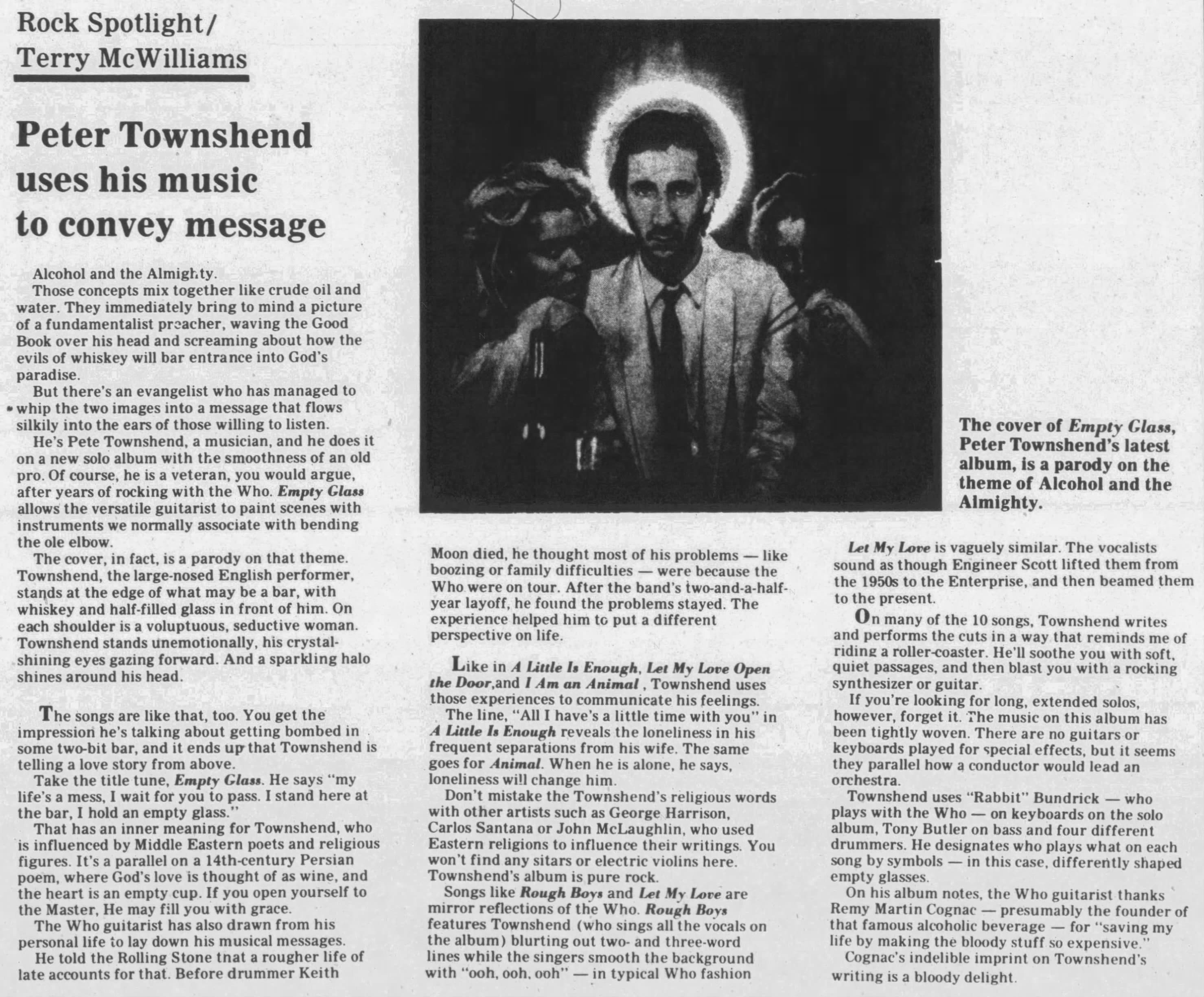
The cover, in fact, is a parody on that theme. Townshend, the large-nosed English performer, stands at the edge of what may be a bar, with whiskey and half-filled glass in front of him. On each shoulder is a voluptuous, seductive woman. Townshend stands unemotionally, his crystal-shining eyes gazing forward. And a sparkling halo shines around his head.
The songs are like that, too. You get the impression he's talking about getting bombed in some two-bit bar, and it ends up that Townshend is telling a love story from above.
Take the title tune, Empty Glass. He says "my life's a mess, I wait for you to pass. I stand here at the bar, I hold an empty glass."
That has an inner meaning for Townshend, who is influenced by Middle Eastern poets and religious figures. It's a parallel on a 14th-century Persian poem, where God's love is thought of as wine, and the heart is an empty cup. If you open yourself to the Master, He may fill you with grace.
The Who guitarist has also drawn from his personal life to lay down his musical messages.
He told the Rolling Stone that a rougher life of late accounts for that. Before drummer Keith Moon died, he thought most of his problems — like boozing or family difficulties — were because the Who were on tour. After the band's two-and-a-half-year layoff, he found the problems stayed. The experience helped him to put a different perspective on life.
Like in A Little Is Enough, Let My Love Open the Door, and I Am an Animal, Townshend uses those experiences to communicate his feelings.
The line, "All I have's a little time with you" in A Little Is Enough reveals the loneliness in his frequent separations from his wife. The same goes for Animal. When he is alone, he says, loneliness will change him.
Don't mistake the Townshend's religious words with other artists such as George Harrison, Carlos Santana or John McLaughlin, who used Eastern religions to influence their writings. You won't find any sitars or electric violins here. Townshend's album is pure rock.
Songs like Rough Boys and Let My Love are mirror reflections of the Who. Rough Boys features Townshend (who sings all the vocals on the album) blurting out two- and three-word lines while the singers smooth the background with "ooh, ooh, ooh" — in typical Who fashion.
Let My Love is vaguely similar. The vocalists sound as though Engineer Scott lifted them from the 1950s to the Enterprise, and then beamed them to the present.
On many of the 10 songs, Townshend writes and performs the cuts in a way that reminds me of riding a roller-coaster. He'll soothe you with soft, quiet passages, and then blast you with a rocking synthesizer or guitar.
If you're looking for long, extended solos, however, forget it. The music on this album has been tightly woven. There are no guitars or keyboards played for special effects, but it seems they parallel how a conductor would lead an orchestra.
Townshend uses "Rabbit" Bundrick — who plays with the Who — on keyboards on the solo album, Tony Butler on bass and four different drummers. He designates who plays what on each song by symbols — in this case, differently shaped empty glasses.
On his album notes, the Who guitarist thanks Remy Martin Cognac — presumably the founder of that famous alcoholic beverage — for "saving my life by making the bloody stuff so expensive."
Cognac's indelible imprint on Townshend's writing is a bloody delight.