1980-04-29-St_Louis_Post_Dispatch
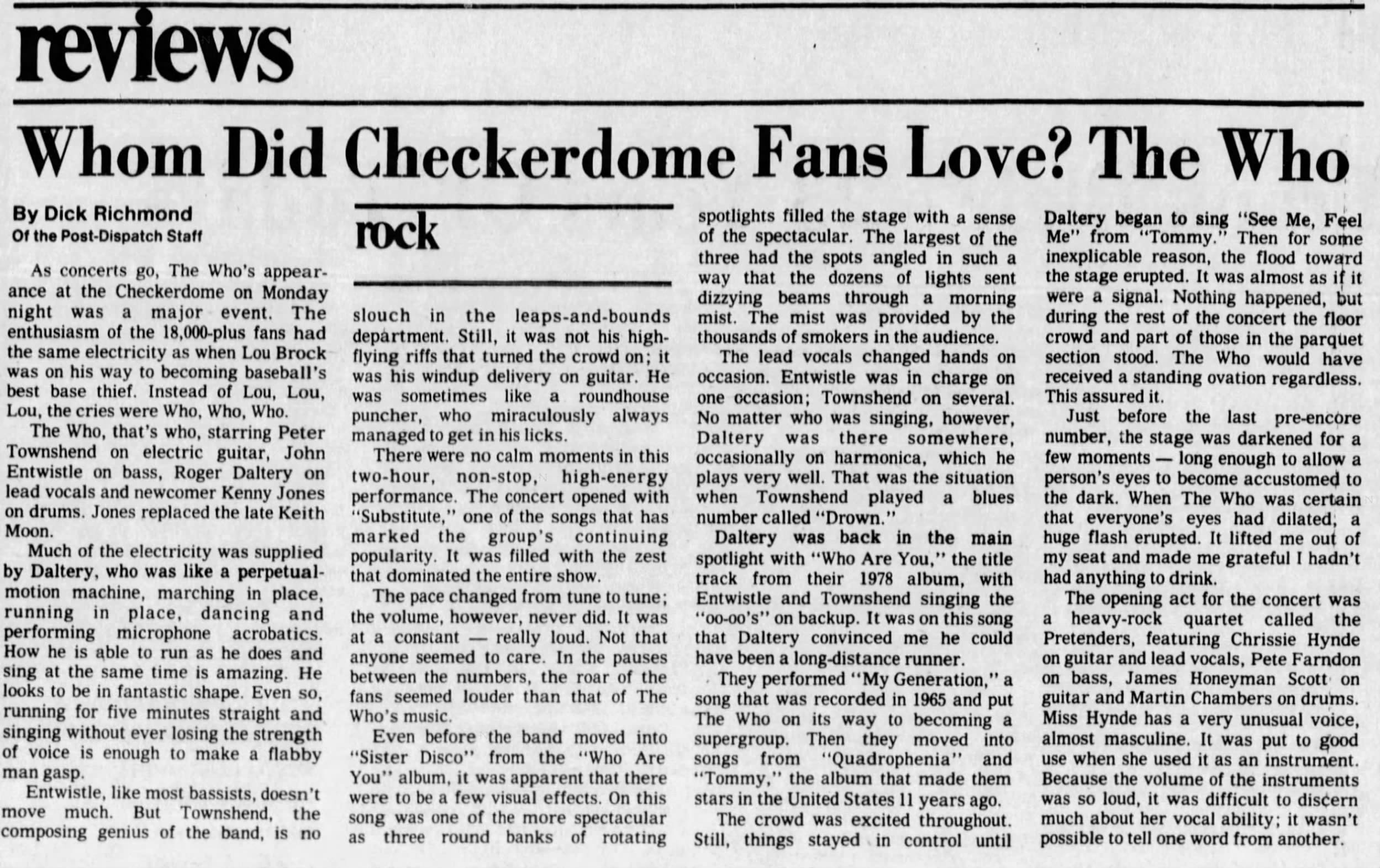
As concerts go, The Who's appearance at the Checkerdome on Monday night was a major event. The enthusiasm of the 18,000-plus fans had the same electricity as when Lou Brock was on his way to becoming baseball's best base thief. Instead of Lou, Lou, Lou, the cries were Who, Who, Who.
The Who, that's who, starring Peter Townshend on electric guitar, John Entwistle on bass, Roger Daltery on lead vocals and newcomer Kenny Jones on drums. Jones replaced the late Keith Moon.
Much of the electricity was supplied by Daltery, who was like a perpetual-motion machine, marching in place, running in place, dancing and performing microphone acrobatics. How he is able to run as he does and sing at the same time is amazing. He looks to be in fantastic shape. Even so, running for five minutes straight and singing without ever losing the strength of voice is enough to make a flabby man gasp.
Entwistle, like most bassists, doesn't move much. But Townshend, the composing genius of the band, is no rock slouch in the leaps-and-bounds department. Still, it was not his high-flying riffs that turned the crowd on; it was his windup delivery on guitar. He was sometimes like a roundhouse puncher, who miraculously always managed to get in his licks.
There were no calm moments in this two-hour, non-stop, high-energy performance. The concert opened with "Substitute," one of the songs that has marked the group's continuing popularity. It was filled with the zest that dominated the entire show.
The pace changed from tune to tune; the volume, however, never did. It was at a constant — really loud. Not that anyone seemed to care. In the pauses between the numbers, the roar of the fans seemed louder than that of The Who's music.
Even before the band moved into "Sister Disco" from the "Who Are You" album, it was apparent that there were to be a few visual effects. On this song was one of the more spectacular as three round banks of rotating spotlights filled the stage with a sense of the spectacular. The largest of the three had the spots angled in such a way that the dozens of lights sent dizzying beams through a morning mist. The mist was provided by the thousands of smokers in the audience.
The lead vocals changed hands on occasion. Entwistle was in charge on one occasion; Townshend on several. No matter who was singing, however, Daltery was there somewhere, occasionally on harmonica, which he plays very well. That was the situation when Townshend played a blues number called "Drown."
Daltery was back in the main spotlight with "Who Are You," the title track from their 1978 album, with Entwistle and Townshend singing the "oo-oo's" on backup. It was on this song that Daltery convinced me he could have been a long-distance runner.
They performed "My Generation," a song that was recorded in 1965 and put The Who on its way to becoming a supergroup. Then they moved into songs from "Quadrophenia" and "Tommy," the album that made them stars in the United States 11 years ago.
The crowd was excited throughout. Still, things stayed in control until Daltery began to sing "See Me, Feel Me" from "Tommy." Then for some inexplicable reason, the flood toward the stage erupted. It was almost as if it were a signal. Nothing happened, but during the rest of the concert the floor crowd and part of those in the parquet section stood. The Who would have received a standing ovation regardless. This assured it.
Just before the last pre-encore number, the stage was darkened for a few moments — long enough to allow a person's eyes to become accustomed to the dark. When The Who was certain that everyone's eyes had dilated; a huge flash erupted. It lifted me out of my seat and made me grateful I hadn't had anything to drink.
The opening act for the concert was a heavy-rock quartet called the Pretenders, featuring Chrissie Hynde on guitar and lead vocals, Pete Farndon on bass, James Honeyman Scott on guitar and Martin Chambers on drums. Miss Hynde has a very unusual voice, almost masculine. It was put to good use when she used it as an instrument. Because the volume of the instruments was so loud, it was difficult to discern much about her vocal ability; it wasn't possible to tell one word from another.