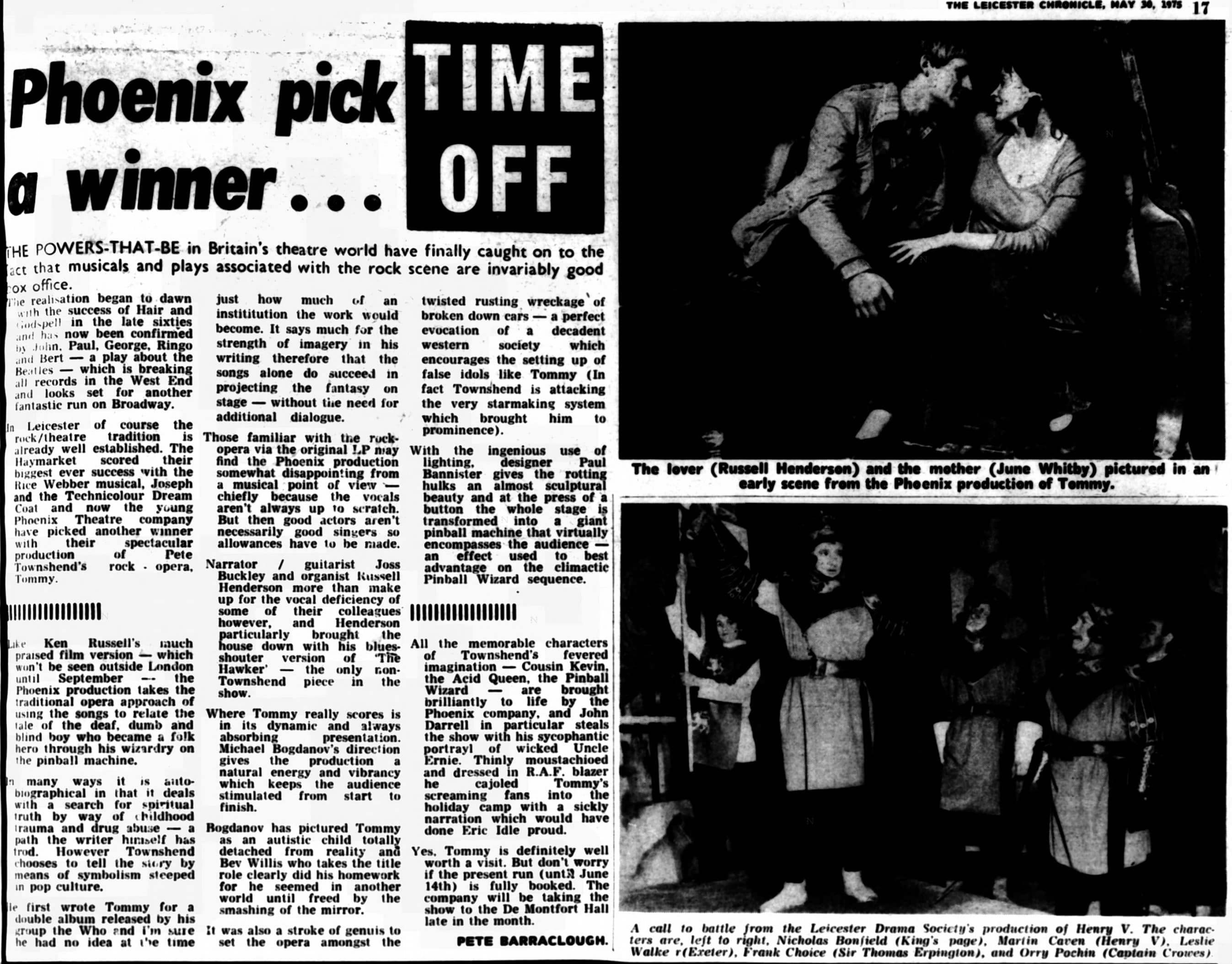
1975-05-30-Leicester_Chronicle
THE POWERS-THAT-BE in Britain's theatre world have finally caught on to the fact that musicals and plays associated with the rock scene are invariably good box office.
The realisation began to dawn with the success of Hair and Idspell in the late sixties and has now been confirmed by John, Paul, George, Ringo and Bert — a play about the Beatles — which is breaking all records in the West End and looks set for another fantastic run on Broadway.
In Leicester of course the rock/theatre tradition is already well established. The Haymarket scored their biggest ever success with the Rice Webber musical, Joseph and the Technicolour Dream Coat and now the Young Phoenix Theatre company have picked another winner with their spectacular production of Pete Townshend's rock – opera, Tommy.
Ken Russell's much praised film version — which won't be seen outside London until September — the Phoenix production takes the traditional opera approach of using the songs to relate the tale of the deaf, dumb and blind boy who became a folk hero through his wizardry on the pinball machine.
In many ways it is autobiographical in that it deals with a search for spiritual truth by way of childhood trauma and drug abuse — a path the writer himself has trod. However Townshend chooses to tell the story by means of symbolism steeped in pop culture.
He first wrote Tommy for a double album released by his group the Who and I'm sure he had no idea at the time just how much of an institution the work would become. It says much for the strength of imagery in his writing therefore that the songs alone do succeed in projecting the fantasy on stage — without the need for additional dialogue.
Those familiar with the rock-opera via the original LP may find the Phoenix production somewhat disappointing from a musical point of view — chiefly because the vocals aren't always up to scratch. But then good actors aren't necessarily good singers so allowances have to be made.
Narrator and guitarist Joss Buckley and organist Russell Henderson more than make up for the vocal deficiency of some of their colleagues however, and Henderson particularly brought the house down with his blues shouter version of "The Hawker" — the only non-Townshend piece in the show.
Where Tommy really scores is in its dynamic and always absorbing presentation. Michael Bogdanov's direction gives the production a natural energy and vibrancy which keeps the audience stimulated from start to finish.
Bogdanov has pictured Tommy as an autistic child totally detached from reality and Bev Willis who takes the title role clearly did his homework for he seemed in another world until freed by the smashing of the mirror.
It was also a stroke of genius to set the opera amongst the twisted rusting wreckage of broken down cars — a perfect evocation of a decadent western society which encourages the setting up of false idols like Tommy (In fact Townshend is attacking the very starmaking system which brought him to prominence).
With the ingenious use of lighting, designer Paul Bannister gives the rotting hulks an almost sculptural beauty and at the press of a button the whole stage is transformed into a giant pinball machine that virtually encompasses the audience — an effect used to best advantage on the climactic Pinball Wizard sequence.
All the memorable characters of Townshend's fevered imagination — Cousin Kevin, the Acid Queen, the Pinball Wizard — are brought brilliantly to life by the Phoenix company, and John Darrell in particular steals the show with his sycophantic portrayal of wicked Uncle Ernie. Thinly moustachioed and dressed in R.A.F. blazer he cajoled Tommy's screaming fans into the holiday camp with a sickly narration which would have done Eric Idle proud.
Yes, Tommy is definitely well worth a visit. But don't worry if the present run (until June 14th) is fully booked. The company will be taking the show to the De Montfort Hall late in the month.