1989-07-02-The_Baltimore_Sun_2
WHO, from 1J home), they had better be prepared to suffer the ill-will of those who believe there is more to the Who than three musicians and a band name.
Musically, there’s plenty of reason to be wary of the current vintage Who, not the least of which being that Townshend won’t be grinding out the ear-crushing powerchords that were once his stock-in-trade.
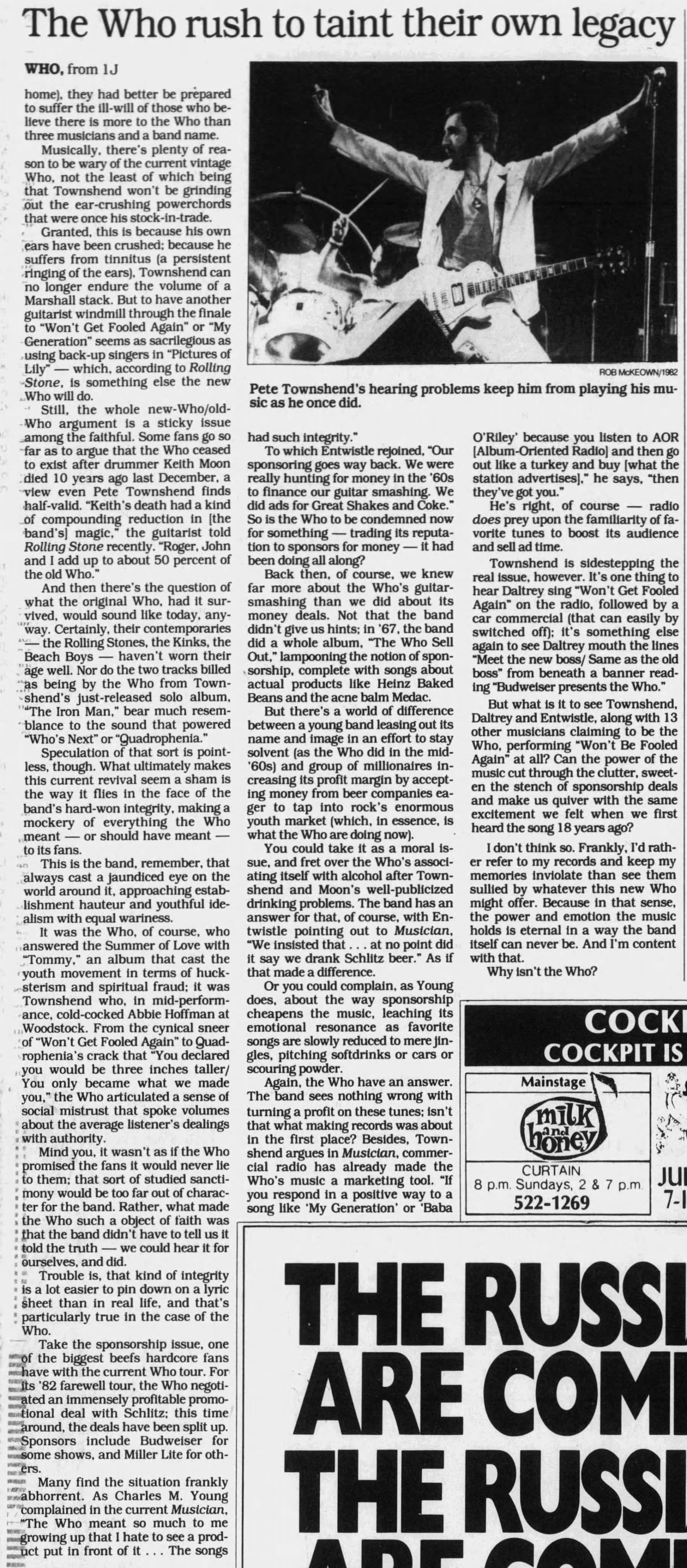
Granted, this is because his own ears have been crushed; because he suffers from tinnitus (a persistent ringing of the ears), Townshend can no longer endure the volume of a Marshall stack. But to have another guitarist windmill through the finale to “Won't Get Fooled Again” or “My Generation” seems as sacrilegious as using back-up singers in “Pictures of Lily” — which, according to Rolling Stone, is something else the new Who will do.
Still, the whole new-Who/old-Who argument is a sticky issue among the faithful. Some fans go so far as to argue that the Who ceased to exist after drummer Keith Moon died 10 years ago last December, a view even Pete Townshend finds half-valid. “Keith's death had a kind of compounding reduction in [the band's] magic,” the guitarist told Rolling Stone recently. “Roger, John and I add up to about 50 percent of the old Who.”
And then there’s the question of what the original Who, had it survived, would sound like today, anyway. Certainly, their contemporaries — the Rolling Stones, the Kinks, the Beach Boys — haven’t worn their age well. Nor do the two tracks billed as being by the Who from Townshend’s just-released solo album, “The Iron Man,” bear much resemblance to the sound that powered “Who’s Next” or “Quadrophenia.”
Speculation of that sort is pointless, though. What ultimately makes this current revival seem a sham is the way it flies in the face of the band’s hard-won integrity, making a mockery of everything the Who meant — or should have meant — to its fans.
This is the band, remember, that always cast a jaundiced eye on the world around it, approaching establishment hauteur and youthful idealism with equal wariness.
It was the Who, of course, who answered the Summer of Love with “Tommy,” an album that cast the youth movement in terms of hucksterism and spiritual fraud; it was Townshend who, in mid-performance, cold-cocked Abbie Hoffman at Woodstock. From the cynical sneer of “Won't Get Fooled Again” to Quadrophenia's crack that “You declared you would be three inches taller/ You only became what we made you,” the Who articulated a sense of social mistrust that spoke volumes about the average listener’s dealings with authority.
Mind you, it wasn’t as if the Who promised the fans it would never lie to them; that sort of studied sanctimony would be too far out of character for the band. Rather, what made the Who such a object of faith was that the band didn’t have to tell us it told the truth — we could hear it for ourselves, and did.
Trouble is, that kind of integrity is a lot easier to pin down on a lyric sheet than in real life, and that’s particularly true in the case of the Who.
Take the sponsorship issue, one of the biggest beefs hardcore fans have with the current Who tour. For its ’82 farewell tour, the Who negotiated an immensely profitable promotional deal with Schlitz; this time around, the deals have been split up. Sponsors include Budweiser for some shows, and Miller Lite for others.
Many find the situation frankly abhorrent. As Charles M. Young complained in the current Musician, “The Who meant so much to me growing up that I hate to see a product put in front of it . . . The songs
[photo caption] Pete Townshend’s hearing problems keep him from playing his music as he once did.
had such integrity.”
To which Entwistle rejoined, “Our sponsoring goes way back. We were really hunting for money in the ’60s to finance our guitar smashing. We did ads for Great Shakes and Coke.” So is the Who to be condemned now for something — trading its reputation to sponsors for money — it had been doing all along?
Back then, of course, we knew far more about the Who’s guitarsmashing than we did about its money deals. Not that the band didn't give us hints: in ’67, the band did a whole album, “The Who Sell Out,” lampooning the notion of sponsorship, complete with songs about actual products like Heinz Baked Beans and the acne balm Medac.
But there’s a world of difference between a young band leasing out its name and image in an effort to stay solvent (as the Who did in the mid-’60s) and group of millionaires increasing its profit margin by accepting money from beer companies eager to tap into rock’s enormous youth market (which, in essence, is what the Who are doing now).
You could take it as a moral issue, and fret over the Who’s associating itself with alcohol after Townshend and Moon’s well-publicized drinking problems. The band has an answer for that, of course, with Entwistle pointing out to Musician, “We insisted that . . . at no point did it say we drank Schlitz beer.” As if that made a difference.
Or you could complain, as Young does, about the way sponsorship cheapens the music, leaching its emotional resonance as favorite songs are slowly reduced to mere jingles, pitching softdrinks or cars or scouring powder.
Again, the Who have an answer. The band sees nothing wrong with turning a profit on these tunes; isn’t that what making records was about in the first place? Besides, Townshend argues in Musician, commercial radio has already made the Who’s music a marketing tool. “If you respond in a positive way to a song like ‘My Generation’ or ‘Baba O’Riley’ because you listen to AOR [Album-Oriented Radio] and then go out like a turkey and buy [what the station advertises],” he says, “then they’ve got you.”
He’s right, of course — radio does prey upon the familiarity of favorite tunes to boost its audience and sell ad time.
Townshend is sidestepping the real issue, however. It’s one thing to hear Daltrey sing “Won’t Get Fooled Again” on the radio, followed by a car commercial (that can easily by switched off); it’s something else again to see Daltrey mouth the lines “Meet the new boss/ Same as the old boss” from beneath a banner reading “Budweiser presents the Who.”
But what is it to see Townshend, Daltrey and Entwistle, along with 13 other musicians claiming to be the Who, performing “Won’t Be Fooled Again” at all? Can the power of the music cut through the clutter, sweeten the stench of sponsorship deals and make us quiver with the same excitement we felt when we first heard the song 18 years ago?
I don’t think so. Frankly, I’d rather refer to my records and keep my memories inviolate than see them sullied by whatever this new Who might offer. Because in that sense, the power and emotion the music holds is eternal in a way the band itself can never be. And I’m content with that.
Why isn’t the Who?