1989-08-31-Florida_Today_1
THE WHO
After the fire, the fire still burns
FLORIDA TODAY
Earlier this summer, as a trio of aging British rockers called The Who prepared to reunite for a 25th anniversary tour, lead guitarist Pete Townshend sounded a bit crochety, if not downright middle aged, about the impending rendezvous with his g-g-generation.
No, insisted the 44-year-old London book editor, there would be none of this windmilling business, that majestic, sweeping, stiff-armed trademark clanging of the chords that corrupted the youth of the '60s in small ways by introducing them to the air guitar. He said he was tired of the days of watching chunks of flesh explode from his fingertips.
Furthermore, Townshend groused about how his eardrums were shot (The Who made "The Guinness Book of World Records", in 1976 after uncorking a 76,000-watt performance registering a teeth-clattering 120 decibels 55 yards away from the speakers). He warned that he was planning to rely almost exclusively on his acoustic six-string Fender.
This time around, he added, there would be backup singers and a four-piece horn section (horns???) oiling The Who's familiar melodies with what appeared to be an ominous amount of lubricant. In short, as the band prepared to swing south for its Florida tour over the weekend — Tampa on Saturday, Miami on Sunday — the mind's eye conjured images of The Who's some what arthritic Live Aid performance in 1985.
During that watershed event, a sense of history compelled The Who to reluctantly reunite three years after their '82 Farewell Tour. But the guys — lead singer Roger Daltrey, bassist John Entwistle, Townshend, and drummer Kenney Jones — were clearly not into it, and the best that could be said about the performance is that it lasted only 15 minutes.
True, the band was never the same after original drummer Keith Moon dropped dead in 1978 following an overdose of medication to cure his alcohol addiction. But if The Who's creative edge in the studio lost its focus during the ensuing four years, it didn't seem to matter to audiences. They could still draw a crowd; 11 fans were crushed to death during a 1979 stampede in Cincinnati.
Three years later, the band announced it was breaking up because they were drained creatively and had nothing left to prove, which was absolutely true.
As performing artists, they had elevated anger as an attitude onto an uncharted plateau; Townshend first turned his guitar into a mallet in January 1965 by smashing it on television.
In the studio, the summits included 1969's "Tommy," the first rock opera, and in 1973, "Quadrophenia," which charted the rat-race of restless characters from Townshend's childhood, the Mods. Both projects made their way into film.
Individually, however, scenes from life as retired rockers looked unnatural, at least to those who never knew them any other way.
Robin Leach interviewed Entwistle at his castle, giving viewers a glimpse of a man who didn't
THE WAY THEY ARE, 1989
[TAMPA CONCERT photo of Pete Townshend, left, and Roger Daltrey, right]
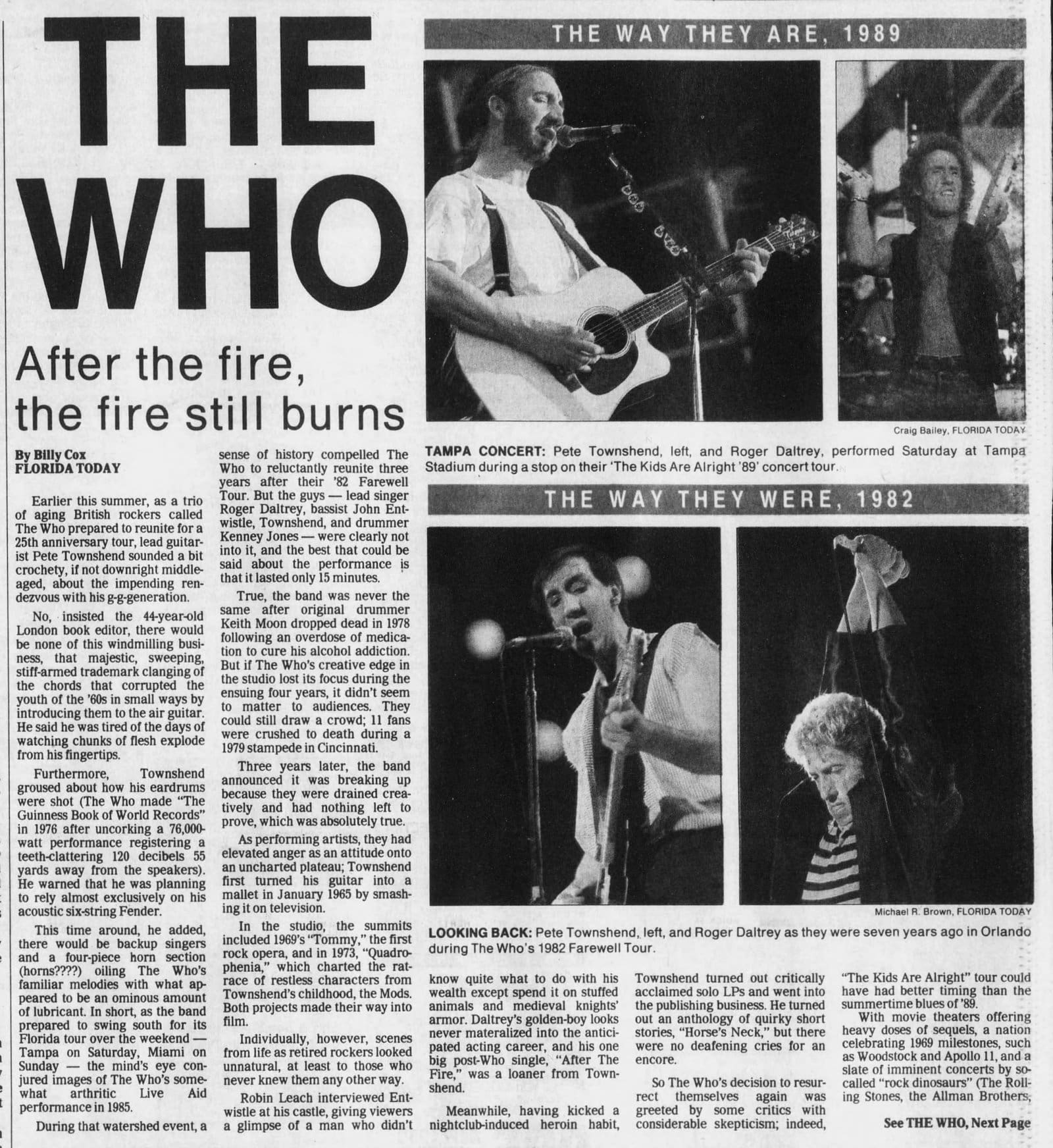
TAMPA CONCERT: Pete Townshend, left, and Roger Daltrey, performed Saturday at Tampa Stadium during a stop on their 'The Kids Are Alright '89' concert tour.
THE WAY THEY WERE, 1982
[photo of Townshend singing in 1982 and Daltrey with arms raised]
Michael R. Brown, FLORIDA TODAY
LOOKING BACK: Pete Townshend, left, and Roger Daltrey as they were seven years ago in Orlando during The Who's 1982 Farewell Tour.
know quite what to do with his wealth except spend it on stuffed animals and medieval knights' armor. Daltrey's golden-boy looks never materialized into the anticipated acting career, and his one big post-Who single, "After The Fire," was a loaner from Townshend.
Meanwhile, having kicked a nightclub-induced heroin habit,
Townshend turned out critically acclaimed solo LPs and went into the publishing business. He turned out an anthology of quirky short stories, "Horse's Neck," but there were no deafening cries for an encore.
So The Who's decision to resurrect themselves again was greeted by some critics with considerable skepticism; indeed,
"The Kids Are Alright" tour could have had better timing than the summertime blues of '89.
With movie theaters offering heavy doses of sequels, a nation celebrating 1969 milestones, such as Woodstock and Apollo 11, and a slate of imminent concerts by socalled "rock dinosaurs" (The Rolling Stones, the Allman Brothers,