1989-07-31-South_Florida_Sun_Sentinel_2.jpg
There was no norm for Who followers on Sunday night.
Duffey sucked Budweisers among the thousands like them who jammed the parking lot as early as 4 p.m. for the show that cranked up at 7:30. They said they camped out at a record store to get tickets to the show; said that camping out, like hanging out before the concert, was "a party and a half."
They looked around them at gray heads and pimply heads and considered the link:
Songs like Baba O'Riley (better known as Teenage Wasteland), Mike said, are "just about society in general. About freedom. About being yourself."
And here's the real connection. The Who, said the two and others like them, "are rebels."
Consider that. John Entwistle, balding and gray. Pete Townshend, deafened by rock 'n' roll. Roger Daltrey, looking less than his mid-40s, but there nonetheless. Rebels.
And if they're blamed with trying to make a quick few million on their way to rock 'n' roll retirement (again), well, Daltrey said it many years ago: "People try to pu, put us down …"
"Hey," Scott said. "How long can you be a rebel? If people follow you, I guess you're the norm."
There was no norm on The Who followers Sunday night.
For every Scott and Mike, there was an Ernie Edson, 34, who admitted with no small chagrin that the last concert he saw was Johnny Mathis.
Edson was seeing The Who for the first time even though he has followed them since their beginning. He used to think about Magic Bus while hitchhiking to see his girlfriend. He used to go hear Grand Funk Railroad and groups like that who caught the fire from The Who, but burned out a lot quicker.
"Roger looks better than he ever has," Edson said. The ones who were there at the beginning call The Who by their first names.
And then there were those like Rhonda Sinclair, at 27, somewhere between the teen-agers and the old-timers. Somewhere in a group that adopted the spirit of Teenage Wasteland, without having inspired it.
"I can look back and say that a certain period was kind of a wasteland," Sinclair said. "In a later time, you look back and say, 'Maybe I didn't have my priorities straight.' I missed a lot of things – honor roll, scholarships – things that didn't seem important at the time."
So maybe that's what brought them, the old fans and the new fans. Maybe it was a chance for the old ones to see if they'd been wrong the first time around. Maybe it turns out to be OK that they misplaced priorities. If not, then maybe Roger and John and Pete wouldn't be up on that stage.
And maybe the young ones were there looking for confirmation that it's OK to play loose. It's OK to overheat your junker now, you can still breeze by in a Volvo in 25 years.
Yeah, that's it. Go ahead and hope you die before you get old, 'cause, look around you at this concert, you ain't going to.
Randy Rhodes, 23, wore a Pink Floyd T-shirt and sipped a Heineken with his friend Debbie Lorey, who is 20. He said he came to see The Who because "they spoke their minds. And they lived how they wanted to live."
In a way, he was there to pay homage, like looking back at the caveman and saying thanks for discovering fire and the wheel and all that.
Because, Rhodes said, today's kids wouldn't have a voice in their wasteland "if it wasn't for that type of youth movement back then."
But, Randy, Debbie, these guys could be your parents.
"Those guys are a lot younger than my mom's 45," Rhodes said.
Morgan Russell was part of a group of eight happy professionals ages 24 to 45 nibbling carrot sticks and celery, drinking white wine outside their Chevy camper van. "It's like coming to a class reunion."
Jim Templeton, 20-ish, was there with a rowdier group drinking beer from a keg: "Hey, it's the summer and this is a concert. And it's THE WHO!"
Airman First Class Rob Sawgling was there dressed in cut-off camouflage fatigues and a Who T-shirt, there because he said he's "a Mod." Said that he and one other guy are the only ones at Avon Park Bombing Range who have scooters just like the ones used in The Who movie Quadrophenia. Said that he practices The Who message, even as he helps practice dropping bombs. Said that this is the message: "Be cool and stay cool and everything else like that."
The younger ones wore tie-dye. The older ones wore designer labels.
Limos disgorged rich-looking women in bottle-processed hair and leather dresses on their way to skyboxes. Blue-collar guys with red eyes staggered to sky-high seats.
Most went the distance with The Who. But some were history before the first note, dancing with lawmen, screaming "What'd I do?" on their way to detention in the bowels of Joe Robbie Stadium.
But they all came with their peculiar Who notions. Some with memories. Some wanting proof. All because, hey, this is The Who and this is their last time around, one dead and one deaf but still the patrons of this legacy that is theirs because they sing about my generation. Any generation.
REVIEW FROM PAGE 1D
Show a reminder of why classic hits remain popular
Opening with an extremely condensed version of Tommy, it was obvious from the start that this would be an evening of power rock, '70s-style.
And that, in and of itself, was quite refreshing. Minus the big hair, makeup and absurd posturing – hallmarks of so many '80s bands – the show served as a potent reminder of why classic hits and the stars who wrote them remain so popular.
From the first intoxicating chords of Overture, the band was off and running. Playing far less of Tommy than they performed in previous cities, The Who likely was making up for the late start time. Though the show was called for 7 p.m., severe traffic snarls caused many fans to arrive late.
The seven songs selected from Tommy were the most easily recognizable, among them It's a Boy, The Acid Queen, Pinball Wizard and the rebellious set-closer, We're Not Gonna Take It.
From there, it was on with the show: Let My Love Open the Door and a stream of other Album Rock staples. About this time, the sun finally set and the group's three mammoth video screens kicked in. This was the usual, much-appreciated benefit for those seated far from the stage, but more importantly this tour serves as a showcase for the growing art form of concert videography.
Though all three members of The Who looked the part of men lowing, mid-40s rockers, there was no apparent shortage of onstage energy, particularly from Daltrey and Townshend.
This was exemplified as they swung into the final, raging section of Who Are You, when a manic Daltrey gave himself an intense aerobic workout, which may explain why he looks so good at his age. Though vocally a bit rough around the edges, he's also still one of the best screamers in rock. These two traits were all he needed to carry the evening, particularly as he let out the climactic wail that frames Won't Get Fooled Again.
Townshend, too, displayed an explosive energy at times. Though he said he wouldn't do it, he unleashed the first of many flesh-flinging guitar windmills during the powerful conclusion of I'm a Man, the old Bo Diddley song.
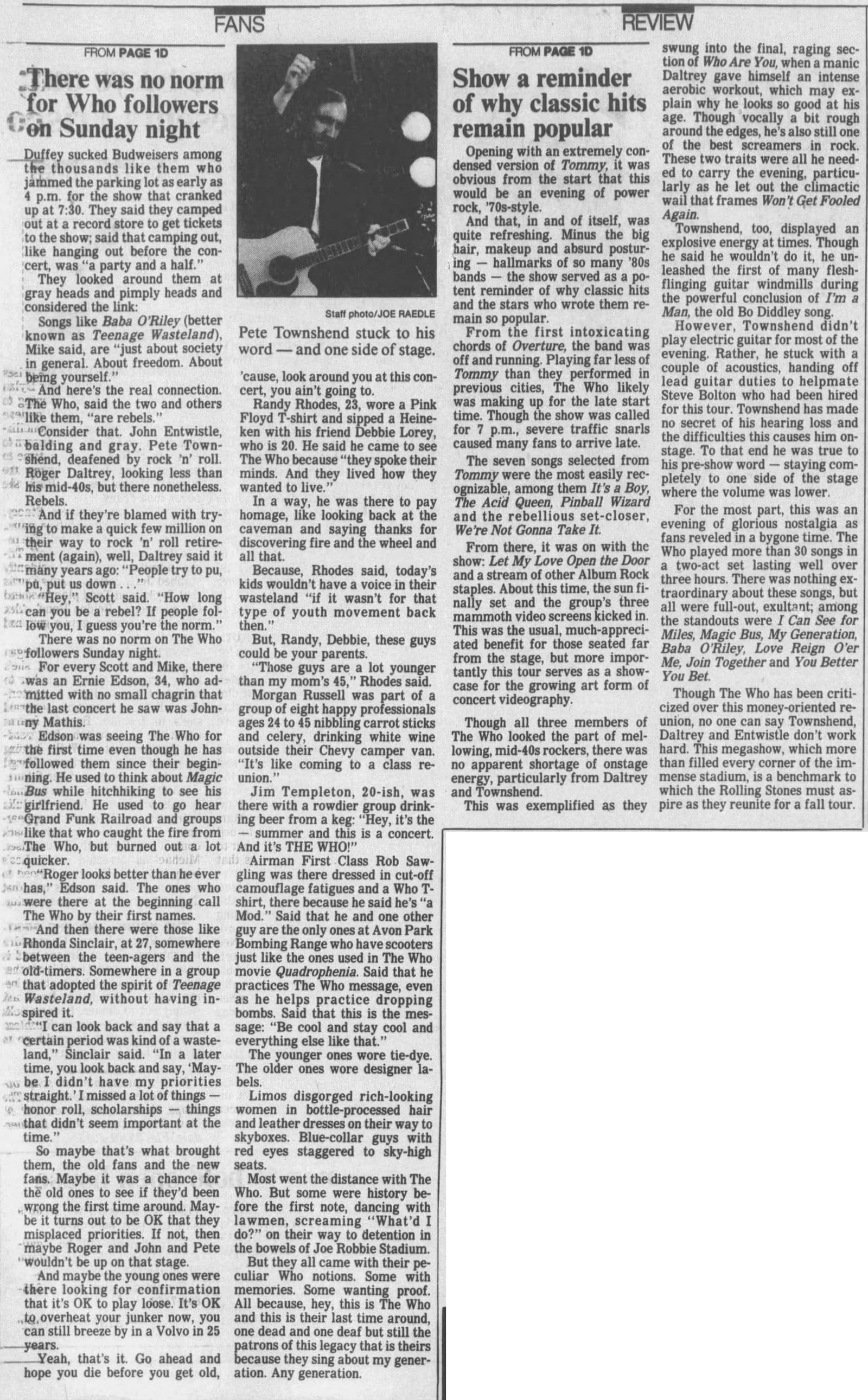
However, Townshend didn't play electric guitar for most of the evening. Rather, he stuck with a couple of acoustics, handing off lead guitar duties to helpmate Steve Bolton who had been hired for this tour. Townshend has made no secret of his hearing loss and the difficulties this causes him onstage. To that end he was true to his pre-show word – staying completely to one side of the stage where the volume was lower.
For the most part, this was an evening of glorious nostalgia as fans reveled in a bygone time. The Who played more than 30 songs in a two-act set lasting well over three hours. There was nothing extraordinary about these songs, but all were full-out, exultant; among the standouts were I Can See for Miles, Magic Bus, My Generation, Baba O'Riley, Love Reign O'er Me, Join Together and You Better You Bet.
Though The Who has been criticized over this money-oriented reunion, no one can say Townshend, Daltrey and Entwistle don't work hard. This megashow, which more than filled every corner of the immense stadium, is a benchmark to which the Rolling Stones must aspire as they reunite for a fall tour.