1982-06-24-Intelligencer_Journal-Chinese_Eyes_Review
Consider Pete Townshend's career. As the mastermind and chief songwriter of The Who, Townshend first steered the band through a period dominated by incredible singles, including "My Generation," "I'm a Boy," "Happy Jack," "I Can See for Miles," "Magic Bus" and "The Kids Are Alright."
When the band was still struggling for recognition in the United States, Townshend expanded his horizons and the result was "The Who Sell Out," one of rock's early concept albums and a record that still sparkles with the flash of originality.
Townshend then trained his eyes on a larger project and unleashed "Tommy," rock's first full-blown opera, on an unsuspecting world. "Tommy," aside from the great single, "Pinball Wizard," wasn't an immediate sensation, but as symphonies began to record it and directors began to film it, The Who were finally established as one of rock's best and most original acts.
The focus narrowed on their next project and the band gave birth to "Who's Next," generally considered one of the best rock albums ever recorded. Some call it the best rock album, and they would get no argument here.
For his next project, Townshend glanced backward at the calamitous rock scene that gave birth to The High Numbers, the name the members of The Who first recorded under, and chronicled the years when the Mods and Rockers battled on the beaches and in the streets of England.
"Quadrophenia," certainly Townshend's most ambitious work, was met with puzzling stares when first released in 1973. The two-record opus has aged well and should be remembered as The Who's high water mark.
Following the release of "Quadrophenia," Townshend ran into philosophical troubles as he began pondering the ramifications of the rock 'n' roll life he had led. The most troubling question he faced was how to deal with his role as Pete Townshend, the aging rock star.
As expected, Townshend never flinched and the result was "The Who By Numbers," perhaps the band's most endearing and sensitive record. It was easily the most personal statement Townshend had ever committed to vinyl.
Admittedly, The Who's career has flagged since that record and the problems within the band were compounded by the death of drummer Keith Moon.
But Townshend continues and has managed some stellar projects apart from the band. There was "Rough Mix," a collaboration with Ronnie Lane, formerly of The Faces, that is one of rock's little-known gems, and "Empty Glass," a solo record that was one of the freshest releases of 1980.
So there you have it 6 a capsule history of the windmilling guitarist that sketches the foundation for a statement like: "Pete Townshend is the wisest man in rock 'n' roll."
Townshend, at 37, remains the most committed musician playing rock 'n' roll today. He's committed to the music itself, to its fans and, most importantly, to his essential role within its sprawling structure.
Because of the size of that commitment, Townshend also understands the music better than anybody else and has arguably been the musician who has used it with the most intelligence of his contemporaries.
That intelligence is abundantly evident on his new solo record, "All the Best Cowboys Have Chinese Eyes." It is a richly satisfying record that is his most personal since "The Who By Numbers."
Judging from a recent interview in "Rolling Stone," Townshend has just concluded a difficult two-year period rife with personal problems and drug and alcohol abuse.
That struggle is documented here, but with none of the sanctimonious soul searching most rock stars indulge in. As usual, Townshend's insights are sharply focused and unapologetic.
Like any good writer, Townshend has the ability to step back, take a deep breath and examine, without prejudice, the joys and sorrows that serve as the signposts of his life. That becomes the material for his songs and, because he is blessed with tremendous communication skills, Townshend consistently manages to cast his ideas and emotions in a way that reflects originality and sparks thought. His humor, which has always been a constant companion, is sprinkled throughout.
Generally, Townshend's solo efforts have eschewed the power-chording sensibilities of The Who's more familiar songs. Although there are hard rock songs on "Chinese Eyes," like "Communication," "Exquisitely Bored" and "Stardom in Action," Townshend generally aims for a softer sound employing guitar and keyboards to equal effect.
Three of the more striking songs on the record are "Face Dances Part II," "Somebody Saved Me" and "Slit Skirts."
While "Face Dances Part II" is generally a light affair, the other two serve as the core of the record, both musically and lyrically. The two verbose songs
"Chinese Eyes" is a good record that is highly recommended. His commitment to rock 'n' roll continues and he simply keeps adding chapter upon chapter to the great book he began writing when he was described as resembling "a nose on a stick."
Let's hope the conclusion is somewhere in the far-off distance. Townshend isn't growing old, he's maturing.
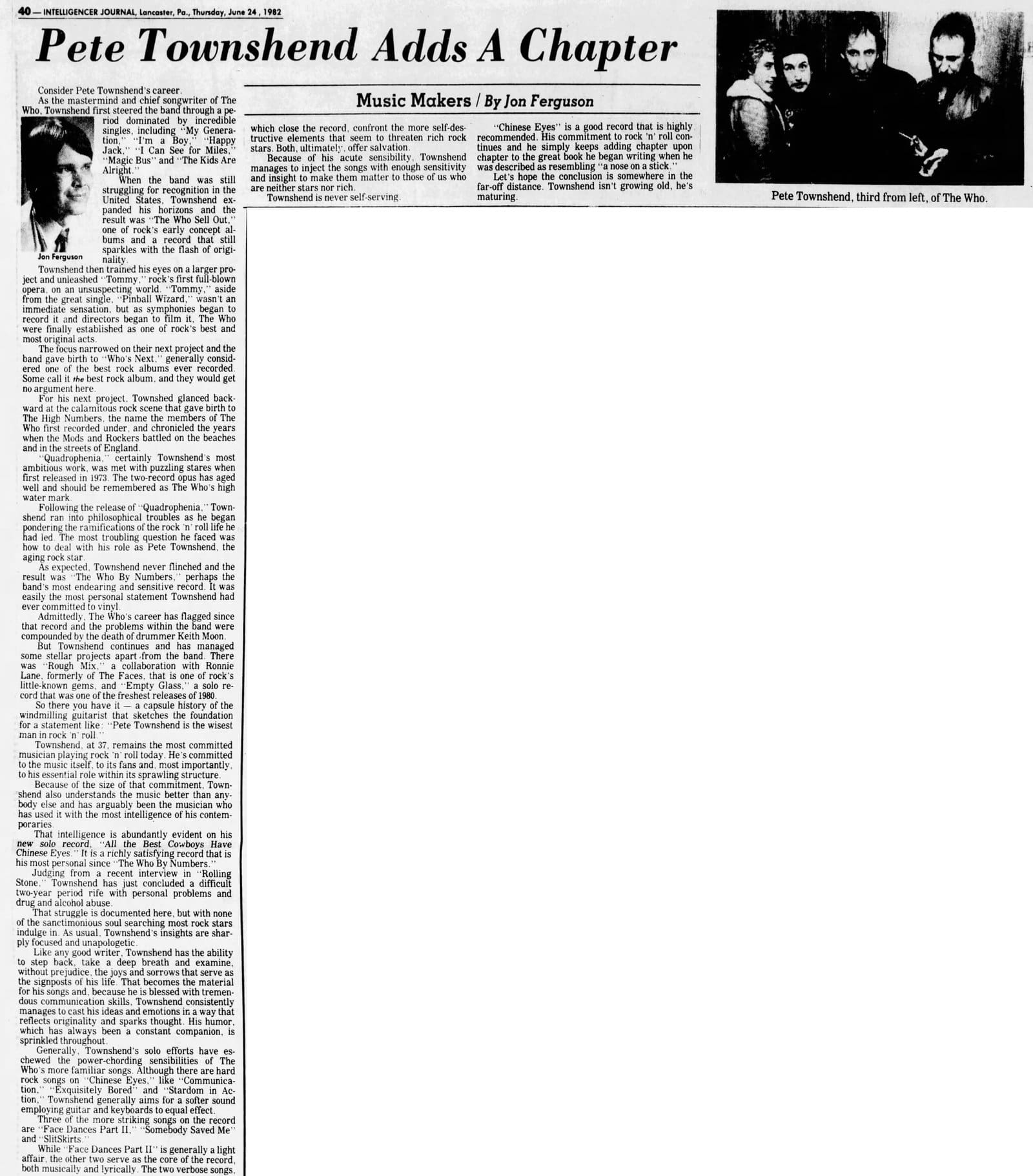
Pete Townshend, third from left, of The Who.