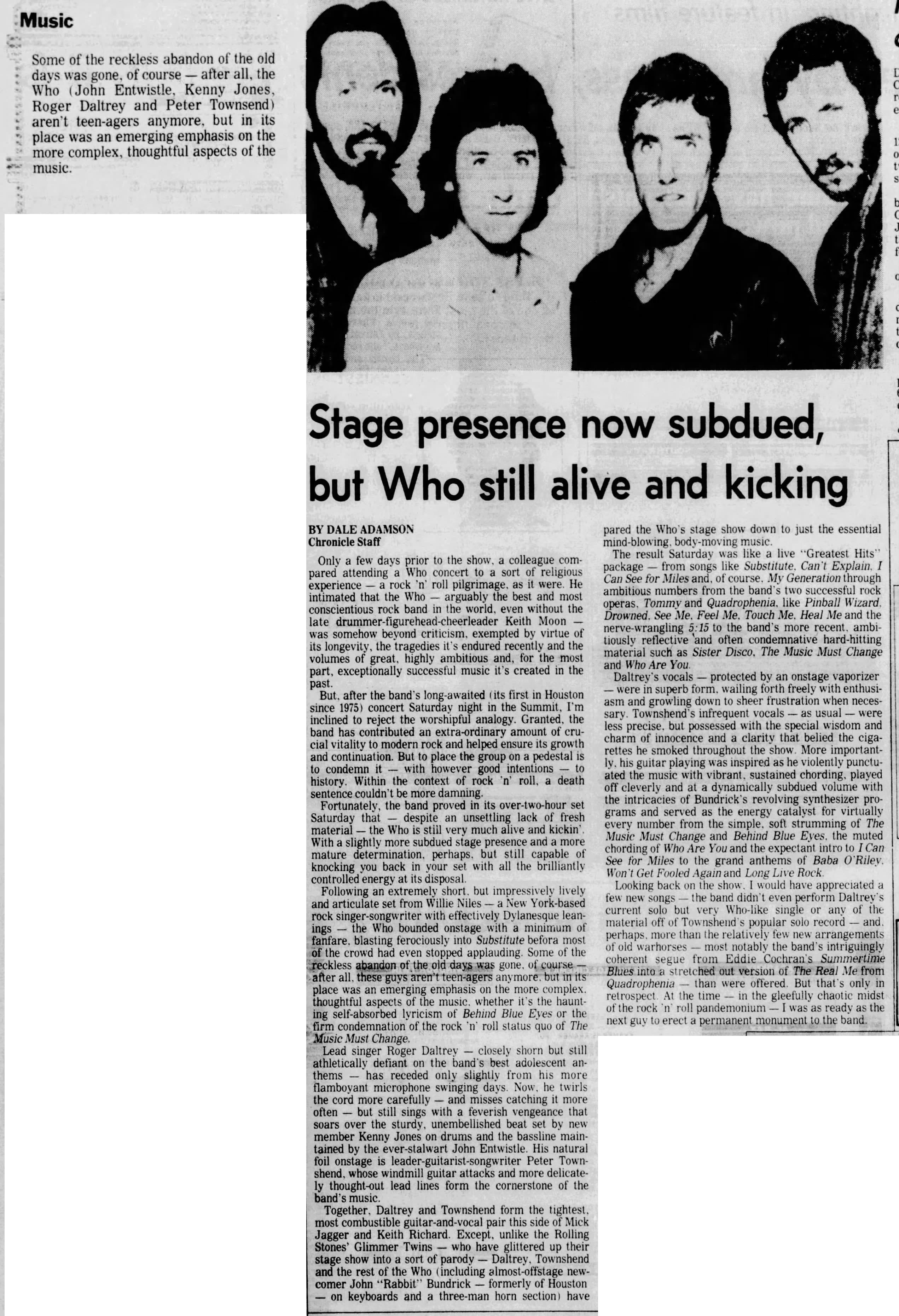
1980-07-07-The_Houston_Chronicle
Only a few days prior to the show, a colleague compared attending a Who concert to a sort of religious experience — a rock ’n’ roll pilgrimage, as it were. He intimated that the Who — arguably the best and most conscientious rock band in the world, even without the late drummer-figurehead-cheerleader Keith Moon — was somehow beyond criticism, exempted by virtue of its longevity, the tragedies it’s endured recently and the volumes of great, highly ambitious and, for the most part, exceptionally successful music it’s created in the past.
But, after the band’s long-awaited (its first in Houston since 1975) concert Saturday night in the Summit, I’m inclined to reject the worshipful analogy. Granted, the band has contributed an extraordinary amount of crucial vitality to modern rock and helped ensure its growth and continuation. But to place the group on a pedestal is to condemn it — with however good intentions — to history. Within the context of rock ’n’ roll, a death sentence couldn’t be more damning.
Fortunately, the band proved in its over-two-hour set Saturday that — despite an unsettling lack of fresh material — the Who is still very much alive and kickin’. With a slightly more subdued stage presence and a more mature determination, perhaps, but still capable of knocking you back in your set with all the brilliantly controlled energy at its disposal.
Following an extremely short, but impressively lively and articulate set from Willie Niles — a New York-based rock singer-songwriter with effectively Dylanesque leanings — the Who bounded onstage with a minimum of fanfare, blasting ferociously into Substitute before most of the crowd had even stopped applauding. Some of the reckless abandon of the old days was gone, of course — after all, these guys aren’t teenagers anymore, but in its place was an emerging emphasis on the more complex, thoughtful aspects of the music, whether it’s the haunting self-absorbed lyricism of Behind Blue Eyes or the firm condemnation of the rock ’n’ roll status quo of The Music Must Change.
Lead singer Roger Daltrey — closely shorn but still athletically defiant on the band’s best adolescent anthems — has receded only slightly from his more flamboyant microphone swinging days. Now, he twirls the cord more carefully — and misses catching it more often — but still sings with a feverish vengeance that soars over the sturdy, unembellished beat set by new member Kenny Jones on drums and the bassline maintained by the ever-stalwart John Entwistle. His natural foil onstage is leader-guitarist-songwriter Peter Townshend, whose windmill guitar attacks and more delicately thought-out lead lines form the cornerstone of the band’s music.
Together, Daltrey and Townshend form the tightest, most combustible guitar-and-vocal pair this side of Mick Jagger and Keith Richard. Except, unlike the Rolling Stones’ Glimmer Twins — who have glittered up their stage show into a sort of parody — Daltrey, Townshend and the rest of the Who (including almost-offstage newcomer John “Rabbit” Bundrick — formerly of Houston — on keyboards and a three-man horn section) have pared the Who’s stage show down to just the essential mind-blowing, body-moving music.
The result Saturday was like a live “Greatest Hits” package — from songs like Substitute, Can’t Explain, I Can See for Miles and, of course, My Generation through ambitious numbers from the band’s two successful rock operas, Tommy and Quadrophenia, like Pinball Wizard, Drowned, See Me, Feel Me, Touch Me, Heal Me and the nerve-wrangling 5:15 to the band’s more recent, ambitiously reflective and often condemnatory hard-hitting material such as Sister Disco, The Music Must Change and Who Are You.
Daltrey’s vocals — protected by an onstage vaporizer — were in superb form, wailing forth freely with enthusiasm and growling down to sheer frustration when necessary. Townshend’s infrequent vocals — as usual — were less precise, but possessed with the special wisdom and charm of innocence and a clarity that belied the cigarettes he smoked throughout the show. More importantly, his guitar playing was inspired as he violently punctuated the music with vibrant, sustained chording, played off cleverly and at a dynamically subdued volume with the intricacies of Bundrick’s revolving synthesizer programs and served as the energy catalyst for virtually every number from the simple, soft strumming of The Music Must Change and Behind Blue Eyes, the muted chording of Who Are You and the expectant intro to I Can See for Miles to the grand anthems of Baba O’Riley, Won’t Get Fooled Again and Long Live Rock.
Looking back on the show, I would have appreciated a few new songs — the band didn’t even perform Daltrey’s current solo but very Who-like single or any of the material off of Townshend’s popular solo record — and perhaps more than the relatively few new arrangements of old warhorses — most notably the band’s intriguingly coherent segue from Eddie Cochran’s Summertime Blues into a stretched-out version of The Real Me from Quadrophenia — that were offered. But that’s only in retrospect. At the time — in the gleefully chaotic midst of the rock ’n’ roll pandemonium — I was as ready as the next guy to erect a permanent monument to the band.