1993-07-12-The_Hamilton_Spectator
Veteran Rocker Still Packs a Punch
Stories by Nick Krewen The Spectator
Contrary to what he expressed in his teen anthem My Generation, Pete Townshend may never grow old.
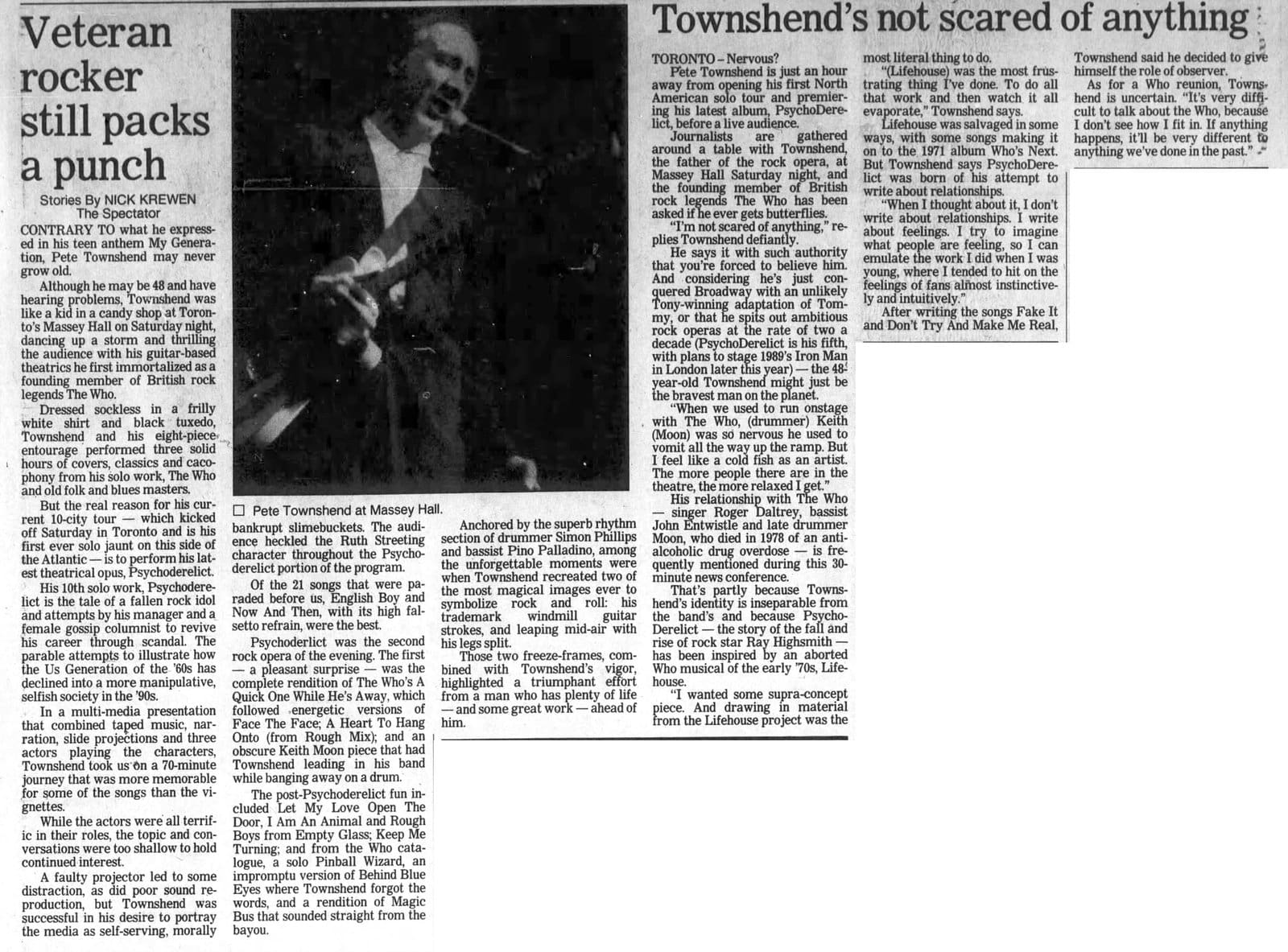
Although he may be 48 and have hearing problems, Townshend was like a kid in a candy shop at Toronto’s Massey Hall on Saturday night, dancing up a storm and thrilling the audience with his guitar-based theatrics he first immortalized as a founding member of British rock legends The Who.
Dressed sockless in a frilly white shirt and black tuxedo, Townshend and his eight-piece entourage performed three solid hours of covers, classics and cacophony from his solo work, The Who and old folk and blues masters.
But the real reason for his current 10-city tour — which kicked off Saturday in Toronto and is his first ever solo jaunt on this side of the Atlantic — is to perform his latest theatrical opus, Psychoderelict.
His 10th solo work, Psychoderelict is the tale of a fallen rock idol and attempts by his manager and a female gossip columnist to revive his career through scandal. The parable attempts to illustrate how the US Generation of the ’60s has declined into a more manipulative, selfish society in the ’90s.
In a multi-media presentation that combined taped music, narration, slide projections and three actors playing the characters, Townshend took us on a 70-minute journey that was more memorable for some of the songs than the vignettes.
While the actors were all terrific in their roles, the topic and conversations were too shallow to hold continued interest.
A faulty projector led to some distraction, as did poor sound reproduction, but Townshend was successful in his desire to portray the media as self-serving, morally bankrupt slimebuckets. The audience heckled the Ruth Streeting character throughout the Psychoderelict portion of the program.
Of the 21 songs that were paraded before us, English Boy and Now And Then, with its high falsetto refrain, were the best.
Psychoderelict was the second rock opera of the evening. The first — a pleasant surprise — was the complete rendition of The Who’s A Quick One While He’s Away, which followed energetic versions of Face The Face; A Heart To Hang Onto (from Rough Mix); and an obscure Keith Moon piece that had Townshend leading in his band while banging away on a drum.
The post-Psychoderelict fun included Let My Love Open The Door, I Am An Animal and Rough Boys from Empty Glass; Keep Me Turning; and from the Who catalogue, a solo Pinball Wizard, an impromptu version of Behind Blue Eyes where Townshend forgot the words, and a rendition of Magic Bus that sounded straight from the bayou.
Anchored by the superb rhythm section of drummer Simon Phillips and bassist Pino Palladino, among the unforgettable moments were when Townshend recreated two of the most magical images ever to symbolize rock and roll: his trademark windmill guitar strokes, and leaping mid-air with his legs split.
Those two freeze-frames, combined with Townshend’s vigor, highlighted a triumphant effort from a man who has plenty of life — and some great work — ahead of him.
Townshend’s not scared of anything
TORONTO — Nervous?
Pete Townshend is just an hour away from opening his first North American solo tour and premiering his latest album, Psychoderelict, before a live audience.
Journalists are gathered around a table with Townshend, the father of the rock opera, at Massey Hall Saturday night, and the founding member of British rock legends The Who has been asked if he ever gets butterflies.
“I’m not scared of anything,” replies Townshend defiantly.
He says it with such authority that you’re forced to believe him. And considering he’s just conquered Broadway with an unlikely Tony-winning adaptation of Tommy, or that he spits out ambitious rock operas at the rate of two a decade (Psychoderelict is his fifth, with plans to stage 1989’s Iron Man in London later this year) — the 48-year-old Townshend might just be the bravest man on the planet.
“When we used to run onstage with The Who, (drummer) Keith (Moon) was so nervous he used to vomit all the way up the ramp. But I feel like a cold fish as an artist. The more people there are in the theatre, the more relaxed I get.”
His relationship with The Who singer Roger Daltrey, bassist John Entwistle and late drummer Moon, who died in 1978 of an antialcoholic drug overdose — is frequently mentioned during this 30-minute news conference.
That’s partly because Townshend’s identity is inseparable from the band’s and because Psychoderelict — the story of the fall and rise of rock star Ray Highsmith — has been inspired by an aborted Who musical of the early ’70s, Lifehouse.
“I wanted some supra-concept piece. And drawing in material from the Lifehouse project was the most literal thing to do.
“(Lifehouse) was the most frustrating thing I’ve done. To do all that work and then watch it all evaporate,” Townshend says.
Lifehouse was salvaged in some ways, with some songs making it on to the 1971 album Who’s Next. But Townshend says Psychoderelict was born of his attempt to write about relationships.
“When I thought about it, I don’t write about relationships. I write about feelings. I try to imagine what people are feeling, so I can emulate the work I did when I was young, where I tended to hit on the feelings of fans almost instinctively and intuitively.”
After writing the songs Fake It and Don’t Try And Make Me Real, Townshend said he decided to give himself the role of observer.
As for a Who reunion, Townshend is uncertain. “It’s very difficult to talk about the Who, because I don’t see how I fit in. If anything happens, it’ll be very different to anything we’ve done in the past.”