1993-07-14-The_Record
No Tommy One Note
Pete Townshend widens his range
Music Critic
Pete Townshend said it wouldn’t be easy. And he was right.
The guitarist and chief creative genius of The Who also said he was doing it to generate “interest in the piece.” And he did.
“It” was Townshend’s live performance of “Psychoderelict.” The unconventionally styled audio drama, blending dialogue and music, tells the tale of a burned-out rock star, who, after some odd intervention, rediscovers his creativity.
Before Townshend’s performance Monday night at the Beacon Theater – the first of two sold-out shows – he acknowledged that he had not conceived of “Psychoderelict” as a concert, but that it “works OK live.”
Based on Monday’s show, it works a lot better than OK. It’s a demanding listen and, at times, an unsettling one. But the rewards are many.
Monday’s concert was just the second stop of Townshend’s first solo American tour, a road trip that returns to the metropolitan area for an Aug. 12 performance at Byrne Arena. As such, the evening had to be viewed as a work-in-progress, as the 48-year-old singer-songwriter was clearly experimenting with the set list and the three-hour concert’s pacing. That said, there was nothing offhand or sloppy about the musical performance, and the spontaneity lent an element of excitement to the show.
Townshend, who recently won a Tony Award for “The Who’s Tommy,” sandwiched the one-hour “Psychoderelict” between his own solo tunes and those from The Who. This wise tactic not only made acceptance of the new material easier, it rewarded listeners for their attention and patience.
Banging a drum, Townshend led his eight-member band to center stage. There, on an odd assortment of instruments, including a pennywhistle and trombone, they performed a brief composition Townshend credited to the late Who drummer Keith Moon.
The quirky, somewhat silly opening paved the way for the serious rock-and-roll that followed. Townshend reaffirmed his guitar-hero status immediately with a no-holds-barred rendition of “Face the Face.” But as mesmerizing as his flashy play was on electric guitar, it was his deft, delicate acoustic touch on tunes such as “Save It For Later” and “Heart to Hang On To” that demonstrated his true guitar prowess. (Both songs come from “Rough Mix,” the album Townshend recorded with Ronnie Lane and which he credits for helping him believe he could have a career apart from The Who.)
Once the familiar was taken care of, it was time to plunge into the largely uncharted waters of “Psychoderelict.”
“English Boy,” which bears a striking resemblance to some rocking Who tunes, began the song cycle and introduced the drama’s key players – washed-up rock star Ray High (played by John Labanowski), manipulative manager Rastus Knight (Linal Haft), and bitchy gossip columnist Ruth Streeting (Jan Ravens). Their snippets of conversation, interspersed into and between the songs, as well as photos and designs projected onto a rear screen, helped advance the story line. But, at times, the spoken words and images proved unnecessary, because the songs said it all.
“Let’s Get Pretentious,” for example, clearly spelled out High’s disdain of hype, with a combination of slash-and-burn rock and amusing lyrics (“Let’s get excited/When we say hello/Let’s be delighted/Though it’s nobody we know”).
Similarly, you didn’t need spoken words to understand “Outlive the Dinosaur,” a funny parody about pop icons introduced by some bluesy harmonica play, courtesy of Peter Hope-Evans.
Oddly, the high points of the rock-and-roll story were not in its up-tempo tunes, but in the ballads, “Now and Then,” “I Am Afraid,” and “Don’t Try to Make Me Real.”
Townshend’s sweet vocals, supported by gentle instrumentation and backing harmonies, heightened the tenderness of the stately “Now and Then.” Phil Palmer’s mournful electric guitar intensified the fear Townshend conveyed in “I Am Afraid.” And it was the combined dynamics of the band – particularly the majestic keyboard touch supplied by John “Rabbit” Bundrick and the shifting rhythms of drummer Simon Phillips and bassist Pino Palladino – that reinforced Townshend’s plaintive cry in “Don’t Try to Make Me Real.”
Sadly, this beautiful song was followed by the drama’s low point: Flashed on the screen were silhouetted images of the manager whipping the columnist. Not only were these S & M images disturbing, they were purely gratuitous.
A reprise of “English Boy” – albeit a funked-up version – brought “Psychoderelict” to an end. It also proved the perfect segue for the show’s final segment, which included a reworked “Magic Bus,” a loose “Won’t Get Fooled Again” (before the song started, Townshend turned to the band and asked “What’s the first line?”), and a spirited solo acoustic “Pinball Wizard.”
It’s the rare performer who can entertain and also make an audience think. Townshend has done that throughout his career, and it’s apparent he’s not about to stop now. And that is good news not only for Townshend’s future, but for the future of rock.
REVIEW PETE TOWNSHEND: At the Beacon Theater in Manhattan. Monday night.
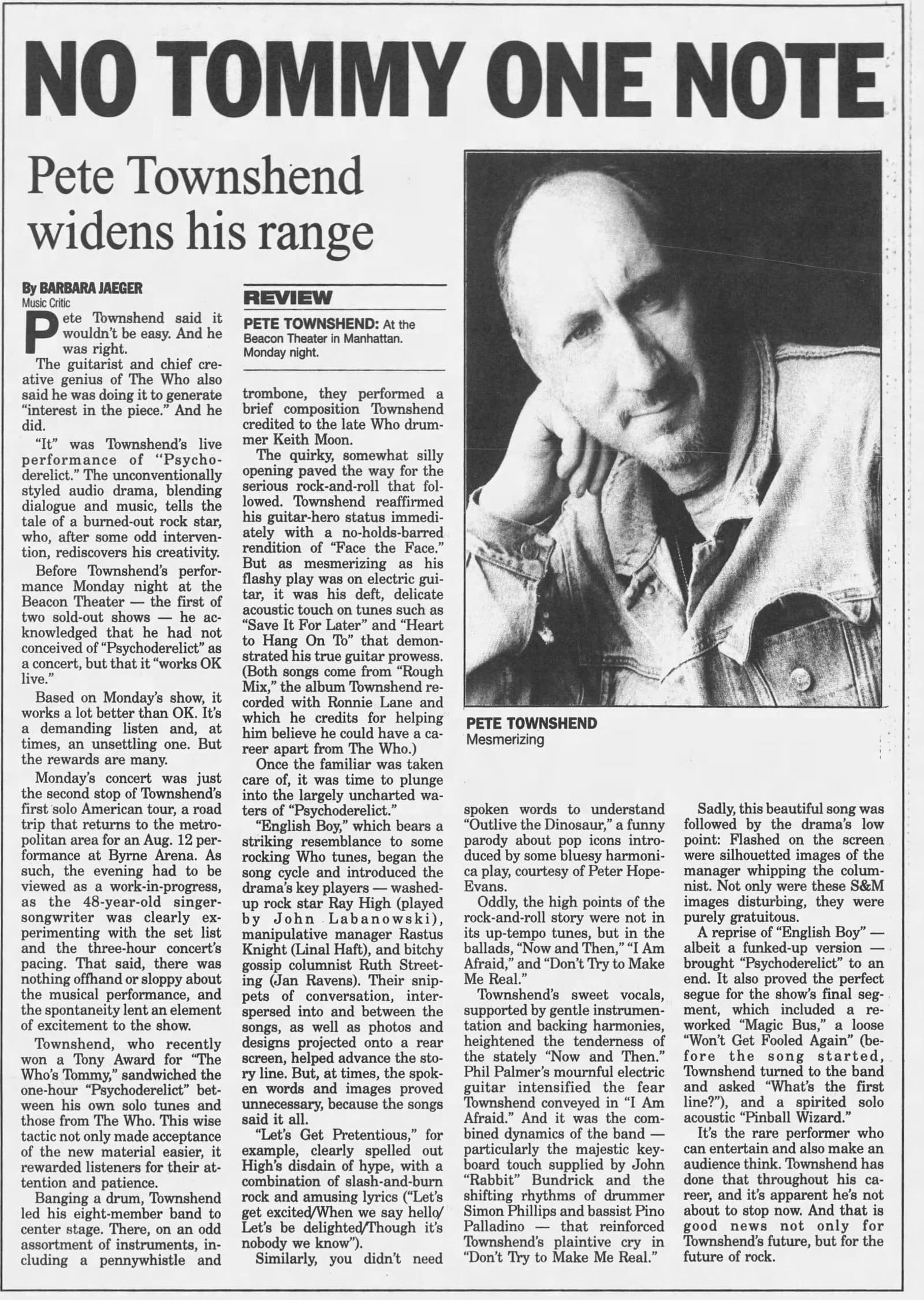
PETE TOWNSHEND Mesmerizing