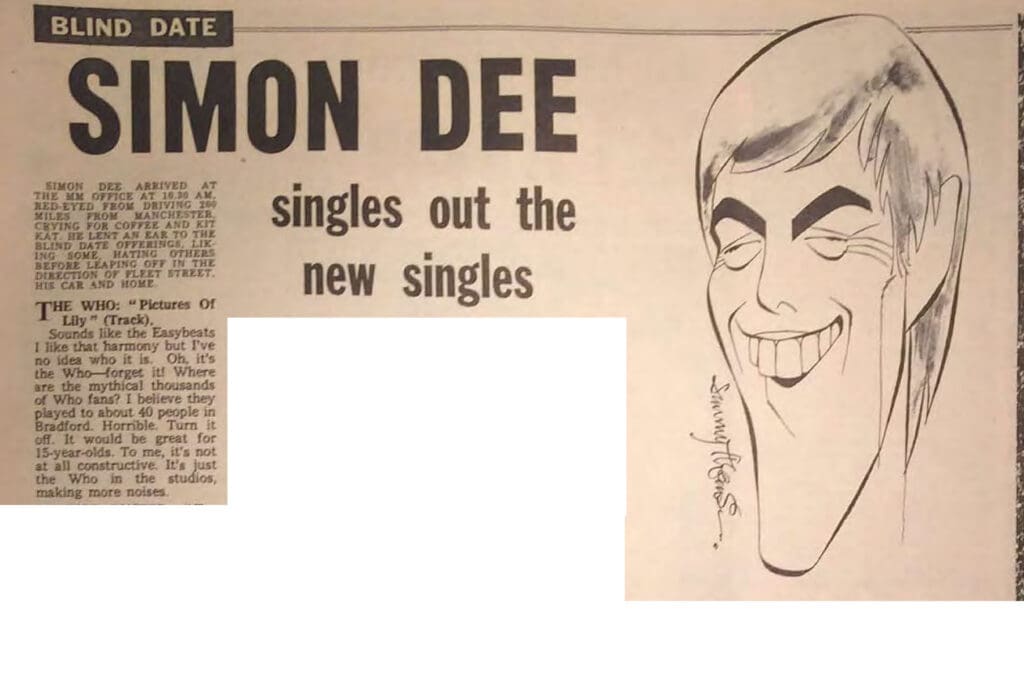
Saturday, April 29th, 1967
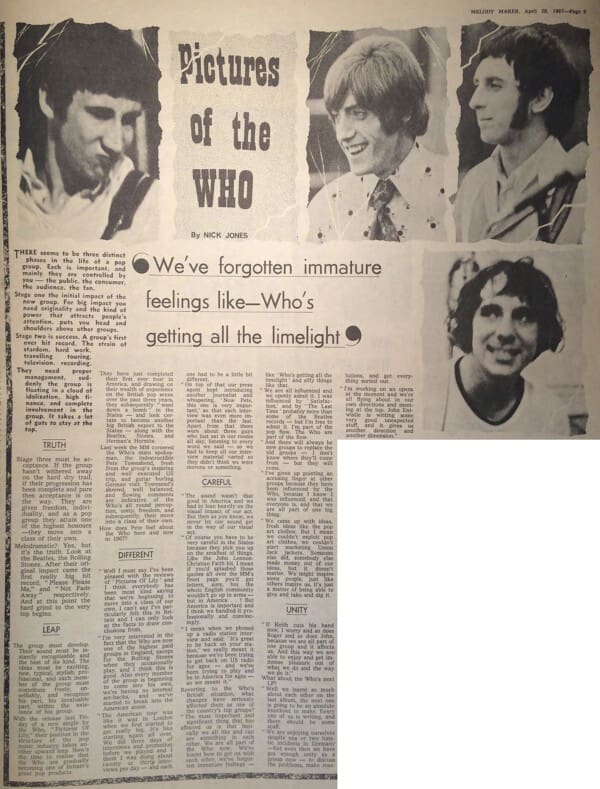
Melody Maker features an article titled "Pictures of the Who" by Nick Jones. "Pop Think in with Carl Wayne" also mentions The Who
Transcript (not reviewed)
Pictures of the WHO
By NICK JONES
“We’ve forgotten immature feelings like—Who’s getting all the limelight”
THERE seems to be three distinct phases in the life of a pop group. Each is important, and mainly they are controlled by the public, the consumer, the audience, the fan.
Stage one the initial impact of the new group. For big impact you need originality and the kind of power that attracts people’s attention, puts you head and shoulders above other groups.
Stage two is success. A group’s first wave hit record. The strain of stardom, hard work, travelling, touring, television, recording.
They need proper management, such discipline the group is floating in a cloud of adulation, high fi- nance, and complete involvement in a huge group. It takes a lot of guts to stay at the top.
TRUTH
Stage three must be ac- ceptance. If the group hasn’t withered away on the hard dry trail, if their progression has been complete and pure then acceptance is the way. They are given freedom, indi- viduality, and at a point group they attain one of the highest honours — they move into a class of their own.
Melodramatic? Yes, but it’s the truth. Look at the Beatles, the Rolling Stones. After their ori- ginal impact came the first really big hit record, “Please Please Me,” and “Not Fade Away.”
And at this point the hard grind to the very top begins.
LEAP
The group must develop. Their sound must be in- stantly recognisable and the best of its kind. The ideas must be exciting, new, typical, stylish, pro- fessional, and each mem- ber of the group must contribute freely, un- selfishly, and recognise his part, his invaluable part, within the exis- tence of his group.
With the release last Fri- day of a new single by the Who, “Pictures of Lily,” their position in pop structure is more truly understood. Now’s the time to realise that the Who are gradually becoming one of Britain’s great pop products.
They have just completed their first tour in America, and drawing on their wealth of experience on the British pop scene over the past three years, they have become, in many ways, a com- pletely different group.
States — and look certain to become another big British export to the States — along with the Beatles, Stones, Herman’s Hermits.
Last week the MM cornered the Who’s main spokesman, the inde- structible Pete Town- shend, fresh from the group’s inspiring and well executed US trip, and guitar hurling German visit.
Townshend’s shrewd, well balanced, and flowing comments are indicative of the Who’s all round perception, unity, freedom, and subsequently, their move into a class of their own.
How does Pete feel about the Who here and now in 1967?
DIFFERENT
“Well I must say I’ve been pleased with the reviews of ‘Pictures of Lily’ and I think everybody has been knocked sideways that we’re beginning to move into a class of our own. I can’t say I’ve particularly felt this in Britain and I can only look at the facts to draw conclusions from.
I’m very interested in the fact that the Who are now one of the highest paid groups in England, except for the Rolling Stones. When they contract this is big pay, and I think this is good. Also every member of the group is beginning to come into his own, we’re having no internal set-backs, and we’ve started to break into the American scene.
The American tour was like it was in London when we first started to get really big. It’s like starting again.
We did three days of interviews and promotion before we played and I think I was doing about twenty or thirty interviews per day — and each one had to be a little bit different.
On top of that our press agent kept introducing another journalist and whispering, ‘Now Pete this one is very important,’ so that each interview was even more important than the last.
Apart from that there were about three guys who just sat in our rooms all day, listening to every word we said — so we had to keep all our inter- view material varied so they didn’t think we were morons or something.”
CAREFUL
“The sound wasn’t that good in America and we had to lean heavily on the visual impact of our act. But then as you know, we never let our sound get in the way of our visual act.
Of course you have to be very careful in the States because they pick you up on the smallest of things. Like the John Lennon Christian faith bit. I mean if you’d splashed those quotes all over the MM front page you’d get letters, sure, but the whole English community wouldn’t go up in arms — but in America [unclear]
But America is important and I think we handled it professionally and con- vincingly.
I mean when we phoned up a radio station inter- view and said, ‘It’s great to be back on your sta- tion,’ we really meant it because we’ve been try- ing to get back on US radio for ages — so we mean it.”
UNITY
“I think it’s important to get together and sort out everything, sort out everything.
I’m working on an opera at the moment and we’re all flying about in our own directions. But getting together again is writing some very good unexpected stuff, and it gives us another direction.
If Keith cuts his hand now, I worry and so does Roger and so does John, because we are all part of one group and it affects us all. And this way we are able to enjoy and get involved in what we do and the way we do it.
What about the Who’s next LP?
Well we learnt so much about each other on the last album, the next one is going to be an absolute knockout to make. Every one of us is writing, and there should be some stuff.
We are enjoying ourselves despite one or two luna- tic incidents in Germany — but even then we have got enough unity as a group now to discuss the problems, make resolu- tions and get everything sorted out.”
Photos