Sunday, July 6th, 1980
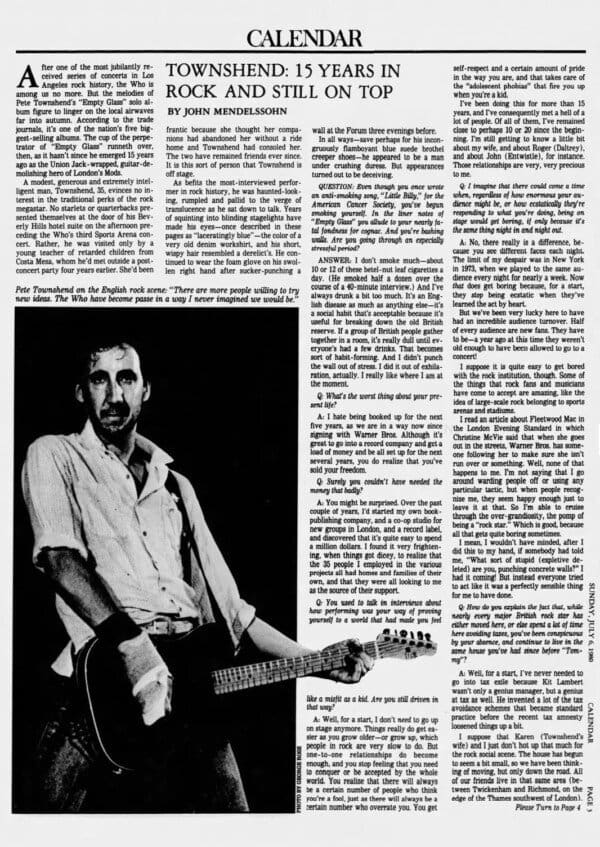
Pete is interviewed in the Los Angeles Times.
Transcript:
TOWNSHEND: 15 YEARS IN ROCK AND STILL ON TOP
BY JOHN MENDELSOHN
After one of the most jubilantly received series of concerts in Los Angeles rock history, the Who is among us no more. But the melodies of Pete Townshend’s “Empty Glass” solo album figure to linger on the local airwaves far into autumn. According to the trade journals, it’s one of the nation’s five biggest-selling albums. The cup of the perpetrator of “Empty Glass” runneth over then, as it hasn’t since he emerged 15 years ago as the Union Jack-wrapped, guitar-demolishing hero of London’s Mods.
A modest, generous and extremely intelligent man, Townshend, 35, evinces no interest in the traditional perks of the rock megastar. No starlets or quarterbacks presented themselves at the door of his Beverly Hills hotel suite on the afternoon preceding the Who’s third Sports Arena concert. Rather, he was visited only by a young teacher of retarded children from Costa Mesa, whom he’d met outside a post-concert party four years earlier. She’d been frantic because she thought her companions had abandoned her without a ride home and Townshend had consoled her. The two have remained friends ever since. It is this sort of person that Townshend is offstage.
As befits the most-interviewed performer in rock history, he was haunted-looking, rumpled and pallid to the verge of translucence as he sat down to talk. Years of squinting into blinding stage-lights have made his eyes—once described in these pages as “laceratingly blue”—the color of a very old denim workshirt, and his short, wispy hair resembled a derelict’s. He continued to wear the foam glove on his swollen right hand after sucker-punching a wall at the Forum three evenings before.
In all ways—save perhaps for his incongruously flamboyant blue suede brothel creeper shoes—he appeared to be a man under crushing duress. But appearances turned out to be deceiving.
QUESTION: Even though you once wrote an anti-smoking song, “Little Billy,” for the American Cancer Society, you’ve begun smoking yourself. In the liner notes of “Empty Glass” you allude to your nearly fatal fondness for cognac. And you’re bashing walls. Are you going through an especially stressful period?
ANSWER: I don’t smoke much—about 10 or 12 of these betel-nut leaf cigarettes a day. (He smoked half a dozen over the course of a 40-minute interview.) And I’ve always drunk a bit too much. It’s an English disease as much as anything else—it’s a social habit that’s acceptable because it’s useful for breaking down the old British reserve. If a group of British people gather together in a room, it’s really dull until everyone’s had a few drinks. That becomes sort of habit-forming. And I didn’t punch the wall out of stress. I did it out of exhilaration, actually. I really like where I am at the moment.
Q: What’s the worst thing about your present life?
A: I hate being booked up for the next five years, as we are in a way now since signing with Warner Bros. Although it’s great to go into a record company and get a load of money and be all set up for the next several years, you do realize that you’ve sold your freedom.
Q: Surely you couldn’t have needed the money that badly?
A: You might be surprised. Over the past couple of years, I’d started my own book-publishing company, and a co-op studio for new groups in London, and a record label, and discovered that it’s quite easy to spend a million dollars. I found it very frightening, when things got dicey, to realize that the 35 people I employed in the various projects all had homes and families of their own, and that they were all looking to me as the source of their support.
Q: You used to talk in interviews about how performing was your way of proving yourself to a world that had made you feel like a misfit as a kid. Are you still driven in that way?
A: Well, for a start, I don’t need to go up on stage anymore. Things really do get easier as you grow older—or grow up, which people in rock are very slow to do. But one-to-one relationships do become enough, and you stop feeling that you need to conquer or be accepted by the whole world. You realize that there will always be a certain number of people who think you’re a fool, just as there will always be a certain number who overrate you. You get self-respect and a certain amount of pride in the way you are, and that takes care of the “adolescent phobias” that fire you up when you’re a kid.
I’ve been doing this for more than 15 years, and I’ve consequently met a hell of a lot of people. Of all of them, I’ve remained close to perhaps 10 or 20 since the beginning. I’m still getting to know a little bit about my wife, and about Roger (Daltrey), and about John (Entwistle), for instance. Those relationships are very, very precious to me.
Q: I imagine that there could come a time when, regardless of how enormous your audience might be, or how ecstatically they’re responding to what you’re doing, being on stage would get boring, if only because it’s the same thing night in and night out.
A: No, there really is a difference, because you see different faces each night. The limit of my despair was in New York in 1973, when we played to the same audience every night for nearly a week. Now that does get boring because, for a start, they stop being ecstatic when they’ve learned the act by heart.
But we’ve been very lucky here to have had an incredible audience turnover. Half of every audience are new fans. They have to be—a year ago at this time they weren’t old enough to have been allowed to go to a concert!
I suppose it is quite easy to get bored with the rock institutions, though. Some of the things that rock fans and musicians have come to accept are amazing, like the idea of large-scale rock belonging to sports arenas and stadiums.
I read an article about Fleetwood Mac in the London Evening Standard in which Christine McVie said that when she goes out in the streets, Warner Bros. has someone following her to make sure she isn’t run over or something. Well, none of that happens to me. I’m not saying that I go around warding people off or using any particular tactic, but when people recognize me, they seem happy enough just to leave it at that. So I’m able to cruise through the over-grandiosity, the pomp of being a “rock star.” Which is good, because all that gets quite boring sometimes.
I mean, I wouldn’t have minded, after I did this to my hand, if somebody had told me, “What sort of stupid (expletive deleted) are you, punching concrete walls?” I had it coming! But instead everyone tried to act like it was a perfectly sensible thing for me to have done.
Q: How do you explain the fact that, while nearly every major British rock star has either moved here, or else spent a lot of time here avoiding taxes, you’ve been conspicuous by your absence, and continue to live in the same house you’ve had since before “Tommy”?
A: Well, for a start, I’ve never needed to go into tax exile because Kit Lambert wasn’t only a genius manager, but a genius at tax as well. He invented a lot of the tax avoidance schemes that became standard practice before the recent tax amnesty loosened things up a bit.
I suppose that Karen (Townshend’s wife) and I just don’t hot up that much for the rock social scene. The house has begun to seem a bit small, so we have been thinking of moving, but only down the road. All of our friends live in that same area (between Twickenham and Richmond, on the edge of the Thames southwest of London).
Those who’ve left have all come back again, like Ronnie Lane, who moved to Wales for a while. When you’re within walking distance of 20 friends that you could turn to in a time of real crisis, as we are, you’d be crazy to move away.
Q: You’ve always given Lambert enormous credit for his role in the Who’s success, both as co-manager and producer. Why did you split?
A: I didn’t split from him—he went mad. He put himself into the Court of Protection, which is an acknowledgement that you’re incapable of looking after your own affairs. Before he can buy or sell anything or sign any sort of contract, he has to appear before this court and convince seven judges that he’s not insane. How, even if you’re the sanest man in the world, do you go about convincing someone that you’re not mad?
Q: Was that hurtful to you?
A: Yes, and not only personally, but artistically as well. As a songwriter, I really relied on him to edit my work. He’d be very valuable to me now.
Q: You’ve been remarkably successful as far as attracting a new generation of American fans. Have you been comparably successful at home in Britain?
A: The scene there is much richer in a way. It’s faster-changing because there are more people in the record business willing to try new ideas. The Who have become passé in a way that I never imagined we would be.
Q: Can you imagine what your life would be like now if the Who had flopped and you’d given up on being a performing musician?
A: It’d be at home a lot more, which I’d really like. I could record and write—not just songs but writing as well—in my own environment, which I find the most creatively stimulating. I’ve been having this running dialogue with Roger for ages. It seems to be under the misapprehension that I write my best stuff in hotel rooms. I have written some good stuff in hotel rooms, I suppose, but not much, because when you come home from a gig you’re either flattened, or else just want to stick your head in the television.
It’s a good thing I’m not trying to make my living writing songs for other people. Most of the time, other artists find the songs I submit to them completely off-the-wall. I wrote “And I Moved” on my album Rough Mix. Better Midler, but someone in her office who got hold of the demo decided it was too smutty for her. At first I was going to insist that she be given the chance to make up her own mind, but my pride prevented that, so I just wound up keeping the song. I wrote a song for Art Garfunkel called “Brooklyn Kids,” about a rape, but only implicitly. His people seemed to quite like it but wanted me to make it a bit more wholesome. I wound up withdrawing it. And I wrote “Let My Love Open the Door” for Blondie, but (producer) Chris Thomas convinced me to save it for my own album.
Q: What did you mean when you said that you’d write “writing,” as opposed to songs?
A: Stories, for instance. I kept a detailed journal of my dreams for a few months and discovered that I don’t have the sort of dreams most people do. I’ve turned several of the images in them into stories. And I’ve done a series of erotic stories as well. Karen was shocked when she discovered them. She didn’t know I had it in me!
Getting back to your question about what I’d be doing if there were no Who, I suppose I might also be a record producer, in which case I’d probably have an even more unrhythmic life than I do now. Chris Thomas’ life is every bit as chaotic as my own. After he finished my album and the Pretenders’, which he was doing concurrently, he was a dead man.
Q: I really miss the days when the Who wore ridiculously flamboyant stage costumes, like your famous gold-sequined jacket.
A: But don’t forget that there’s something slightly ridiculous about the way the group looks at the moment. I find it very, very funny when Roger goes on stage looking like he just came in off the beach, stunning a rich bronze. It may be quite appropriate in Los Angeles, but he does the same thing in Wembley Stadium, in the pouring rain!
I was never comfortable in gold sequins anyway. I reacted to all that in the end when I began wearing the most horrible things I could find—boiler suits, with trousers legs that only came down to mid-calf. And some people think that guy in Cheap Trick is the first ridiculous-looking rock guitarist
Photos
