Saturday, July 25th, 1981
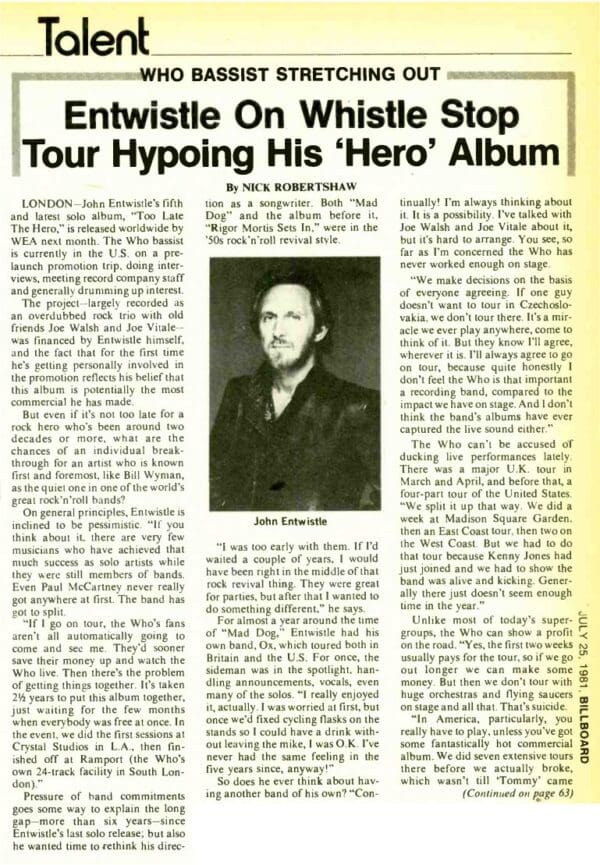
Billboard magazine carries an article titled "Entwistle on Whistle Stop Tour Hypoing His 'Hero" Album"
Transcript:
Talent
WHO BASSIST STRETCHING OUT
Entwistle On Whistle Stop Tour Hypoing His ‘Hero’ Album
By NICK ROBERTSHAW
LONDON—John Entwistle’s fifth and latest solo album, “Too Late The Hero,” is released worldwide by WEA next month. The Who bassist is currently in the U.S. on a pre-launch promotion trip, doing interviews, meeting record company staff and generally drumming up interest.
The project—largely recorded as an overdubbed rock trio with old friends Joe Walsh and Joe Vitale—was financed by Entwistle himself, and the fact that for the first time he’s getting personally involved in the promotion reflects his belief that this album is potentially the most commercial he has made.
But even if it’s not too late for a rock hero who’s been around two decades or more, what are the chances of an individual breakthrough for an artist who is known first and foremost, like Bill Wyman, as the quiet one in one of the world’s great rock ‘n’ roll bands?
On general principles, Entwistle is inclined to be pessimistic. “If you think about it, there are very few musicians who have achieved that much success as solo artists while they were still members of bands. Even Paul McCartney never really got anywhere at first. The band has got to split.
“If I go on tour, the Who’s fans aren’t all automatically going to come and see me. They’d sooner save their money and watch the Who live. Then there’s the problem of getting things together. It’s taken 2½ years to put this album together, just waiting for the few months when everybody was free at once. In the event, we did the first sessions at Crystal Studios in L.A., then finished off at Ramport (the Who’s own 24-track facility in South London).”
Pressure of band commitments goes some way to explain the long gap—more than six years—since Entwistle’s last solo release; but also he wanted time to rethink his direction as a songwriter. Both “Mad Dog” and the album before it, “Rigor Mortis Sets In,” were in the ’50s rock ‘n’ roll revival style.
John Entwistle
“I was too early with them. If I’d waited a couple of years, I would have been right in the middle of that rock revival thing. They were great for parties, but after that I wanted to do something different,” he says.
For almost a year around the time of “Mad Dog,” Entwistle had his own band, Ox, which toured both in Britain and the U.S. For once, the sideman was in the spotlight, handling announcements, vocals, even many of the solos. “I really enjoyed it, actually. I was worried at first, but once we’d fixed cycling flasks to the stands so I could have a drink without leaving the mike, I was O.K. I’ve never had the same feeling in the five years since, anyway!”
So does he ever think about having another band of his own? “Continually! I’m always thinking about it. It is a possibility. I’ve talked with Joe Walsh and Joe Vitale about it, but it’s hard to arrange. You see, so far as I’m concerned, the Who has never worked enough on stage.
“We make decisions on the basis of everyone agreeing. If one guy doesn’t want to tour in Czechoslovakia, we don’t tour there. It’s a miracle we ever play anywhere, come to think of it. But they know I’ll agree, wherever it is. I’ll always agree to go on tour, because quite honestly I don’t feel the Who is that important a recording band, compared to the impact we have on stage. And I don’t think the band’s albums have ever captured the live sound either.”
The Who can’t be accused of ducking live performances lately. There was a major U.K. tour in March and April, and before that, a four-part tour of the United States. “We split it up that way. We did a week at Madison Square Garden, then an East Coast tour, then two on the West Coast. But we had to do that tour because Kenny Jones had just joined and we had to show the band was alive and kicking. Generally there just doesn’t seem enough time in the year.”
Unlike most of today’s super-groups, the Who can show a profit on the road. “Yes, the first two weeks usually pays for the tour, so if we go out longer we can make some money. But then we don’t tour with huge orchestras and flying saucers on stage and all that. That’s suicide.
“In America, particularly, you really have to play, unless you’ve got some fantastically hot commercial album. We did seven extensive tours there before we actually broke, which wasn’t till ‘Tommy’ came
along. There’s no free ticket to the States, you pay your dues, all right.”
Since “Tommy,” which Entwistle describes with a grimace as the band’s most universally commercial LP, Who releases have all done well in the U.S. The most recent, “Face Dances,” reached the top 10. “They tend to go in quick, then come out again quick,” Entwistle observes. “I suppose it’s because everyone who’s going to buy the album knows about it.
“Then when we do a tour they’ll crawl back into the charts. The kind of fans we’ve had have really remained constant throughout, though now it’s the sons and daughters of the original fans. Once you’ve got a mortgage and kids, you don’t want the hassle of a sweaty rock gig!”
Entwistle remains very much the musician; he’s not much interested in the Who’s various business interests; those include a piece of the Shepperton film studios. “That was like buying a car with no engine. You open the bonnet and there’s nothing there. If it was up to me, we’d get rid of all that stuff and start again from scratch.”
He’s much keener to talk about songwriting—“I don’t listen to too much music; I don’t want to sit down and spend five hours writing somebody else’s song”—or the virtues of his 8-string Alembic bass that he uses for demos instead of a guitar. When the Who record, each member plays demo tapes of the songs he wants included. There are three of Entwistle’s on “Who Are You” and two more on “Face Dances”; though he claims to be far from prolific and, anyway, scraps most of his work at the manuscript stage.
The Who came through the punk/new wave upheaval with barely a flicker. “That’s because the band those new wave acts were basing themselves on was ours,” explains Entwistle. But how long can they go on? Rumors of backstage discord were rife after the last U.K. tour. “That’s normal. We always dissect the show in the dressing-room. There just happened to be reporters around. I don’t know how long we’ll carry on. As long as we still feel we’re accomplishing something musically, I suppose. We got a new lease of life when Kenny joined, and we’ve still got things going on. There’s a video of “The Kids Are Alright” coming out soon, for instance, which was a film we financed ourselves.
“From my own point of view, I feel I’m 100 times better as a composer, as an arranger, as a musician, than I ever was when I was younger. I’ll just carry on until I drop, which won’t be too long!”
Photos
