1989-08-13-St_Louis_Post_Dispatch
ROCK MUSIC
The Who Is Better Than Alright
50,000 At Busch Find Gold In Band’s Silver Anniversary Tour
When The Who decided to go back out on the road with its "The Kids Are Alright Tour: 1964-1989," after a seven-year absence from the concert stage, there were serious doubts among fans and critics alike as to the group's ability to carry it off.
Well, the verdict is in and by an overwhelming show of approval, the 50,000 or so in attendance at Busch Stadium during The Who concert Friday night have spoken. The "Kids" are indeed alright. In fact, they're more than alright. They're inventive, courageous, energetic and inspired.
For all Pete Townshend's pre-tour talk about this not being The Who most people remember, the singer-guitarist, pumped up by his own performance and that of his bandmates, had changed his tune by the end of the evening. "Whatever you think, old or young," he said, "we are The Who." Truer words were never spoken.
Of course, it took a little while for things to really get cooking. After all, Townshend, Roger Daltrey and John Entwistle are all over 40 years of age. Consequently, on a muggy evening in August, the old bones needed some time to get adjusted. A 35-minute medley of songs from Townshend's rock opera "Tommy" provided the perfect warm-up for the 3 1/2-hour show.
The stage, built between the left field and right field bleacher seats of the stadium, was framed on either side and behind by backdrops that constantly changed patterns throughout the evening. During the "Tommy" medley, the scenes were made to resemble the inside of a pinball machine. Then, during one of the songs, a giant silver "pinball" balloon was released to bounce amid the crowd.
Except for some clever lighting later in the show, that was the only special effect that didn't come from one of the musical instruments on stage. And there were plenty of those. The members of The Who were backed by a 12-piece band that included a five-man horn section, three singers, a percussionist, a keyboardist and another lead guitar player, in addition to a drummer.
Although there was some debate over the relative worth of using such a large back-up band, in this case there were only a couple of instances where the extra accompaniment intruded upon the original intent of the song. In both situations, during "You Better You Bet" and "Won't Get Fooled Again," the horns were superfluous.
Nevertheless, the inclusion of the horn section on a tune such as "Rough Boys" made for a fuller, more potent sound than on the recorded version. The same was true of "Goodbye Sister Disco," which benefited not only from the orchestral-type arrangement but from the addition of an acoustic guitar solo by Townshend that allowed him to stretch in directions seldom explored within the confines of The Who.
Because of Townshend's hearing problems, he played without monitors, directly through the PA. On the other side of the stage, Steve "Boltz" Bolton picked up many of the parts Townshend would ordinarily have performed. Especially in the second half of the show, however, Townshend began to cut loose. He handled lead guitar solos with authority, and if he didn't put his whole arm into those full circle "windmills" of his, the audience couldn't tell the difference. He leaped and scissor split his way through "Baba O'Riley," "My Generation" and "Won't Get Fooled Again" with verve and panache.
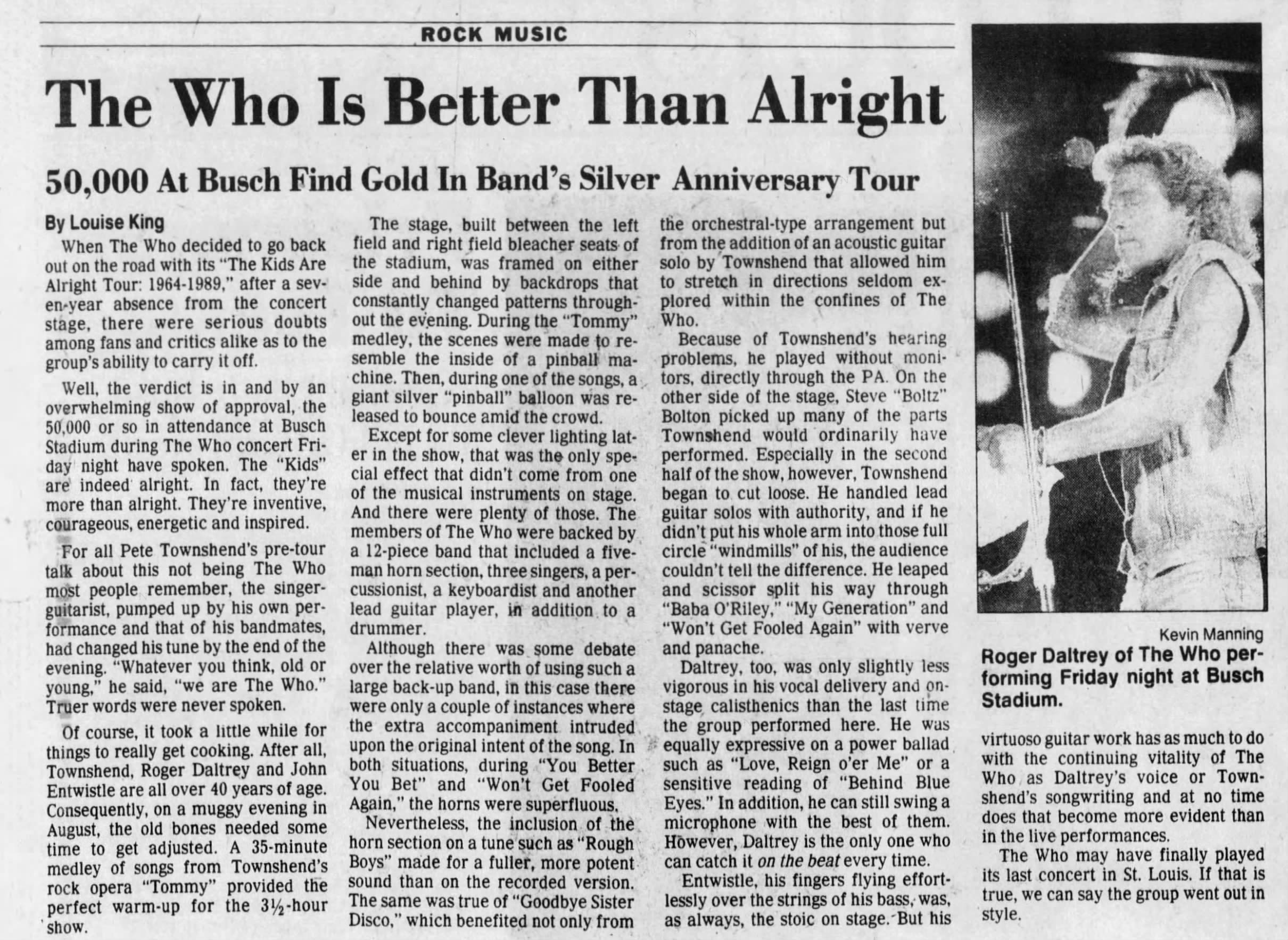
Daltrey, too, was only slightly less vigorous in his vocal delivery and on-stage calisthenics than the last time the group performed here. He was equally expressive on a power ballad such as "Love, Reign o'er Me" or a sensitive reading of "Behind Blue Eyes." In addition, he can still swing a microphone with the best of them. However, Daltrey is the only one who can catch it on the beat every time.
Entwistle, his fingers flying effortlessly over the strings of his bass, was, as always, the stoic on stage. But his virtuoso guitar work has as much to do with the continuing vitality of The Who as Daltrey's voice or Townshend's songwriting and at no time does that become more evident than in the live performances.
The Who may have finally played its last concert in St. Louis. If that is true, we can say the group went out in style.