Monday, November 11th, 1996
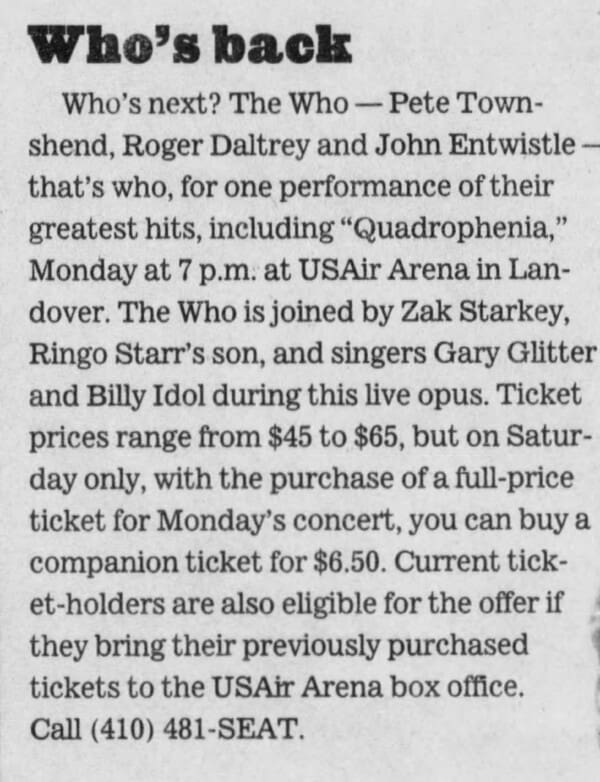
The Who play the US Air Arena in Landover, Maryland (outside of Washington D.C.)
The Washington Post had the following review:
THE WHO'S 4-STAR 'QUAD' By Richard Harrington
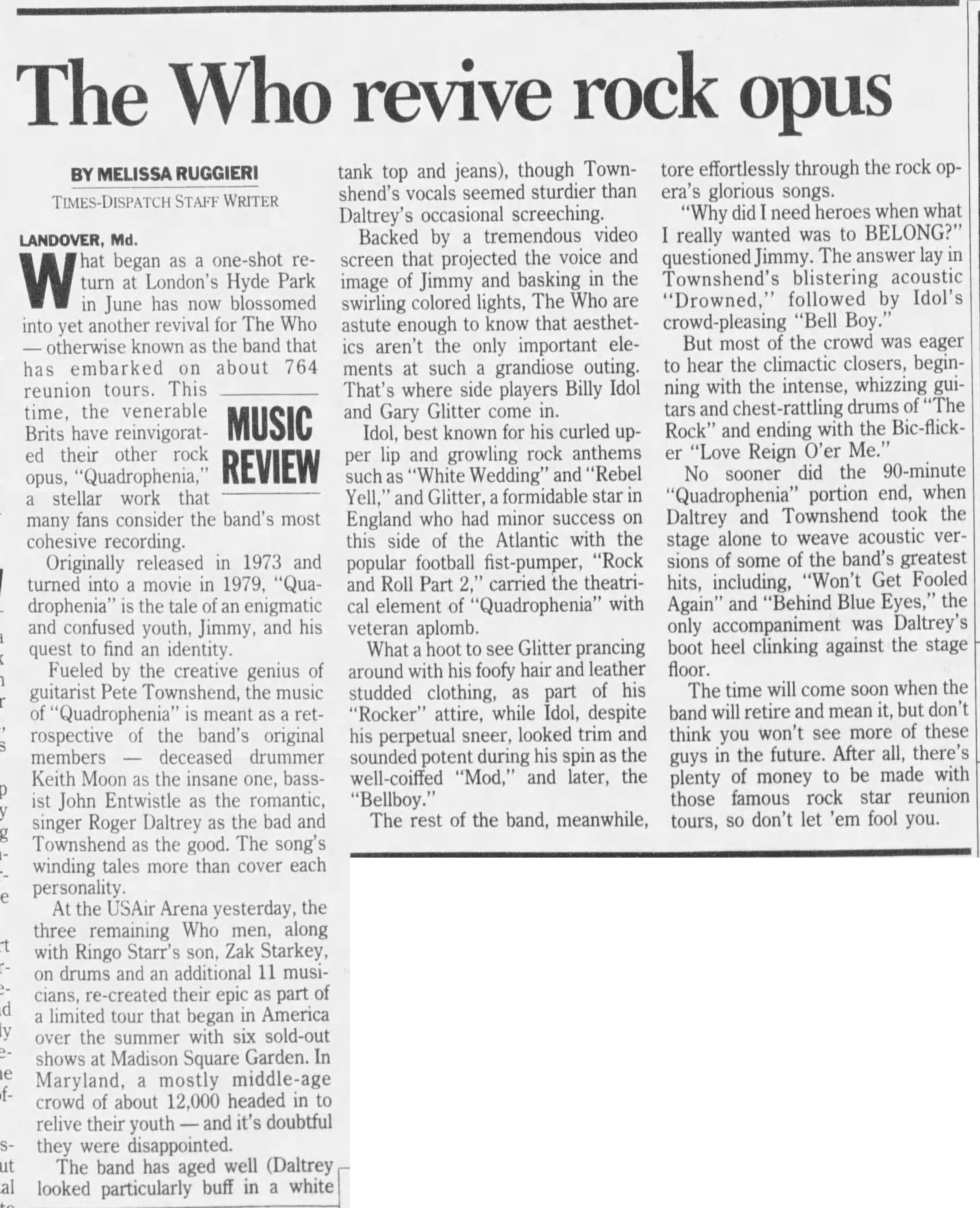
The Who may not be interested in reviving themselves, but they've done a fabulous job on their "other" rock opera, "Quadrophenia." The group didn't sell out USAir Arena last night, but the 12,000 fans who came witnessed a bold, at times brilliant reframing of the work that took advantage of advanced technology, a greatly expanded band and the realization that "Quadrophenia" was never opera. It is theater, and composer Pete Townshend is clearly seeking the same kind of reconsideration afforded its fabled predecessor, "Tommy."
The Who briefly toured "Quadrophenia" in 1973 but technical problems stymied the effort; 1996 marks the first time this long-neglected work has been performed live and in its entirety. In retrospect, it may have been a brilliant move to abandon it for more than 20 years, because "Quadrophenia" seems new again. A sober expansion of "My Generation," "Quadrophenia" is about the divide between adulthood and arrested adolescence. When it first arrived in 1973, the piece was envisioned as a way for the band to put both "Tommy" and the '60s behind. Like "Tommy," "Quadrophenia" has a linear plot: Jimmy the Mod gravitates to a seaside town, gets caught up in a rumble with the rival Rockers, has trouble finding either a job or a girl and finally realizes that neither life nor rock-and-roll is quite what it's cracked up to be.
However, "Quadrophenia" centered on a fashion/music-driven '60s subculture -- Britain's mods -- that never had much impact stateside. Originally, neither did the double album, though it produced two great concert staples in "5.15" and "Love, Reign O'er Me." In addition, Townshend's concept of a four-way split personality (which, along with the soon-failed quad sound system, gave the work its name) proved too confusing for audiences. Each facet of Jimmy's personality was supposed to reflect that of a band member while also representing youthful traits as disparate as aggression, insecurity, love and spirituality.
It's easier now to see the work as a meditation on teenage existentialism -- call it "Whospotting." Like "Trainspotting," "Quadrophenia" addresses boredom and despair, drugs, unemployment, sex and solitude. And Townshend's finale, in which Jimmy steals a rowboat, gets stranded on "The Rock" and briefly contemplates suicide, sets the stage for Townshend's variation on "Choose life!"
Onstage, Townshend, singer Roger Daltrey and bassist John Entwhistle were joined by drummer Zak Starkey (Keith Moon died in 1978 and his replacement, Kenny Jones, is not on this tour) and lead guitarist Simon Townshend, as well as two keyboardists, two backup singers, a five-man brass section and a percussionist, plus guest vocalists Billy Idol and Gary Glitter. The add-ons simply enriched the sound, giving it greater depth and vitality, but the focus was clearly on Pete Townshend (playing fiery acoustic guitar for most of the night), Daltrey (whose dynamo voice was in terrific shape) and Entwhistle (rapid-fire runs and rock-steady presence, as always)
To advance the story, the Who turned to Phil Daniels (who played Jimmy in the 1979 film version). They used some old film footage but relied on a newly shot narrative that appeared on a screen between songs, a process that occasionally slowed the music's momentum but went a great way toward ensuring that the plot made sense.
While the propulsive "5.15" and the anthemic "Love, Reign O'er Me" provoked easy recognition and approval, they were not the evening's highlights. The trilogy of "Helpless Dancer," "Is It in My Head?" and "I've Had Enough" were roiling with expressive energy, and the last included some emotionally riveting ensemble vocals from Pete Townshend, Daltrey, Idol and Glitter as Jimmy's disintegrated personality. In retrospect, "Doctor Jimmy" is a Who classic waiting for validation.
Townshend's features -- "Cut My Hair," "I Am One" and "Drowned" -- were searing; though his guitar was acoustic, the emotions were electric and the wonderfully yearning timbre of his voice is as mesmerizing as ever.
Overall, "Quadrophenia" is chock-full of guitar-driven crescendos and songs such as "The Punk and the Godfather" and "Bell Boy" that offer sharp but sympathetic takes on youthful disillusionment.
After a deservedly thunderous ovation, the Who returned for a mostly acoustic encore of "Won't Get Fooled Again," "Behind Blue Eyes" and "Who Are You." It felt oddly unnecessary and was certainly less urgent and dramatic than what had come before. In contrast, "Quadrophenia" sounded Who-ish, looked Who-ish and was most definitely Who-ish. The codgers are all right. CAPTION: Just like old times: Lead singer Roger Daltrey belted out a tune last night at USAir Arena as the Who revisited its 1973 theater piece, "Quadrophenia."
« 1996-11-09 1996-11-12 »