1975-12-05-The_Cincinnati_Enquirer
The Who's Inside Battles, Criticisms Kept Inside
To Concertize At Riverfront Coliseum
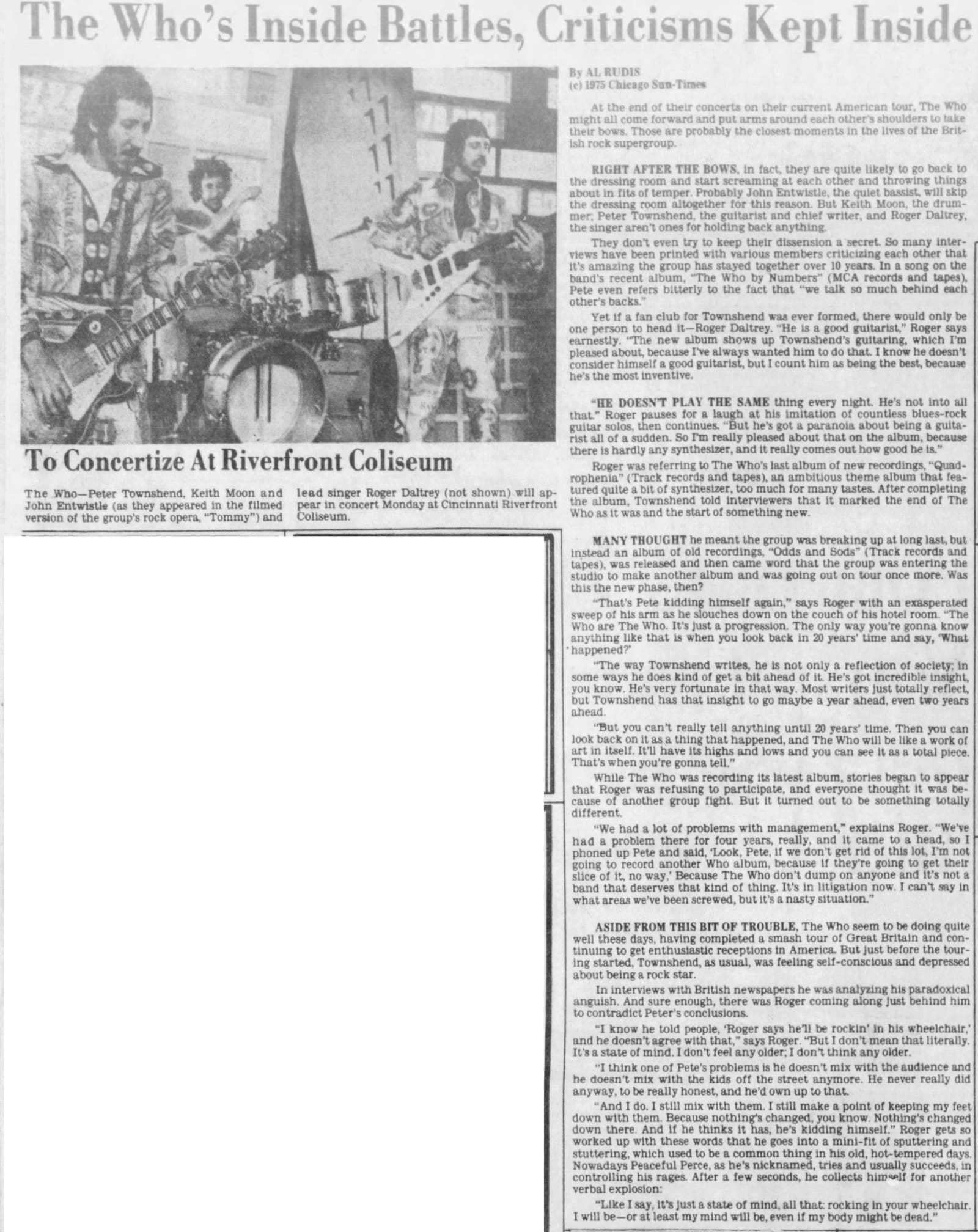
The Who—Peter Townshend, Keith Moon and John Entwistle (as they appeared in the filmed version of the group’s rock opera, “Tommy”) and lead singer Roger Daltrey (not shown) will appear in concert Monday at Cincinnati Riverfront Coliseum.
(c) 1975 Chicago Sun-Times
At the end of their concerts on their current American tour, The Who might all come forward and put arms around each other's shoulders to take their bows. Those are probably the closest moments in the lives of the British rock supergroup.
RIGHT AFTER THE BOWS, in fact, they are quite likely to go back to the dressing room and start screaming at each other and throwing things about in fits of temper. Probably John Entwistle, the quiet bassist, will skip the dressing room altogether for this reason. But Keith Moon, the drummer; Peter Townshend, the guitarist and chief writer, and Roger Daltrey, the singer aren't ones for holding back anything.
They don’t even try to keep their dissension a secret. So many interviews have been printed with various members criticizing each other that it’s amazing the group has stayed together over 10 years. In a song on the band’s recent album, “The Who by Numbers” (MCA records and tapes), Pete even refers bitterly to the fact that “we talk so much behind each other’s backs.”
Yet if a fan club for Townshend was ever formed, there would only be one person to head it—Roger Daltrey. “He is a good guitarist,” Roger says earnestly. “The new album shows up Townshend’s gutfaring, which I’m pleased about, because I’ve always wanted him to do that. I know he doesn’t consider himself a good guitarist, but I count him as being the best, because he’s the most inventive.
“HE DOESN’T PLAY THE SAME thing every night. He’s not into all that.” Roger pauses for a laugh at his imitation of countless blues-rock guitar solos, then continues. “But he’s got a paranoia about being a guitarist all of a sudden. So I’m really pleased about that on the album, because there is hardly any synthesizer, and it really comes out how good he is.”
Roger was referring to The Who’s last album of new recordings, “Quadrophenia” (Track records and tapes), an ambitious theme album that featured quite a bit of synthesizer, too much for many tastes. After completing the album, Townshend told interviewers that it marked the end of The Who as it was and the start of something new.
MANY THOUGHT he meant the group was breaking up at long last, but instead an album of old recordings, “Odds and Sods” (Track records and tapes), was released and then came word that the group was entering the studio to make another album and was going out on tour once more. Was this the new phase, then?
“That’s Pete kidding himself again,” says Roger with an exasperated sweep of his arm as he slouches down on the couch of his hotel room. “The Who are The Who. It’s just a progression. The only way you’re gonna know anything like that is when you look back in 20 years’ time and say, ‘What happened?’
“The way Townshend writes, he is not only a reflection of society; in some ways he does kind of get a bit ahead of it. He’s got incredible insight, you know. He’s very fortunate in that way. Most writers just totally reflect, but Townshend has that insight to go maybe a year ahead, even two years ahead.
“But you can’t really tell anything until 20 years’ time. Then you can look back on it as a thing that happened, and The Who will be like a work of art in itself. It’ll have its highs and lows and you can see it as a total piece. That’s when you’re gonna tell.”
While The Who was recording its latest album, stories began to appear that Roger was refusing to participate, and everyone thought it was because of another group fight. But it turned out to be something totally different.
“We had a lot of problems with management,” explains Roger. “We’ve had a problem there for four years, really, and it came to a head, so I phoned up Pete and said, ‘Look, Pete, if we don’t get rid of this lot, I’m not going to record another Who album, because if they’re going to get their slice of it, no way.’ Because The Who don’t dump on anyone and it’s not a band that deserves that kind of thing. It’s in litigation now. I can’t say in what areas we’ve been screwed, but it’s a nasty situation.”
ASIDE FROM THIS BIT OF TROUBLE, The Who seem to be doing quite well these days, having completed a smash tour of Great Britain and continuing to get enthusiastic receptions in America. But just before the touring started, Townshend, as usual, was feeling self-conscious and depressed about being a rock star.
In interviews with British newspapers he was analyzing his paradoxical anguish. And sure enough, there was Roger coming along just behind him to contradict Peter’s conclusions.
“I know he told people, ‘Roger says he’ll be rockin’ in his wheelchair,’ and he doesn’t agree with that,” says Roger. “But I don’t mean that literally. It’s a state of mind. I don’t feel any older; I don’t think any older.
“I think one of Pete’s problems is he doesn’t mix with the audience and he doesn’t mix with the kids off the street anymore. He never really did anyway, to be really honest, and he’d own up to that.
“And I do. I still mix with them. I still make a point of keeping my feet down with them. Because nothing’s changed, you know. Nothing’s changed down there. And if he thinks it has, he’s kidding himself.” Roger gets so worked up with these words that he goes into a mini-fit of sputtering and stuttering, which used to be a common thing in his old, hot-tempered days. Nowadays Peaceful Perce, as he’s nicknamed, tries and usually succeeds, in controlling his rages. After a few seconds, he collects himself for another verbal explosion:
“Like I say, it’s just a state of mind, all that: rocking in your wheelchair. I will be—or at least my mind will be, even if my body might be dead.”