1975-12-12-The_Hamilton_Spectator
Group Almost Outshone Light Show
TORONTO — You can talk about your Rolling Stones, your Led Zeppelins, your Dylans, or your Pink Floyds, but, if you weren’t at Maple Leaf Gardens last evening, you can’t talk about rock’n’roll. At least, not the real rock’n’roll.
As The Who — guitarist Peter Townshend, vocalist Roger Daltrey, drummer Keith Moon, and bassist John Entwistle — so graphically demonstrated during their first local appearance in far too long, there may, in fact, be only one true rock’n’roll band of any stature today. And that band is The Who.
For 105 searing minutes at volumes loud enough to stagger an ox the British quartet charged through what has become a classic rock’n’roll repertoire: early Who numbers like My Wife, subsequent hits like My Generation, the pinnacle of rock’n’roll success with a condensed version of Townshend’s score from Tommy and music from the ’70s like Won’t Be Fooled Again and the new Who By Numbers.
Finally, as if to provide a complete tour of the rock’n’roll world there were non—Who compositions like Summertime Blues.
Subtlety doesn’t figure prominently in The Who’s work. Daltrey bellows — though, oddly enough, managing to retain an angelic tone that is markedly out of character with the rest of the music — while Townshend slashes at his instrument with flourishing windmill-like sweeps. Roger Moon, the drummer, is deceptive in his fury, for there is grace and intelligence hidden behind those brutal percussive attacks.
The movements, like the music, attack rather than suggest. As Daltrey heaves his microphone high into the air, pulling it back like an audio yo-yo, Townshend swaggers across the stage, reels backwards and forwards, punctuating his savage riffs with exuberant leaps. Meanwhile, Moon slashes, apparently at random but always coming through with the right sound, at all corners of his monstrous drum set. Only Entwistle, affectionately known as “The Ox,” preserves a staid composure.
If subtlety — as it surely is — is lacking, however, impact has been carried to new heights. Townshend writes around very basic frameworks, most of them borrowed from early rock’n’roll styles. The uncomplicated nature of the material allows the energies to be channeled into force rather than musical complexities. The message is simple: Visceral reaction is the order of the day.
The audience reacted like Pavlov’s dog, forcing its way to the front of the stage, standing on seats to applaud, and lingering for more than ten minutes after the last notes had died in the Gardens’ rafters, screaming for more, though what more the band could have provided isn’t entirely obvious.
Perversely, considering the elementary nature of the music, the performance was staged in a manner that would put even the best Broadway stage lighting to shame. Almost two hundred overhead colored lights, a massive bank of blinding floodlights, and a magnificent array of tiny laser-like beams combined to provide what is unquestionably the finest lighting display ever to grace a stage in this part of the world.
When the band reached the climactic moments of We’re Not Going to Take it from Tommy, a spectacular trio of glowing fans sprang up in multi-hued radiance at the rear of the stage, rising to dance like tiny stars along the Gardens’ ceiling, then the floodlights surged on, bathing the stage in a heavenly bright, pure whiteness. The lighting alone was worth the sizeable price of admission ($10 tops).
But words fail to describe the energy, the glory, the precision, and the ultimate triumph of the event. The Who were once the promise of rock. Today, they are the realization of that promise, a living monument to the possibilities inherent in rock theatrics. They have achieved what other bands have not even dared to imagine:
They are, in sum, more than a band. They are the embodiment of rock’n’roll and rock’n’roll has never seen finer days.
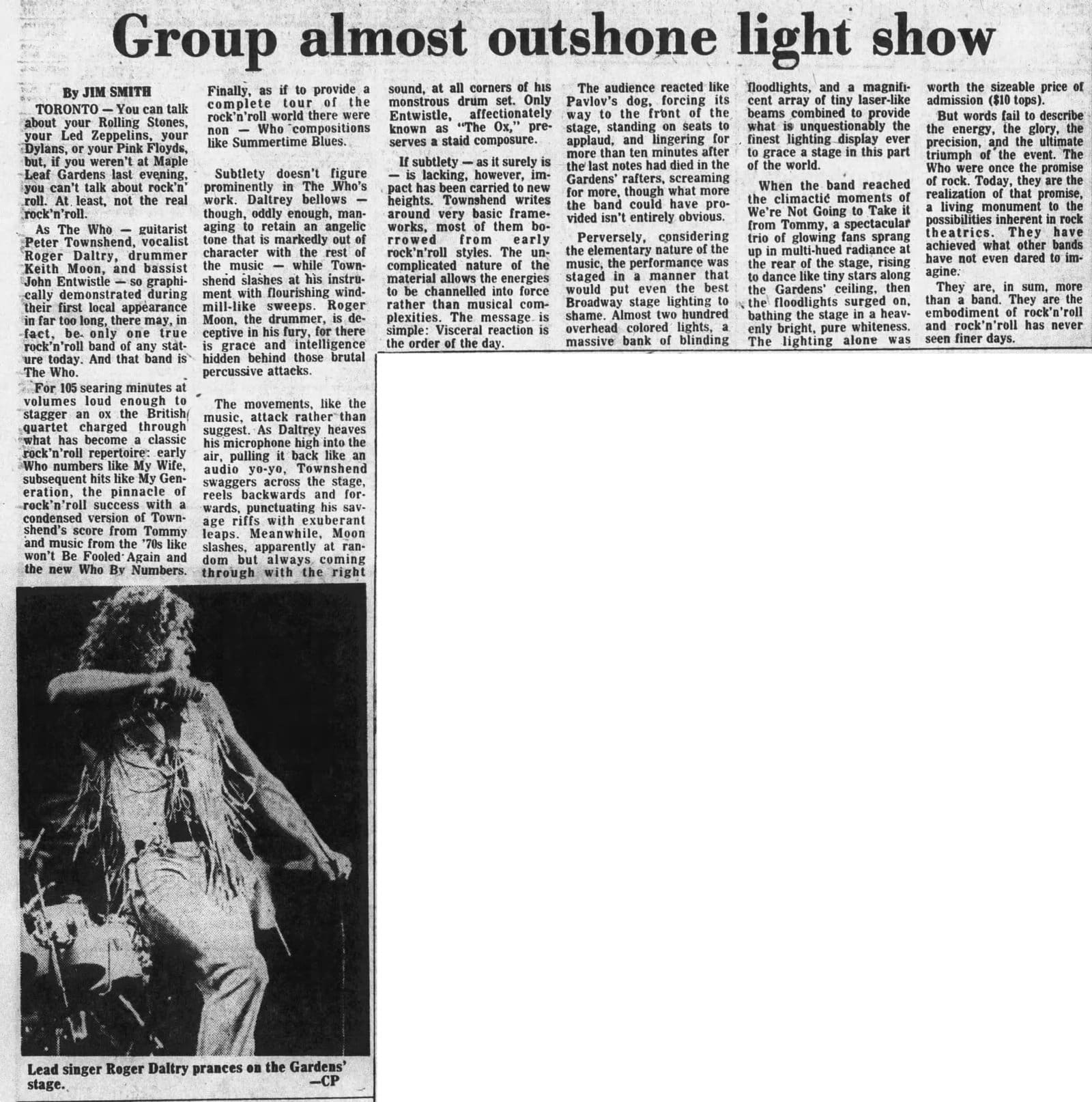
Lead singer Roger Daltrey prances on the Gardens’ stage. —CP