1976-03-15-Star_Tribune
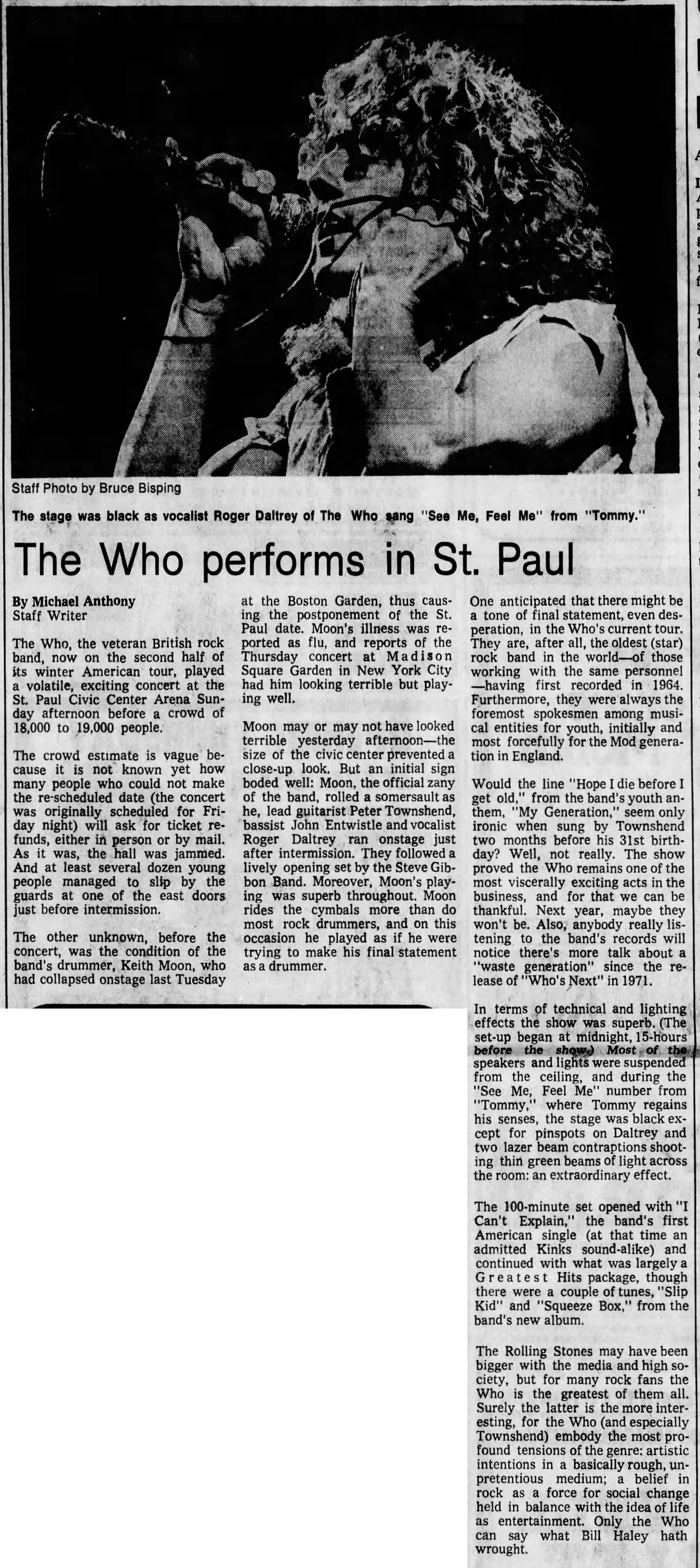
Staff Photo by Bruce Bisping
The stage was black as vocalist Roger Daltrey of The Who sang "See Me, Feel Me" from "Tommy."
The Who, the veteran British rock band, now on the second half of its winter American tour, played a volatile, exciting concert at the St. Paul Civic Center Arena Sunday afternoon before a crowd of 18,000 to 19,000 people.
The crowd estimate is vague because it is not known yet how many people who could not make the re-scheduled date (the concert was originally scheduled for Friday night) will ask for ticket refunds, either in person or by mail. As it was, the hall was jammed. And at least several dozen young people managed to slip by the guards at one of the east doors just before intermission.
The other unknown, before the concert, was the condition of the band's drummer, Keith Moon, who had collapsed onstage last Tuesday at the Boston Garden, thus causing the postponement of the St. Paul date. Moon's illness was reported as flu, and reports of the Thursday concert at Madison Square Garden in New York City had him looking terrible but playing well.
Moon may or may not have looked terrible yesterday afternoon—the size of the civic center prevented a close-up look. But an initial sign boded well: Moon, the official zany of the band, rolled a somersault as he, lead guitarist Peter Townshend, bassist John Entwistle and vocalist Roger Daltrey ran onstage just after intermission. They followed a lively opening set by the Steve Gibbon Band. Moreover, Moon's playing was superb throughout. Moon rides the cymbals more than do most rock drummers, and on this occasion he played as if he were trying to make his final statement as a drummer.
One anticipated that there might be a tone of final statement, even desperation, in the Who's current tour. They are, after all, the oldest (star) rock band in the world—of those working with the same personnel—having first recorded in 1964. Furthermore, they were always the foremost spokesmen among musical entities for youth, initially and most forcefully for the Mod generation in England.
Would the line "Hope I die before I get old," from the band's youth anthem, "My Generation," seem only ironic when sung by Townshend two months before his 31st birthday? Well, not really. The show proved the Who remains one of the most viscerally exciting acts in the business, and for that we can be thankful. Next year, maybe they won't be. Also, anybody really listening to the band's records will notice there's more talk about a "waste generation" since the release of "Who's Next" in 1971.
In terms of technical and lighting effects the show was superb. (The set-up began at midnight, 15-hours before the show.) Most of the speakers and lights were suspended from the ceiling, and during the "See Me, Feel Me" number from "Tommy," where Tommy regains his senses, the stage was black except for pinspots on Daltrey and two lazer beam contraptions shooting thin green beams of light across the room: an extraordinary effect.
The 100-minute set opened with "I Can't Explain," the band's first American single (at that time an admitted Kinks sound-alike) and continued with what was largely a Greatest Hits package, though there were a couple of tunes, "Slip Kid" and "Squeeze Box," from the band's new album.
The Rolling Stones may have been bigger with the media and high society, but for many rock fans the Who is the greatest of them all. Surely the latter is the more interesting, for the Who (and especially Townshend) embody the most profound tensions of the genre: artistic intentions in a basically rough, unpretentious medium; a belief in rock as a force for social change held in balance with the idea of life as entertainment. Only the Who can say what Bill Haley hath wrought.