1976-03-15-The_Minneapolis_Star
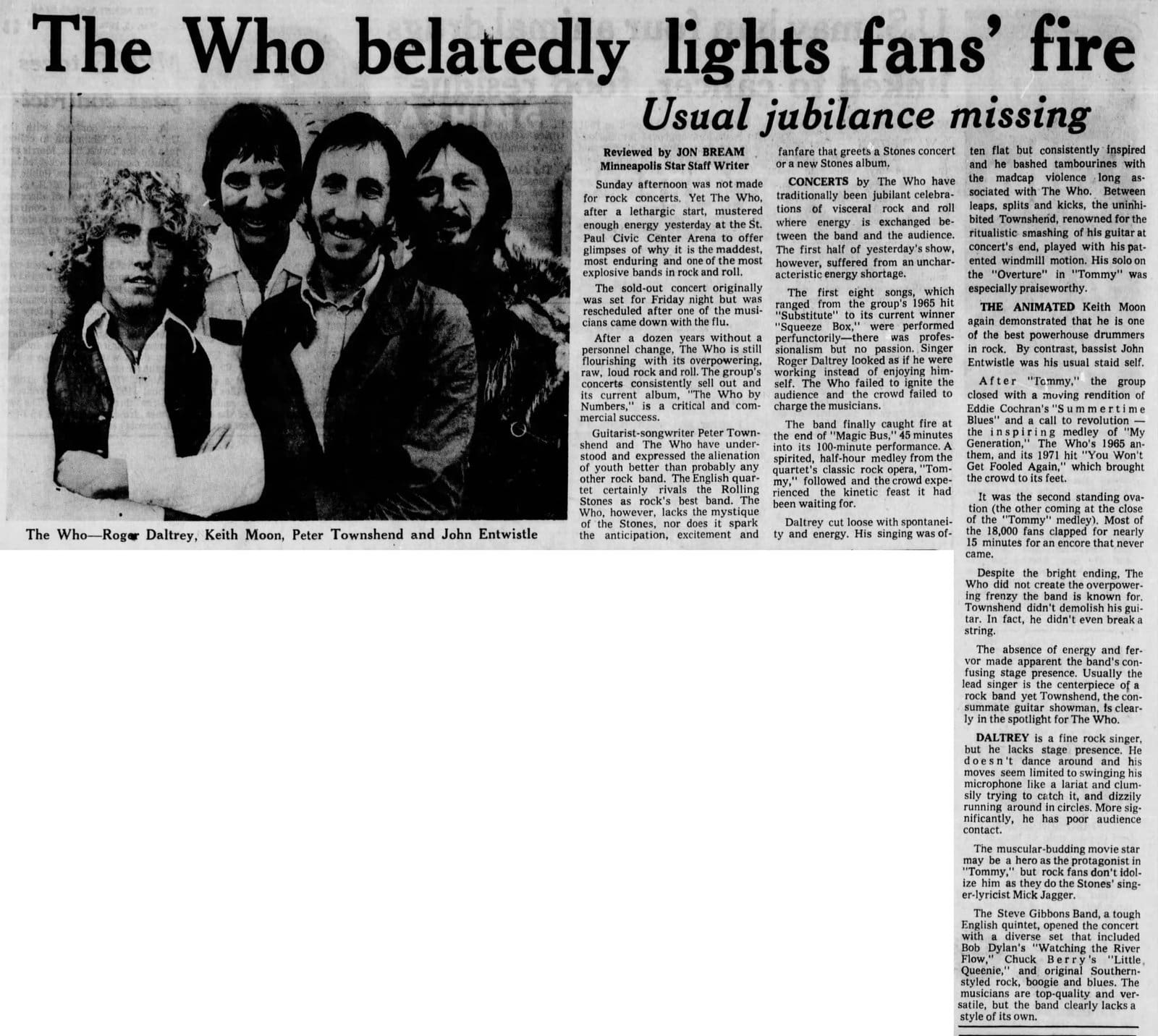
The Who—Roger Daltrey, Keith Moon, Peter Townshend and John Entwistle
Sunday afternoon was not made for rock concerts. Yet The Who, after a lethargic start, mustered enough energy yesterday at the St. Paul Civic Center Arena to offer glimpses of why it is the maddest, most enduring and one of the most explosive bands in rock and roll.
The sold-out concert originally was set for Friday night but was rescheduled after one of the musicians came down with the flu.
After a dozen years without a personnel change, The Who is still flourishing with its overpowering, raw, loud rock and roll. The group's concerts consistently sell out and its current album, "The Who by Numbers," is a critical and commercial success.
Guitarist-songwriter Peter Townshend and The Who have understood and expressed the alienation of youth better than probably any other rock band. The English quartet certainly rivals the Rolling Stones as rock's best band. The Who, however, lacks the mystique of the Stones, nor does it spark the anticipation, excitement and fanfare that greets a Stones concert or a new Stones album.
CONCERTS by The Who have traditionally been jubilant celebrations of visceral rock and roll where energy is exchanged between the band and the audience. The first half of yesterday's show, however, suffered from an uncharacteristic energy shortage.
The first eight songs, which ranged from the group's 1965 hit "Substitute" to its current winner "Squeeze Box," were performed perfunctorily—there was professionalism but no passion. Singer Roger Daltrey looked as if he were working instead of enjoying himself. The Who failed to ignite the audience and the crowd failed to charge the musicians.
The band finally caught fire at the end of "Magic Bus," 45 minutes into its 100-minute performance. A spirited, half-hour medley from the quartet's classic rock opera, "Tommy," followed and the crowd experienced the kinetic feast it had been waiting for.
Daltrey cut loose with spontaneity and energy. His singing was often flat but consistently inspired and he bashed tambourines with the madcap violence long associated with The Who. Between leaps, splits and kicks, the uninhibited Townshend, renowned for the ritualistic smashing of his guitar at concert's end, played with his patented windmill motion. His solo on the "Overture" in "Tommy" was especially praiseworthy.
THE ANIMATED Keith Moon again demonstrated that he is one of the best powerhouse drummers in rock. By contrast, bassist John Entwistle was his usual staid self.
After "Tommy," the group closed with a moving rendition of Eddie Cochran's "Summertime Blues" and a call to revolution—the inspiring medley of "My Generation," The Who's 1965 anthem, and its 1971 hit "You Won't Get Fooled Again," which brought the crowd to its feet.
It was the second standing ovation (the other coming at the close of the "Tommy" medley). Most of the 18,000 fans clapped for nearly 15 minutes for an encore that never came.
Despite the bright ending, The Who did not create the overpowering frenzy the band is known for. Townshend didn't demolish his guitar. In fact, he didn't even break a string.
The absence of energy and fervor made apparent the band's confusing stage presence. Usually the lead singer is the centerpiece of a rock band yet Townshend, the consummate guitar showman, is clearly in the spotlight for The Who.
DALTREY is a fine rock singer, but he lacks stage presence. He doesn't dance around and his moves seem limited to swinging his microphone like a lariat and clumsily trying to catch it, and dizzily running around in circles. More significantly, he has poor audience contact.
The muscular-budding movie star may be a hero as the protagonist in "Tommy," but rock fans don't idolize him as they do the Stones' singer-lyricist Mick Jagger.
The Steve Gibbons Band, a tough English quintet, opened the concert with a diverse set that included Bob Dylan's "Watching the River Flow," Chuck Berry's "Little Queenie," and original Southern-styled rock, boogie and blues. The musicians are top-quality and versatile, but the band clearly lacks a style of its own.