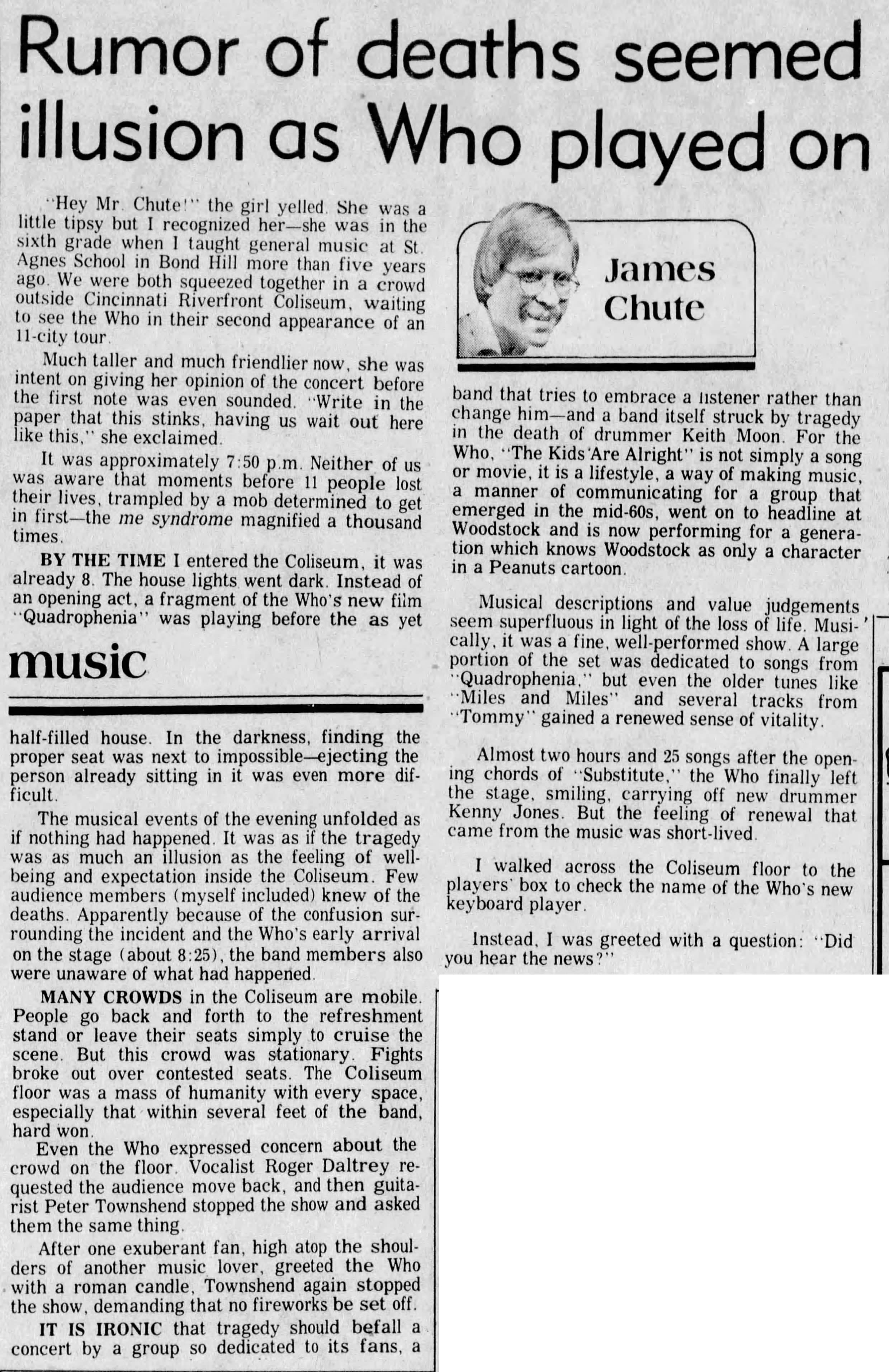
1979-12-04-The_Cincinnati_Post
"Hey Mr. Chute!" the girl yelled. She was a little tipsy but I recognized her—she was in the sixth grade when I taught general music at St. Agnes School in Bond Hill more than five years ago. We were both squeezed together in a crowd outside Cincinnati Riverfront Coliseum, waiting to see the Who in their second appearance of an 11-city tour.
Much taller and much friendlier now, she was intent on giving her opinion of the concert before the first note was even sounded. "Write in the paper that this stinks, having us wait out here like this," she exclaimed.
It was approximately 7:50 p.m. Neither of us was aware that moments before 11 people lost their lives, trampled by a mob determined to get in first—the me syndrome magnified a thousand times.
The musical events of the evening unfolded as if nothing had happened. It was as if the tragedy was as much an illusion as the feeling of well-being and expectation inside the Coliseum. Few audience members (myself included) knew of the deaths. Apparently because of the confusion surrounding the incident and the Who's early arrival on the stage (about 8:25), the band members also were unaware of what had happened.
MANY CROWDS in the Coliseum are mobile. People go back and forth to the refreshment stand or leave their seats simply to cruise the scene. But this crowd was stationary. Fights broke out over contested seats. The Coliseum floor was a mass of humanity with every space, especially that within several feet of the band, hard won.
Even the Who expressed concern about the crowd on the floor. Vocalist Roger Daltrey requested the audience move back, and then guitarist Peter Townshend stopped the show and asked them the same thing.
After one exuberant fan, high atop the shoulders of another music lover, greeted the Who with a roman candle, Townshend again stopped the show, demanding that no fireworks be set off.
IT IS IRONIC that tragedy should befall a concert by a group so dedicated to its fans, a band that tries to embrace a listener rather than change him—and a band itself struck by tragedy in the death of drummer Keith Moon. For the Who, "The Kids Are Alright" is not simply a song or movie, it is a lifestyle, a way of making music, a manner of communicating for a group that emerged in the mid-60s, went on to headline at Woodstock and is now performing for a generation which knows Woodstock as only a character in a Peanuts cartoon.
Musical descriptions and value judgements seem superfluous in light of the loss of life. Musically, it was a fine, well-performed show. A large portion of the set was dedicated to songs from "Quadrophenia," but even the older tunes like "Miles and Miles" and several tracks from "Tommy" gained a renewed sense of vitality.
Almost two hours and 25 songs after the opening chords of "Substitute," the Who finally left the stage, smiling, carrying off new drummer Kenny Jones. But the feeling of renewal that came from the music was short-lived.
I walked across the Coliseum floor to the players' box to check the name of the Who's new keyboard player.
Instead, I was greeted with a question: "Did you hear the news?"