1979-12-05-The_Buffalo_News_1
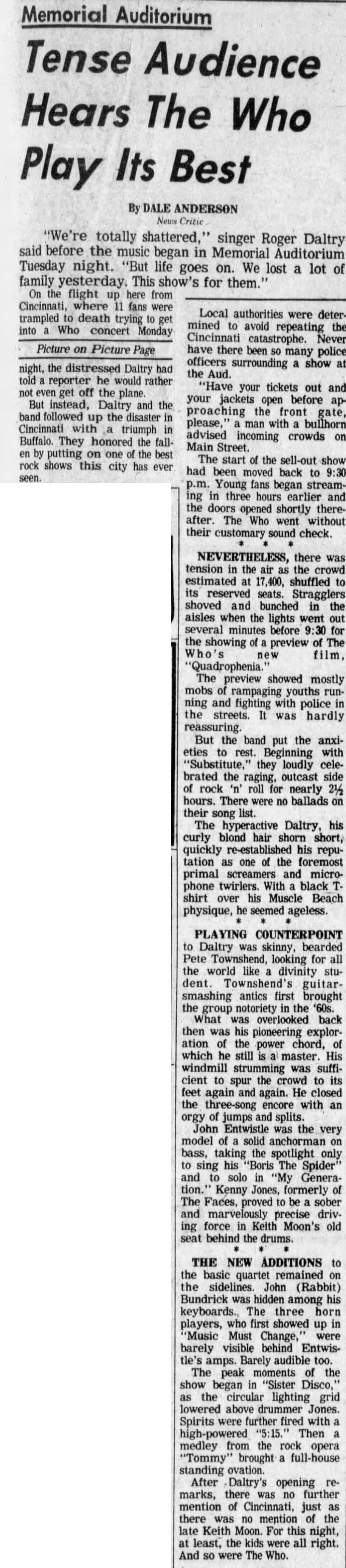
“We’re totally shattered,” singer Roger Daltry said before the music began in Memorial Auditorium Tuesday night. “But life goes on. We lost a lot of family yesterday. This show’s for them.”
On the flight up here from Cincinnati, where 11 fans were trampled to death trying to get into a Who concert Monday night, the distressed Daltry had told a reporter he would rather not even get off the plane.
But instead, Daltry and the band followed up the disaster in Cincinnati with a triumph in Buffalo. They honored the fallen by putting on one of the best rock shows this city has ever seen.
Local authorities were determined to avoid repeating the Cincinnati catastrophe. Never have there been so many police officers surrounding a show at the Aud.
“Have your tickets out and your jackets open before approaching the front gate, please,” a man with a bullhorn advised incoming crowds on Main Street.
The start of the sell-out show had been moved back to 9:30 p.m. Young fans began streaming in three hours earlier and the doors opened shortly thereafter. The Who went without their customary sound check.
* * *
NEVERTHELESS, there was tension in the air as the crowd estimated at 17,400 shuffled to its reserved seats. Stragglers shoved and bunched in the aisles when the lights went out several minutes before 9:30 for the showing of a preview of The Who’s new film, “Quadrophenia.”
The preview showed mostly mobs of rampaging youths running and fighting with police in the streets. It was hardly reassuring.
But the band put the anxieties to rest. Beginning with “Substitute,” they loudly celebrated the raging, outcast side of rock ’n’ roll for nearly 2½ hours. There were no ballads on their song list.
The hyperactive Daltry, his curly blond hair shorn short, quickly re-established his reputation as one of the foremost primal screamers and microphone twirlers. With a black T-shirt over his Muscle Beach physique, he seemed ageless.
* * *
PLAYING COUNTERPOINT to Daltry was skinny, bearded Pete Townshend, looking for all the world like a divinity student. Townshend’s guitar-smashing antics first brought the group notoriety in the ’60s.
What was overlooked back then was his pioneering exploration of the power chord, of which he still is a master. His windmill strumming was sufficient to spur the crowd to its feet again and again. He closed the three-song encore with an orgy of jumps and splits.
John Entwistle was the very model of a solid anchorman on bass, taking the spotlight only to sing his “Boris The Spider” and to solo in “My Generation.” Kenny Jones, formerly of The Faces, proved to be a sober and marvelously precise driving force in Keith Moon’s old seat behind the drums.
* * *
THE NEW ADDITIONS to the basic quartet remained on the sidelines. John (Rabbit) Bundrick was hidden among his keyboards. The three horn players, who first showed up in “Music Must Change,” were barely visible behind Entwistle’s amps. Barely audible too.
The peak moments of the show began in “Sister Disco,” as the circular lighting grid lowered above drummer Jones. Spirits were further fired with a high-powered “5:15.” Then a medley from the rock opera “Tommy” brought a full-house standing ovation.
After Daltry’s opening remarks, there was no further mention of Cincinnati, just as there was no mention of the late Keith Moon. For this night, at least, the kids were all right.