1980-04-29-The_Minneapolis_Star
These days, everyone seems to be bad-mouthing The Who.
Item 1: Last week, I heard a radio commercial advertising a local performance by an unknown band that re-creates the music of the Doors. "More chairs broken there than at The Who's concert," the ad boasted of the group's show in some club in some city on the East Coast. Of course, I doubt the Who and this little-known band played in the same club. Nevertheless, the ad made its point.
Item 2: A couple of weeks ago at the John Denver concert in St. Paul, two men sitting behind me were complaining about how they had paid the top ticket price for loge seats that seemed miles away from the stage-in-the-round. They yearned for seats on the main floor that surrounded the stage and could find little solace in their situation. "One thing I know for sure," one man said, "I wouldn't want to sit down there for The Who concert." I turned around and saw two 40ish men wearing suits. I doubt either man could name one song by The Who.
The Who doesn't deserve this bad rap, whether it's coming from middle-aged men who don't know any better or rock club owners who should know better. This band deserves some respect.
The Who gained this reputation and eternal notoriety because 11 persons were trampled to death trying to get into the band's concert in Cincinnati in December. Although The Who attracted those 11 young people to Riverfront Coliseum that night, it was not the band's fault that the tragedy occurred.
The management of the privately owned coliseum mishandled the crowd-control situation by opening too few arena doors after the announced opening time for the general-admission concert.
Since that concert, the city of Cincinnati has adopted new regulations, banning general-admission seating and requiring more doors open at an earlier time, cracking down on smoking inside the arena and tightening overall security. Concerts by ZZ Top and Linda Ronstadt have since been held there with no major incidents.
(Those kinds of policies have been practiced at the St. Paul Civic Center and Bloomington's Met Center for several years. However, for Wednesday's Who concert in St. Paul, there will be more plainclothes police outside the civic center than usual for sold-out rock concerts, building manager John Friedman said, because spring weather might attract more gate-crashers and ticket scalpers.)
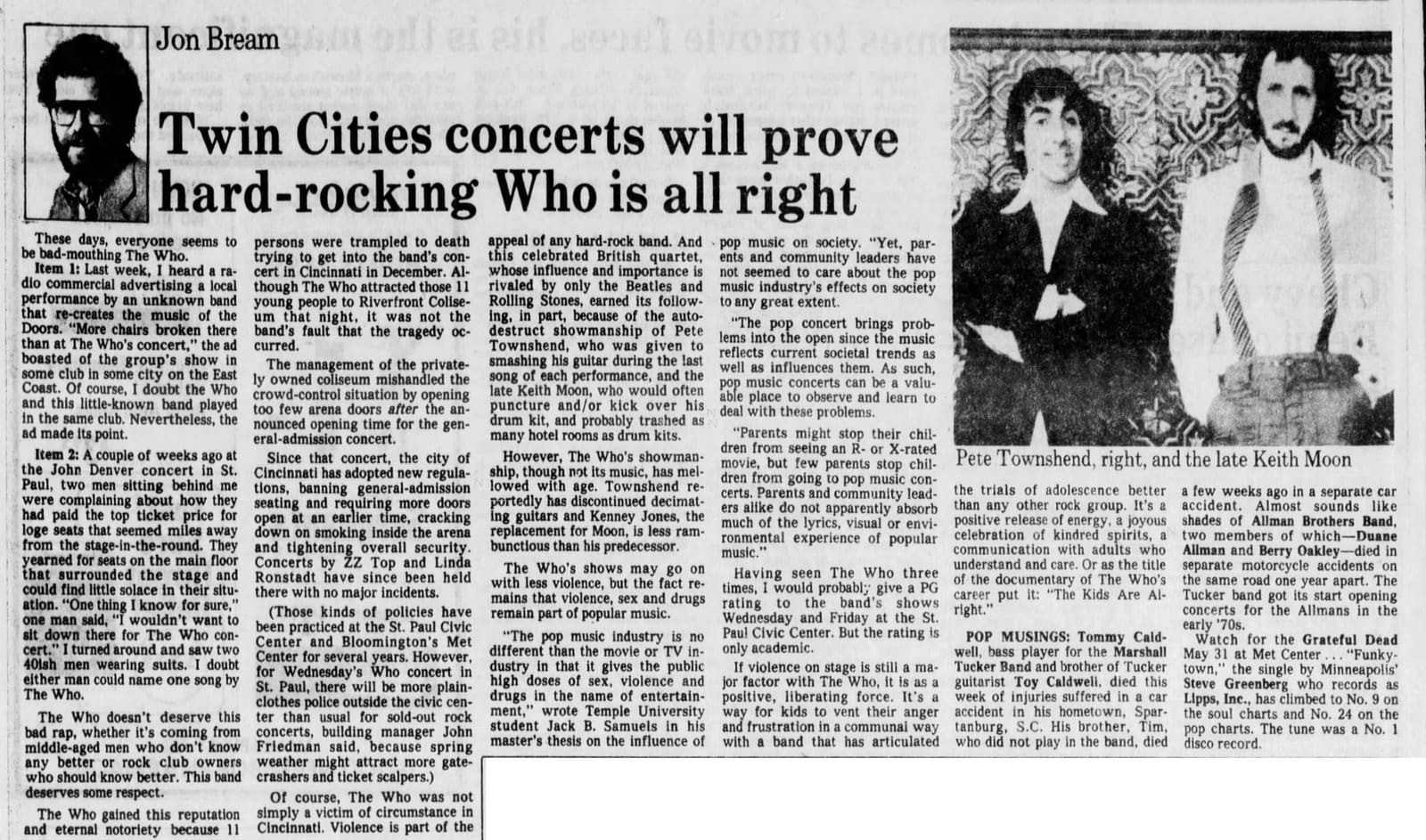
Of course, The Who was not simply a victim of circumstance in Cincinnati. Violence is part of the appeal of any hard-rock band. And this celebrated British quartet, whose influence and importance is rivaled by only the Beatles and Rolling Stones, earned its following, in part, because of the autodestruct showmanship of Pete Townshend, who was given to smashing his guitar during the last song of each performance, and the late Keith Moon, who would often puncture and/or kick over his drum kit, and probably trashed as many hotel rooms as drum kits.
However, The Who's showmanship, though not its music, has mellowed with age. Townshend reportedly has discontinued decimating guitars and Kenney Jones, the replacement for Moon, is less rambunctious than his predecessor.
The Who's shows may go on with less violence, but the fact remains that violence, sex and drugs remain part of popular music.
"The pop music industry is no different than the movie or TV industry in that it gives the public high doses of sex, violence and drugs in the name of entertainment," wrote Temple University student Jack B. Samuels in his master's thesis on the influence of pop music on society. "Yet, parents and community leaders have not seemed to care about the pop music industry's effects on society to any great extent.
"The pop concert brings problems into the open since the music reflects current societal trends as well as influences them. As such, pop music concerts can be a valuable place to observe and learn to deal with these problems.
"Parents might stop their children from seeing an R- or X-rated movie, but few parents stop children from going to pop music concerts. Parents and community leaders alike do not apparently absorb much of the lyrics, visual or enviromental experience of popular music."
Having seen The Who three times, I would probably give a PG rating to the band's shows Wednesday and Friday at the St. Paul Civic Center. But the rating is only academic.
If violence on stage is still a major factor with The Who, it is as a positive, liberating force. It's a way for kids to vent their anger and frustration in a communal way with a band that has articulated
Pete Townshend, right, and the late Keith Moon
the trials of adolescence better than any other rock group. It's a positive release of energy, a joyous celebration of kindred spirits, a communication with adults who understand and care. Or as the title of the documentary of The Who's career put it: "The Kids Are Alright."
POP MUSINGS: Tommy Caldwell, bass player for the Marshall Tucker Band and brother of Tucker guitarist Toy Caldwell, died this week of injuries suffered in a car accident in his hometown, Spartanburg, S.C. His brother, Tim, who did not play in the band, died a few weeks ago in a separate car accident. Almost sounds like shades of Allman Brothers Band, two members of which 6uane Allman and Berry Oakley 6 died in separate motorcycle accidents on the same road one year apart. The Tucker band got its start opening concerts for the Allmans in the early '70s.
Watch for the Grateful Dead May 31 at Met Center … "Funkytown," the single by Minneapolis' Steve Greenberg who records as Lipps, Inc., has climbed to No. 9 on the soul charts and No. 24 on the pop charts. The tune was a No. 1 disco record.