1980-05-01-The_Rocket
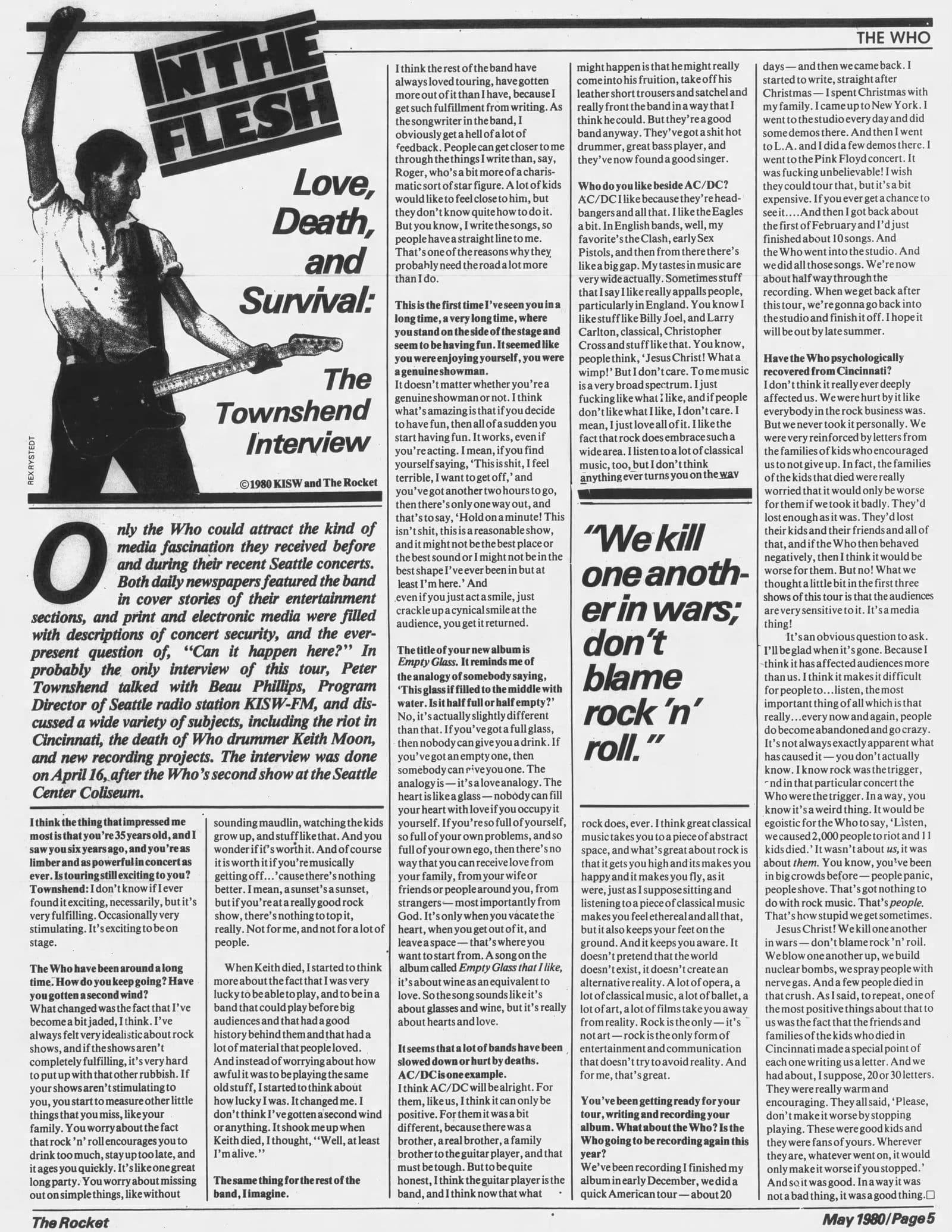
Only the Who could attract the kind of media fascination they received before and during their recent Seattle concerts. Both daily newspapers featured the band in cover stories of their entertainment sections, and print and electronic media were filled with descriptions of concert security, and the ever-present question of, "Can it happen here?" In probably the only interview of this tour, Peter Townshend talked with Beau Phillips, Program Director of Seattle radio station KISW-FM, and discussed a wide variety of subjects, including the riot in Cincinnati, the death of Who drummer Keith Moon, and new recording projects. The interview was done on April 16, after the Who's second show at the Seattle Center Coliseum.
I think the thing that impressed me most is that you're 35 years old, and I saw you six years ago, and you're as limber and as powerful in concert as ever. Is touring still exciting to you? Townshend: I don't know if I ever found it exciting, necessarily, but it's very fulfilling. Occasionally very stimulating. It's exciting to be on stage.
The Who have been around a long time. How do you keep going? Have you gotten a second wind? What changed was the fact that I've become a bit jaded, I think. I've always felt very idealistic about rock shows, and if the shows aren't completely fulfilling, it's very hard to put up with that other rubbish. If your shows aren't stimulating to you, you start to measure other little things that you miss, like your family. You worry about the fact that rock 'n' roll encourages you to drink too much, stay up too late, and it ages you quickly. It's like one great long party. You worry about missing out on simple things, like without sounding maudlin, watching the kids grow up, and stuff like that. And you wonder if it's worth it. And of course it is worth it if you're musically getting off… 'cause there's nothing better. I mean, a sunset's a sunset, but if you're at a really good rock show, there's nothing to top it, really. Not for me, and not for a lot of people.
When Keith died, I started to think more about the fact that I was very lucky to be able to play, and to be in a band that could play before big audiences and that had a good history behind them and that had a lot of material that people loved. And instead of worrying about how awful it was to be playing the same old stuff, I started to think about how lucky I was. It changed me. I don't think I've gotten a second wind or anything. It shook me up when Keith died, I thought, "Well, at least I'm alive."
The same thing for the rest of the band, I imagine.
I think the rest of the band have always loved touring, have gotten more out of it than I have, because I get such fulfillment from writing. As the songwriter in the band, I obviously get a hell of a lot of feedback. People can get closer to me through the things I write than, say, Roger, who's a bit more of a charismatic sort of star figure. A lot of kids would like to feel close to him, but they don't know quite how to do it. But you know, I write the songs, so people have a straight line to me. That's one of the reasons why they probably need the road a lot more than I do.
This is the first time I've seen you in a long time, a very long time, where you stand on the side of the stage and seem to be having fun. It seemed like you were enjoying yourself, you were a genuine showman.
It doesn't matter whether you're a genuine showman or not. I think what's amazing is that if you decide to have fun, then all of a sudden you start having fun. It works, even if you're acting. I mean, if you find yourself saying, 'This is shit, I feel terrible, I want to get off,' and you've got another two hours to go, then there's only one way out, and that's to say, 'Hold on a minute! This isn't shit, this is a reasonable show, and it might not be the best place or the best sound or I might not be in the best shape I've ever been in but at least I'm here.' And even if you just act a smile, just crackle up a cynical smile at the audience, you get it returned.
The title of your new album is Empty Glass. It reminds me of the analogy of somebody saying, 'This glass is filled to the middle with water. Is it half full or half empty?'
No, it's actually slightly different than that. If you've got a full glass, then nobody can give you a drink. If you've got an empty one, then somebody can give you one. The analogy is — it's a love analogy. The heart is like a glass — nobody can fill your heart with love if you occupy it yourself. If you're so full of yourself, so full of your own problems, and so full of your own ego, then there's no way that you can receive love from your family, from your wife or friends or people around you, from strangers — most importantly from God. It's only when you vacate the heart, when you get out of it, and leave a space — that's where you want to start from. A song on the album called Empty Glass that I like, it's about wine as an equivalent to love. So the song sounds like it's about glasses and wine, but it's really about hearts and love.
It seems that a lot of bands have been slowed down or hurt by deaths. AC/DC is one example.
I think AC/DC will be alright. For them, like us, I think it can only be positive. For them it was a bit different, because there was a brother, a real brother, a family brother to the guitar player, and that must be tough. But to be quite honest, I think the guitar player is the band, and I think now that what might happen is that he might really come into his fruition, take off his leather short trousers and satchel and really front the band in a way that I think he could. But they're a good band anyway. They've got a shit hot drummer, great bass player, and they've now found a good singer.
Who do you like beside AC/DC?
AC/DC I like because they're headbangers and all that. I like the Eagles a bit. In English bands, well, my favorite's the Clash, early Sex Pistols, and then from there there's like a big gap. My tastes in music are very wide actually. Sometimes stuff that I say I like really appalls people, particularly in England. You know I like stuff like Billy Joel, and Larry Carlton, classical, Christopher Cross and stuff like that. You know, people think, 'Jesus Christ! What a wimp!' But I don't care. To me music is a very broad spectrum. I just fucking like what I like, and if people don't like what I like, I don't care. I mean, I just love all of it. I like the fact that rock does embrace such a wide area. I listen to a lot of classical music, too, but I don't think anything ever turns you on the way rock does, ever. I think great classical music takes you to a piece of abstract space, and what's great about rock is that it gets you high and its makes you happy and it makes you fly, as it were, just as I suppose sitting and listening to a piece of classical music makes you feel ethereal and all that, but it also keeps your feet on the ground. And it keeps you aware. It doesn't pretend that the world doesn't exist, it doesn't create an alternative reality. A lot of opera, a lot of classical music, a lot of ballet, a lot of art, a lot of films take you away from reality. Rock is the only — it's not art — rock is the only form of entertainment and communication that doesn't try to avoid reality. And for me, that's great.
You've been getting ready for your tour, writing and recording your album. What about the Who? Is the Who going to be recording again this year?
We've been recording I finished my album in early December, we did a quick American tour — about 20 days — and then we came back. I started to write, straight after Christmas — I spent Christmas with my family. I came up to New York. I went to the studio every day and did some demos there. And then I went to L.A. and I did a few demos there. I went to the Pink Floyd concert. It was fucking unbelievable! I wish they could tour that, but it's a bit expensive. If you ever get a chance to see it… And then I got back about the first of February and I'd just finished about 10 songs. And the Who went into the studio. And we did all those songs. We're now about half way through the recording. When we get back after this tour, we're gonna go back into the studio and finish it off. I hope it will be out by late summer.
Have the Who psychologically recovered from Cincinnati?
I don't think it really ever deeply affected us. We were hurt by it like everybody in the rock business was. But we never took it personally. We were very reinforced by letters from the families of kids who encouraged us to not give up. In fact, the families of the kids that died were really worried that it would only be worse for them if we took it badly. They'd lost enough as it was. They'd lost their kids and their friends and all of that, and if the Who then behaved negatively, then I think it would be worse for them. But no! What we thought a little bit in the first three shows of this tour is that the audiences are very sensitive to it. It's a media thing!
It's an obvious question to ask. I'll be glad when it's gone. Because I think it has affected audiences more than us. I think it makes it difficult for people to… listen, the most important thing of all which is that really… every now and again, people do become abandoned and go crazy. It's not always exactly apparent what has caused it — you don't actually know. I know rock was the trigger, and in that particular concert the Who were the trigger. In a way, you know it's a weird thing. It would be egoistic for the Who to say, 'Listen, we caused 2,000 people to riot and 11 kids died.' It wasn't about us, it was about them. You know, you've been in big crowds before — people panic, people shove. That's got nothing to do with rock music. That's people. That's how stupid we get sometimes.
Jesus Christ! We kill one another in wars — don't blame rock 'n' roll. We blow one another up, we build nuclear bombs, we spray people with nerve gas. And a few people died in that crush. As I said, to repeat, one of the most positive things about that to us was the fact that the friends and families of the kids who died in Cincinnati made a special point of each one writing us a letter. And we had about, I suppose, 20 or 30 letters. They were really warm and encouraging. They all said, 'Please, don't make it worse by stopping playing. These were good kids and they were fans of yours. Wherever they are, whatever went on, it would only make it worse if you stopped.' And so it was good. In a way it was not a bad thing, it was a good thing…