1980-05-06-The_Globe_and_Mail
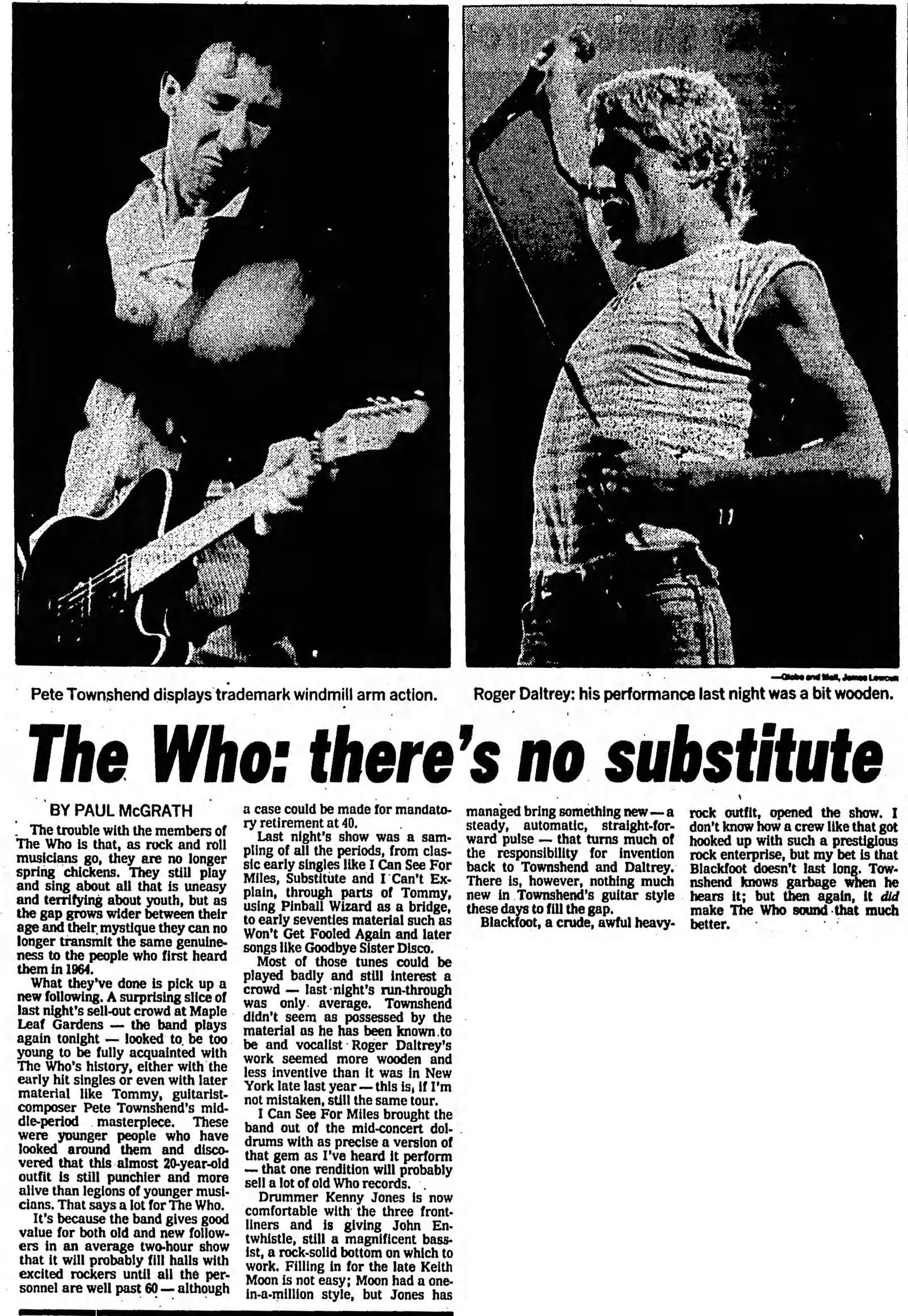
Pete Townshend displays trademark windmill arm action.
Roger Daltrey: his performance last night was a bit wooden.
The Who: there's no substitute
The trouble with the members of The Who is that, as rock and roll musicians go, they are no longer spring chickens. They still play and sing about all that is uneasy and terrifying about youth, but as the gap grows wider between their age and their mystique they can no longer transmit the same genuineness to the people who first heard them in 1964.
What they've done is pick up a new following. A surprising slice of last night's sell-out crowd at Maple Leaf Gardens – the band plays again tonight – looked to be too young to be fully acquainted with The Who's history, either with the early hit singles or even with later material like Tommy, guitarist-composer Pete Townshend's middle-period masterpiece. These were younger people who have looked around them and discovered that this almost 20-year-old outfit is still punchier and more alive than legions of younger musicians. That says a lot for The Who.
It's because the band gives good value for both old and new followers in an average two-hour show that it will probably fill halls with excited rockers until all the personnel are well past 60 – although a case could be made for mandatory retirement at 40.
Last night's show was a sampling of all the periods, from classic early singles like I Can See For Miles, Substitute and I Can't Explain, through parts of Tommy, using Pinball Wizard as a bridge, to early seventies material such as Won't Get Fooled Again and later songs like Goodbye Sister Disco.
Most of those tunes could be played badly and still interest a crowd – last night's run-through was only average. Townshend didn't seem as possessed by the material as he has been known to be and vocalist Roger Daltrey's work seemed more wooden and less inventive than it was in New York late last year – this is, if I'm not mistaken, still the same tour.
I Can See For Miles brought the band out of the mid-concert doldrums with as precise a version of that gem as I've heard it perform – that one rendition will probably sell a lot of old Who records.
Drummer Kenny Jones is now comfortable with the three front-liners and is giving John Entwhistle, still a magnificent bassist, a rock-solid bottom on which to work. Filling in for the late Keith Moon is not easy; Moon had a one-in-a-million style, but Jones has managed bring something new – a steady, automatic, straight-forward pulse – that turns much of the responsibility for invention back to Townshend and Daltrey. There is, however, nothing much new in Townshend's guitar style these days to fill the gap.
Blackfoot, a crude, awful heavy-rock outfit, opened the show. I don't know how a crew like that got hooked up with such a prestigious rock enterprise, but my bet is that Blackfoot doesn't last long. Townshend knows garbage when he hears it; but then again, it did make The Who sound that much better.