1980-05-08-The_Gazette
The snows of yesteryear have long buried the boys of summer who urged us to “go surfin’ now/Everybody’s learnin’ how.” Herman’s Hermits have sung about ’Enery the Eighth at least a thousand times too many.
Rock bands have wandered off into Strawberry Fields Forever, disappeared into the House of the Rising Sun or changed the crew of their Jefferson Airplane and headed for outer space on a Starship. There just aren’t many survival groups from the mid-1960s rockpile — with the notable exception of most of the Rolling Stones…and The Who.
A new generation
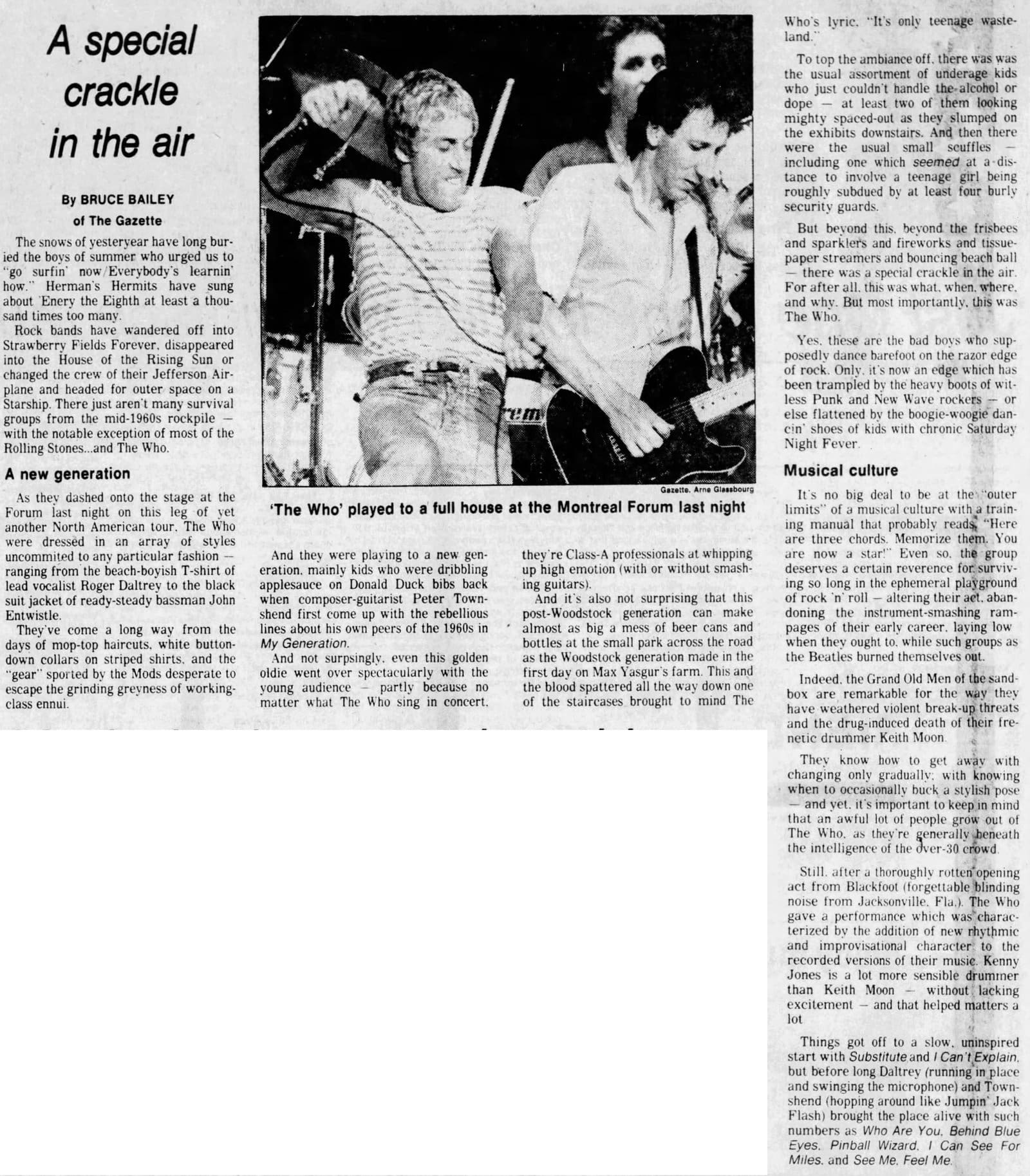
As they dashed onto the stage at the Forum last night on this leg of yet another North American tour, The Who were dressed in an array of styles uncommitted to any particular fashion — ranging from the beach-boyish T-shirt of lead vocalist Roger Daltrey to the black suit jacket of ready-steady bassman John Entwistle.
They’ve come a long way from the days of mop-top haircuts, white button-down collars on striped shirts, and the “gear” sported by the Mods desperate to escape the grinding greyness of working-class ennui.
And they were playing to a new generation, mainly kids who were dribbling applesauce on Donald Duck bibs back when composer-guitarist Peter Townshend first come up with the rebellious lines about his own peers of the 1960s in My Generation.
And not surprisingly, even this golden oldie went over spectacularly with the young audience — partly because no matter what The Who sing in concert, they’re Class-A professionals at whipping up high emotion (with or without smashing guitars).
And it’s also not surprising that this post-Woodstock generation can make almost as big a mess of beer cans and bottles at the small park across the road as the Woodstock generation made in the first day on Max Yasgur’s farm. This and the blood spattered all the way down one of the staircases brought to mind The Who’s lyric. “It’s only teenage wasteland.”
To top the ambiance off, there was was the usual assortment of underage kids who just couldn’t handle the alcohol or dope — at least two of them looking mighty spaced-out as they slumped on the exhibits downstairs. And then there were the usual small scuffles including one which seemed at a distance to involve a teenage girl being roughly subdued by at least four burly security guards.
But beyond this, beyond the frisbees and sparklers and fireworks and tissue-paper streamers and bouncing beach ball — there was a special crackle in the air. For after all, this was what, when, where, and why. But most importantly, this was The Who.
Yes, these are the bad boys who supposedly dance barefoot on the razor edge of rock. Only it’s now an edge which has been trampled by the heavy boots of witless Punk and New Wave rockers — or else flattened by the boogie-woogie dancin’ shoes of kids with chronic Saturday Night Fever.
Musical culture
It’s no big deal to be at the “outer limits” of a musical culture with a training manual that probably reads, “Here are three chords. Memorize them. You are now a star!” Even so, the group deserves a certain reverence for surviving so long in the ephemeral playground of rock ’n’ roll — altering their act, abandoning the instrument-smashing rampages of their early career, laying low when they ought to, while such groups as the Beatles burned themselves out.
Indeed, the Grand Old Men of the sandbox are remarkable for the way they have weathered violent break-up threats and the drug-induced death of their frenetic drummer Keith Moon.
They know how to get away with changing only gradually, with knowing when to occasionally buck a stylish pose — and yet, it’s important to keep in mind that an awful lot of people grow out of The Who, as they’re generally beneath the intelligence of the over-30 crowd.
Still, after a thoroughly rotten opening act from Blackfoot (forgettable blinding noise from Jacksonville, Fla.), The Who gave a performance which was characterized by the addition of new rhythmic and improvisational character to the recorded versions of their music. Kenny Jones is a lot more sensible drummer than Keith Moon — without lacking excitement — and that helped matters a lot.
Things got off to a slow, uninspired start with Substitute and I Can't Explain, but before long Daltrey (running in place and swinging the microphone) and Townshend (hopping around like Jumpin’ Jack Flash) brought the place alive with such numbers as Who Are You, Behind Blue Eyes, Pinball Wizard, I Can See For Miles, and Smell The Flowers.