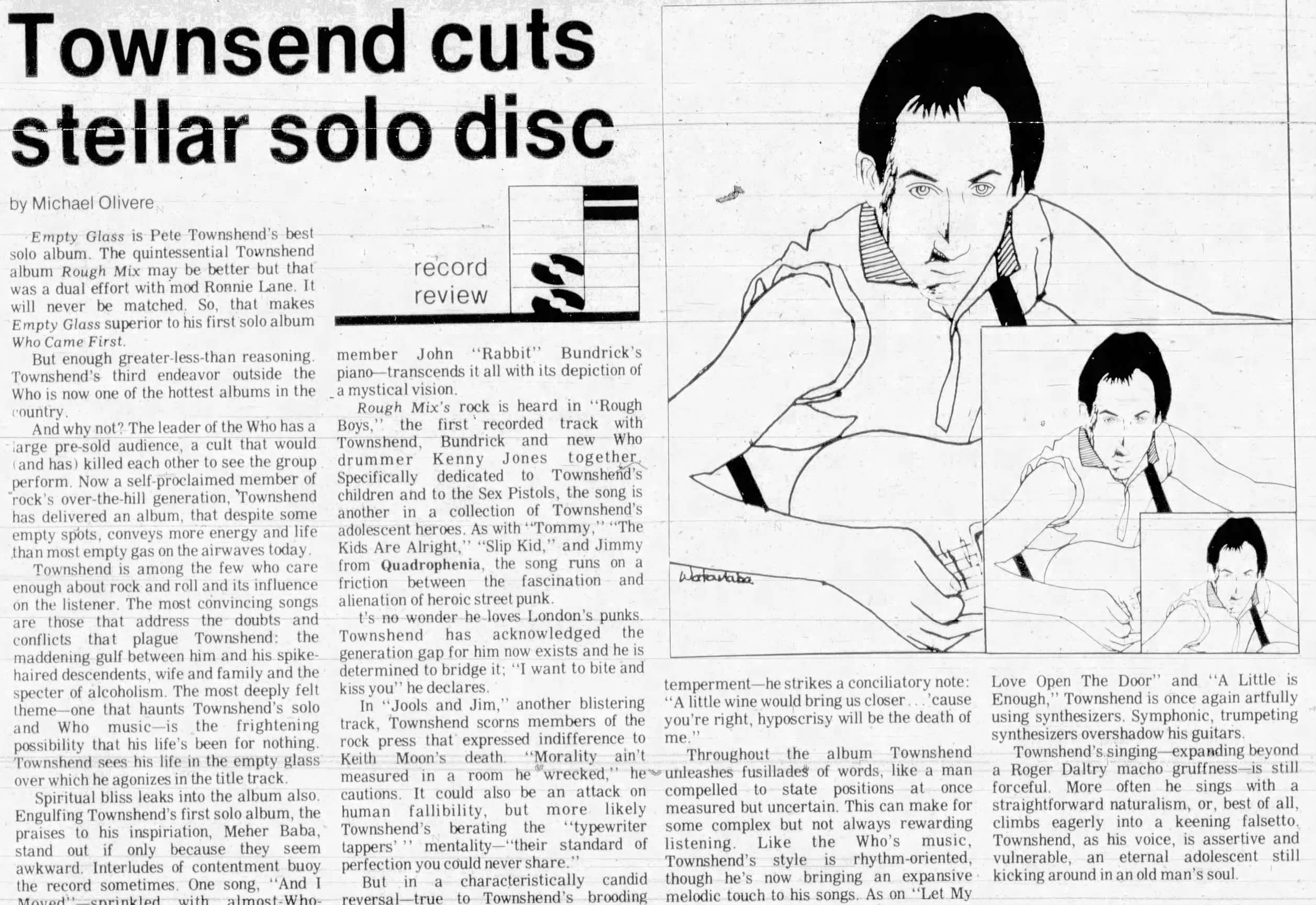
Townsend cuts stellar solo disc
Empty Glass is Pete Townshend's best solo album. The quintessential Townshend album Rough Mix may be better but that was a dual effort with mod Ronnie Lane. It will never be matched. So, that makes Empty Glass superior to his first solo album Who Came First.
But enough greater-less-than reasoning. Townshend's third endeavor outside the Who is now one of the hottest albums in the country.
And why not? The leader of the Who has a large pre-sold audience, a cult that would (and has) killed each other to see the group perform. Now a self-proclaimed member of rock's over-the-hill generation, Townshend has delivered an album, that despite some empty spots, conveys more energy and life than most empty gas on the airwaves today.
Townshend is among the few who care enough about rock and roll and its influence on the listener. The most convincing songs are those that address the doubts and conflicts that plague Townshend: the maddening gulf between him and his spike-haired descendents, wife and family and the specter of alcoholism. The most deeply felt theme-one that haunts Townshend's solo and Who music-is the frightening possibility that his life's been for nothing. Townshend sees his life in the empty glass over which he agonizes in the title track.
Spiritual bliss leaks into the album also. Engulfing Townshend's first solo album, he praises to his inspiration, Meher Baba, stand out if only because they seem awkward. Interludes of contentment buoy the record sometimes. One song, "And I Went Out With a Who
member John "Rabbit" Bundrick's piano-transcends it all with its depiction of a mystical vision.
Rough Mix's rock is heard in "Rough Boys," the first recorded track with Townshend, Bundrick and new Who drummer Kenny Jones together. Specifically dedicated to Townshend's children and to the Sex Pistols, the song is another in a collection of Townshend's adolescent heroes. As with "Tommy," "The Kids Are Alright," "Slip Kid," and Jimmy from Quadrophenia, the song runs on a friction between the fascination and alienation of heroic street punk.
It's no wonder he loves London's punks. Townshend has acknowledged the generation gap for him now exists and he is determined to bridge it; "I want to bite and kiss you" he declares.
In "Jools and Jim," another blistering track, Townshend scorns members of the rock press that expressed indifference to Keith Moon's death. "Morality ain't measured in a room he wrecked," he cautions. It could also be an attack on human fallibility, but more likely Townshend's berating the "typewriter tappers' mentality - "their standard of perfection you could never share."
But in a characteristically candid reversal-true to Townshend's brooding temperament-he strikes a conciliatory note: "A little wine would bring us closer. 'cause you're right, hypocrisy will be the death of me."
Throughout the album Townshend unleashes fusillades of words, like a man compelled to state positions at once measured but uncertain. This can make for some complex but not always rewarding listening. Like the Who's music, Townshend's style is rhythm-oriented, though he's now bringing an expansive melodic touch to his songs. As on "Let My Love Open The Door" and "A Little is Enough," Townshend is once again artfully using synthesizers. Symphonic, trumpeting synthesizers overshadow his guitars.
Townshend's singing - expanding beyond a Roger Daltry macho gruffness-is still forceful. More often he sings with a straightforward naturalism, or, best of all, climbs eagerly into a keening falsetto. Townshend, as his voice, is assertive and vulnerable, an eternal adolescent still kicking around in an old man's soul.