Townshend and his tale of anguish
Staff Writer
Peter Townshend has always been concerned with roles, responsibilities and personal struggles — both his own and those of his band, the Who.
The composer-guitarist extraordinaire, through 15 years of compelling lyrics and music and articulate interviews, has done much to counter the widely-held misconception that rock'n'roll stardom — and in the process, one's sanity — is easy to maintain.
We sometimes snicker at Jackson Browne's whimpering about the difficult, lonely and redundant life on the road during concert tours. But Townshend, as he has matured in the past decade and retreated a bit from his '60s themes of youth alienation, has painted a deeper and more disturbing picture of the difficulties of his and the Who's personal fame.
Townshend doesn't whimper, and he surely provides proof that he and his mates have a tough cross to bear.
The subject of Peter Townshend and his struggles rises out of the release of his third solo album apart from the Who (the second, Rough Mix, was actually a collaboration with Ronnie Lane), plus a fascinating story-interview written by Greil Marcus in a recent Rolling Stone issue.
The new album, titled Empty Glass (Atco), explores those themes that have concerned Townshend since the rise of the Who — the ideas of roles, responsibilities and personal struggles. Unlike other so-called hard luck stories, however, one feels honest sympathy for Townshend when he speaks with Marcus about the burden of the Who's history: "A great knapsack — you carry it around, and nobody ever empties it. You've got the old stale sandwiches in it, as well as the new ones."
The burden of the Who, as Townshend again acknowledges so well in Empty Glass, is one that few, if any, other musicians have been forced to cope with. The band (and especially Townshend, since he's the main songwriter), have been considered spokesmen and symbols of more than one generation of disaffected youth. Perhaps to live up to an image, the band — most notably the late Keith Moon — partook in lunacy such as trashing and ruining hotel rooms.
Townshend's past five years or so could be considered as a living hell, with bouts with alcohol; problems with deafness; a genuine dislike of touring at the expense of his family life; the rise of punk, whose members sometimes labeled the Who as over the hill; the death of drummer Moon almost two years ago and most recently, the anguish felt because of the death of 11 persons trying to enter a Who concert in Cincinnati's Riverfront Coliseum last December.
All of these thoughts are addressed in Townshend's marvelous new record. With conviction and his still sharp touch at writing memorable tunes, he both admires and admonishes the punks. For instance, in "Rough Boys," which he dedicates to his children and the Sex Pistols, he sings: "Rough boys, don't walk away, I very nearly missed you." Yet, in the almost bitter "Jools and Jim," he takes on a punk scene and press that often denigrated the 1970s and didn't blink an eye when Moon died: "Morality ain't measured in a room he wrecked," he tells some poseurs.
Townshend apparently cares what the punks, and all others, think, because of his concern with his own role. But that concern, since he still knows he can contribute mightily to rock'n'roll with his messages and music, has not allowed him to drown in his pessimism. In the Rolling Stone interview, he concedes these are not the worst of times for himself.
"I mean, life revolves quite nicely — you know what I'm saying? I get paid a lot of money for the privilege. The first ten years in the Who were awful; miserable, violent, unhappy times. It's nice to now sit back and enjoy it."
That optimism is mirrored in some of the songs here. In one song, a Kinks'-like dirge, the chorus implores him to "keep on working," and he agrees — but not because he admits he's "a bit in the red", but because "if you never have pleasure then you could be dead."
His love songs show a renewed vigor, too. "Let My Love Open the Door" is as upbeat as any song he has ever written, while the powerful "A Little is Enough" notes: "My spirit ain't broken."
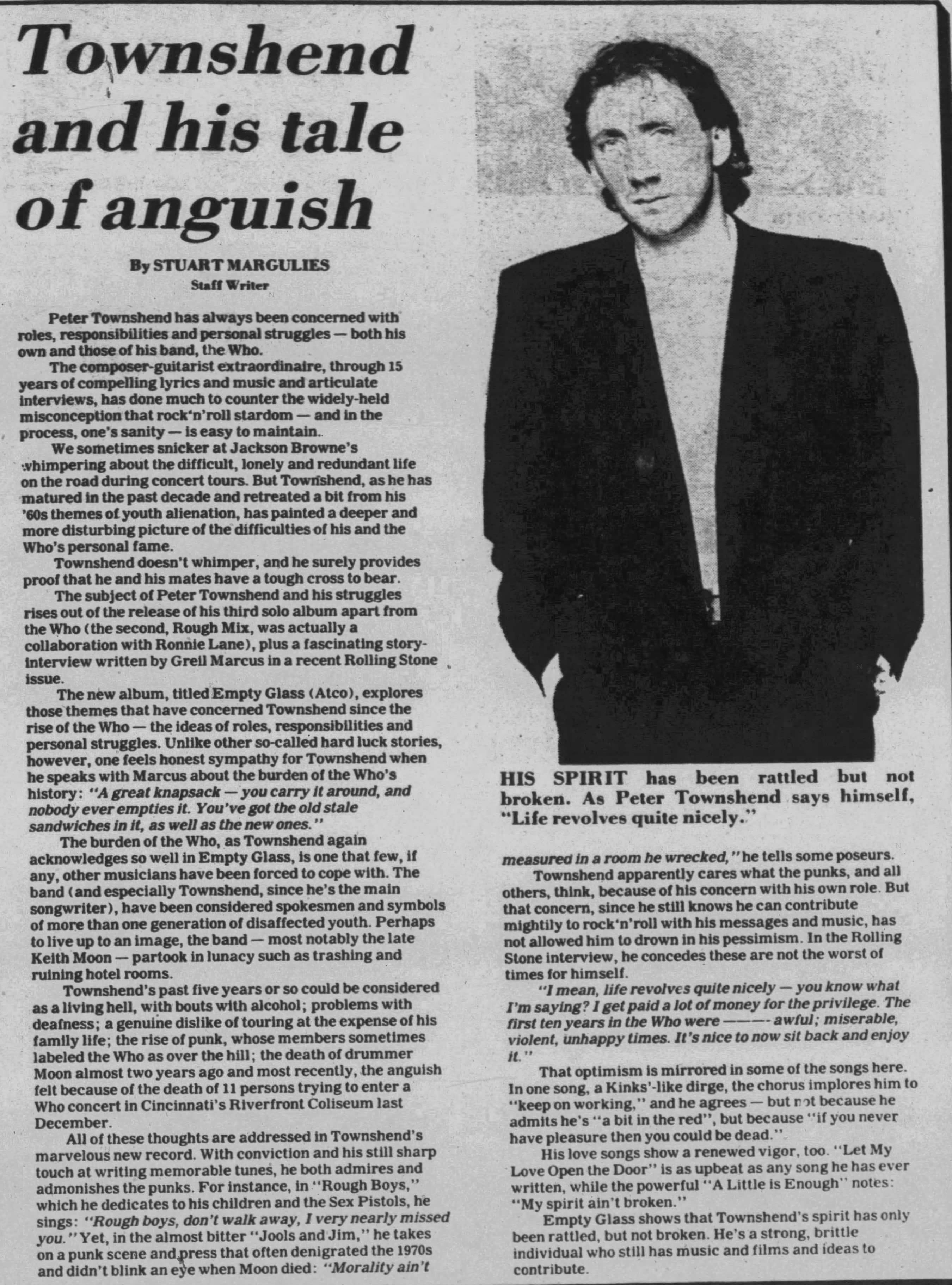
Empty Glass shows that Townshend's spirit has only been rattled, but not broken. He's a strong, brittle individual who still has music and films and ideas to contribute.