1980-07-17-The_Toronto_Star
Who fans are the winners
Toronto Star
You can come out of your bomb shelters now. It's quite all right. Calm down. Make yourself a cup of soothing tea.
The Who have finally left town.
The Who's last raid on the city was a brief two months ago, a rock shootout at Maple Leaf Gardens. We all survived that skirmish. Most of the citizenry didn't even work up a minor sweat about the incident. We were well barricaded. That time.
Then the rumors of another imminent attack surfaced recently. This time, a major assault would be launched. And this time there'd be no quarter given. Some of us recalled with horror what had happened in Cincinnati when the British rock outlaws stormed that city, and suddenly their visit here was a serious business indeed.
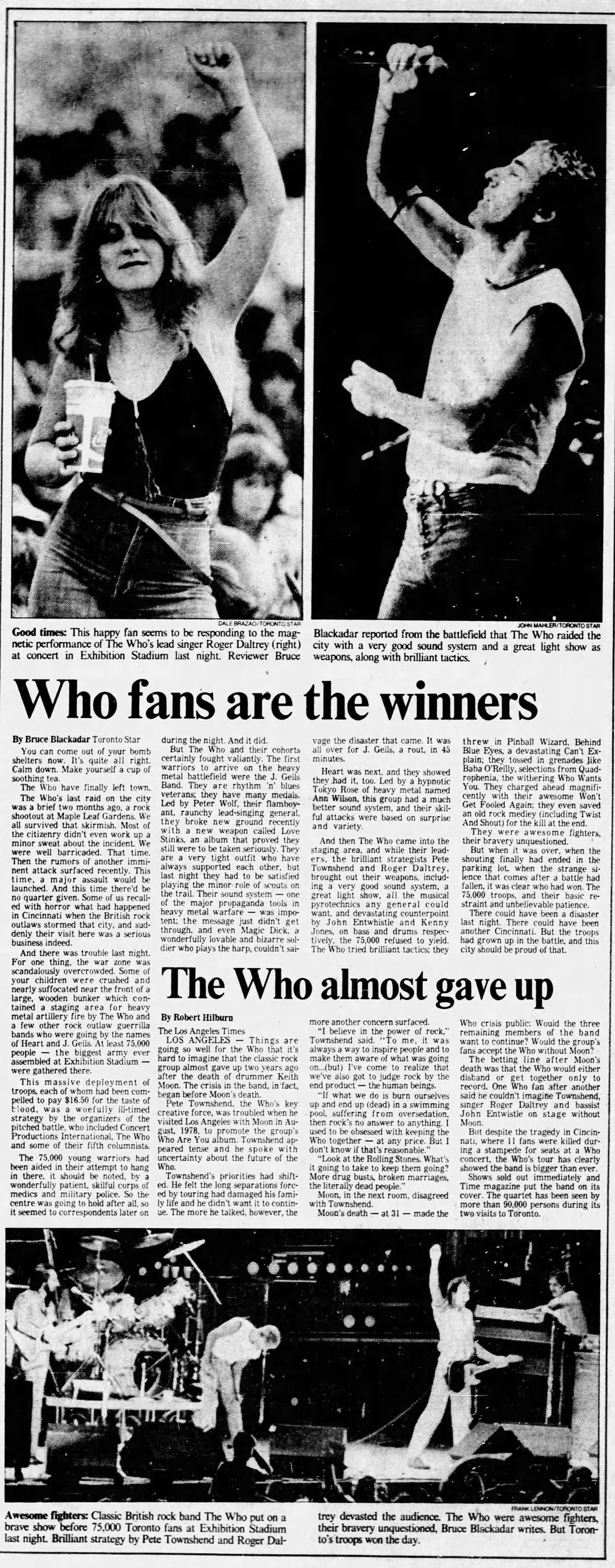
And there was trouble last night. For one thing, the war zone was scandalously overcrowded. Some of your children were crushed and nearly suffocated near the front of a large, wooden bunker which contained a staging area for heavy metal artillery fire by The Who and a few other rock outlaw guerrilla bands who were going by the names of Heart and J. Geils.
At least 75,000 people 6 the biggest army ever assembled at Exhibition Stadium 6 were gathered there.
This massive deployment of troops, each of whom had been compelled to pay $16.50 for the taste of blood, was a woefully ill-timed strategy by the organizers of the pitched battle, who included Concert Productions International, The Who and some of their fifth columnists.
The 75,000 young warriors had been aided in their attempt to hang in there, it should be noted, by a wonderfully patient, skilful corps of medics and military police. So the centre was going to hold after all, so it seemed to correspondents later on during the night. And it did.
But The Who and their cohorts certainly fought valiantly.
The first warriors to arrive on the heavy metal battlefield were the J. Geils Band. They are rhythm 'n' blues veterans, they have many medals. Led by Peter Wolf, their flamboyant, raunchy lead-singing general, they broke new ground recently with a new weapon called Love Stinks, an album that proved they still were to be taken seriously.
They are a very tight outfit who have always supported each other, but last night they had to be satisfied playing the minor-role of scouts on the trail. Their sound system 6 one of the major propaganda tools in heavy metal warfare 6 was impotent; the message just didn't get through, and even Magic Dick, a wonderfully lovable and bizarre soldier who plays the harp, couldn't salvage the disaster that came.
It was all over for J. Geils, a rout, in 45 minutes.
Heart was next, and they showed they had it, too. Led by a hypnotic Tokyo Rose of heavy metal named Ann Wilson, this group had a much better sound system, and their skillful attacks were based on surprise and variety.
And then The Who came into the staging area, and while their leaders, the brilliant strategists Pete Townshend and Roger Daltrey, brought out their weapons, including a very good sound system, a great light show, all the musical pyrotechnics any general could want, and devastating counterpoint by John Entwistle and Kenny Jones, on bass and drums respectively, the 75,000 refused to yield.
The Who tried brilliant tactics; they threw in Pinball Wizard, Behind Blue Eyes, a devastating Can't Explain; they tossed in grenades like Baba O' Reilly, selections from Quadrophenia, the withering Who Wants You.
They charged ahead magnificently with their awesome Won't Get Fooled Again; they even saved an old rock medley (including Twist And Shout) for the kill at the end.
They were awesome fighters, their bravery unquestioned.
But when it was over, when the shouting finally had ended in the parking lot, when the strange silence that comes after a battle had fallen, it was clear who had won. The 75,000 troops, and their basic restraint and unbelievable patience.
There could have been a disaster last night. There could have been another Cincinnati. But the troops had grown up in the battle, and this city should be proud of that.
The Who almost gave up By Robert Hilburn The Los Angeles Times
LOS ANGELES 6 Things are going so well for the Who that it's hard to imagine that the classic rock group almost gave up two years ago after the death of drummer Keith Moon. The crisis in the band, in fact, began before Moon's death.
Pete Townshend, the Who's key creative force, was troubled when he visited Los Angeles with Moon in August, 1978, to promote the group's Who Are You album. Townshend appeared tense and he spoke with uncertainty about the future of the Who.
Townshend's priorities had shifted. He felt the long separations forced by touring had damaged his family life and he didn't want it to continue. The more he talked, however, the more another concern surfaced.
"I believe in the power of rock," Townshend said. "To me, it was always a way to inspire people and to make them aware of what was going on…(but) I've come to realize that we've also got to judge rock by the end product 6 the human beings.
"If what we do is burn ourselves up and end up (dead) in a swimming pool, suffering from overdosing then rock's no answer to anything. I used to be obsessed with keeping the Who together 6 at any price. But I don't know if that's reasonable."
"Look at the Rolling Stones. What's it going to take to keep them going? More drug busts, broken marriages, the literally dead people."
Moon, in the next room, disagreed with Townshend.
Moon's death 6 at 31 6 made the Who crisis public: Would the three remaining members of the band want to continue? Would the group's fans accept the Who without Moon?
The betting line after Moon's death was that the Who would either disband or get together only to record. One Who fan after another said he couldn't imagine Townshend, singer Roger Daltrey and bassist John Entwistle on stage without Moon.
But despite the tragedy in Cincinnati, where 11 fans were killed during a stampede for seats at a Who concert, the Who's tour has clearly showed the band is bigger than ever.
Shows sold out immediately and Time magazine put the band on its cover. The quartet has been seen by more than 90,000 persons during its two visits to Toronto.