1982-09-25-The_Ottawa_Citizen
As the Who embarks on its first North American tour since 1980, lead guitarist Peter Townshend talks to rock columnist Lisa Robinson about the group's future, his own battle with drugs and alcohol, and his personal philosophy: "Rock is able to contain both danger and crap; and a well-run society should be able to do that as well".
The Who will be at Rich Stadium in Buffalo tomorrow and at CNE Stadium in Toronto, Oct. 9.
Who's last waltz?
When British supergroup the Who announced its "final" U.S. tour to begin this week, tickets for massive stadium shows all over the country sold out within hours.
The Who — Pete Townshend, Roger Daltrey, John Entwistle and Kenny Jones — has not performed in the United States since 1980.
Along with the Rolling Stones, the Who exploded onto the music scene in the early 1960s. The band's high-energy, uncompromising rock 'n' roll has survived through a changing music business as well as personal tragedy (the death of the band's first drummer Keith Moon in 1978) and lead guitarist Townshend's bout with drugs and alcohol for the past year.
In this exclusive interview, lead guitarist Pete Townshend talks candidly about the future of the Who, noting that this current tour will probably be a "last waltz."
Lisa Robinson: Is this really the last tour?
Pete Townshend: There is a considerable limit to the amount of time that the band will continue in the shape they're now in. We've definitely decided to give a concerted effort where everyone in the band devotes their exclusive efforts to the band. To date, I've been trying to blend solo work and publishing work in with Who work, and it's not all that graceful a combination. So we've decided to put in a good year's work and cover some territories that we've neglected badly — Australia, maybe, and see if we can hit Japan for the first time.
We've established a sort of niche in the air that just belongs to us. Even if we vacate it temporarily, it seems to be there when we go back. I do get the feeling that it's a kind of last waltz.
Q: How do you feel about going back on the road?
A: I'm not looking forward to it at all. But I think this time I'll try doing it straight, as a novelty. I've tried every other way, and I've had fun doing it, but I think it would be quite interesting to do a tour awake. I hope to put in some energy and get some out of it.
Q: Why do it at all?
A: If we weren't going to do a tour, then why do an album? As a writer, what's the point of me just sitting and making records at home, which I could do quite happily, and never get any feedback, except for reading dumb record reviews, or getting letters from kids?
Out on a stage you get affirmation of what you've done. You can see it, you can sense it,
"This time I'll try doing it straight"
whether one song worked, whether people understand it, whether it's touched the spot that you originally intended to touch. And as a solo performer – I don't intend to go out and work on my own in concert – I'd be too afraid, I think.
I think what rock 'n' roll thrives on is the kind of danger that we're all living on a day-to-day basis. Rock 'n' roll needs it because rock 'n' roll defies the possibility of a nuclear holocaust — it doesn't pretend that it’s not there. It doesn't sit like an ostrich with its head in the sand.
Q: Does rock 'n' roll still matter?
A: I don't know. Perhaps it's starting to blur at the edges. But it doesn't really matter if it blurs at the edges — it's the central core that matters. It doesn't matter if a few intellectuals in Moscow listen to the Rolling Stones, or if your doctor or lawyer is now 40 and saw the Who at Winterland in 1966. What matters is that there's a constant flow of new input into the business, and the purity that it seems to retain in its heart. Every time it looks like it’s going to fall to bits, something happens to save it. And it's obviously because it's not just music.
… I feel passionately about the potential purity and the uniqueness of rock as a focus. Rock is able to contain both danger and crap, and a well-run society should be able to do that as well. But we don't, we don't know how to deal with criminals and crazy people — so in a microcosmic sense, rock ‘n’ roll has achieved a lot. We know what to do with our crazy people; we pay them to play guitar for us.
Q: Do you think the Who is old-fashioned?
A: We're eminently old-fashioned. But I don't think there's anything wrong with being old-fashioned, because there are certain time-honored structures and methods. Guitar playing as an art started in the European courts; you told the king what you thought was wrong with society, in verse — very, very politely. And it's gone on ever since then. So that's old-fashioned, but there's nothing wrong with it.
Q: When the punk rock movement happened in England in the mid-1970s, did you feel dated, useless, finished?
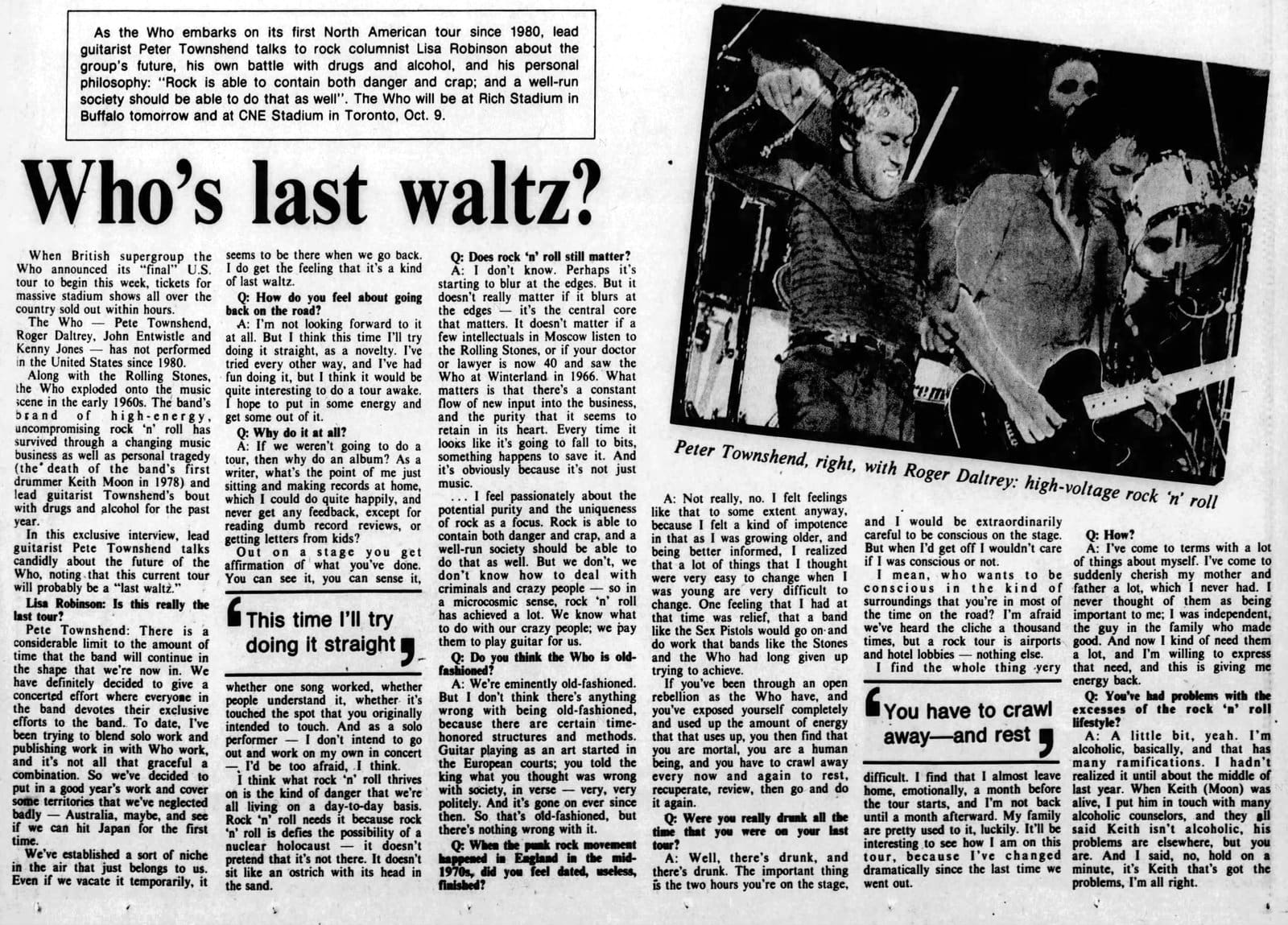
Peter Townshend, right, with Roger Daltrey: high-voltage rock 'n' roll
A: Not really, no. I felt feelings like that to some extent anyway, because I felt a kind of impotence in that as I was growing older, and being better informed, I realized that a lot of things that I thought were very easy to change when I was young are very difficult to change. One feeling that I had at that time was relief, that a band like the Sex Pistols would go on and do work that bands like the Stones and the Who had long given up trying to achieve.
If you've been through an open rebellion as the Who have, and you've exposed yourself completely and used up the amount of energy that that uses up, you then find that you are mortal, you are a human being, and you have to crawl away every now and again to rest, recuperate, review, then go and do it again.
Q: Were you really drunk all the time that you were on your last tour?
A: Well, there's drunk, and there's drunk. The important thing is the two hours you're on the stage,
"You have to crawl away — and rest"
and I would be extraordinarily careful to be conscious on the stage. But when I'd get off I wouldn't care if I was conscious or not.
I mean, who wants to be conscious in the kind of surroundings that you're in most of the time on the road? I'm afraid we've heard the cliche a thousand times, but a rock tour is airports and hotel lobbies — nothing else.
I find the whole thing very difficult. I find that I almost leave home, emotionally, a month before the tour starts, and I'm not back until a month afterward. My family are pretty used to it, luckily. It'll be interesting to see how I am on this tour, because I've changed dramatically since the last time we went out.
Q: How?
A: I've come to terms with a lot of things about myself. I've come to suddenly cherish my mother and father a lot, which I never had. I never thought of them as being important to me; I was independent, the guy in the family who made good. And now I kind of need them a lot, and I'm willing to express that need, and this is giving me energy back.
Q: You've had problems with the excesses of the rock 'n' roll lifestyle?
A: A little bit, yeah. I'm alcoholic, basically, and that has many ramifications. I hadn't realized it until about the middle of last year. When Keith (Moon) was alive, I put him in touch with many alcoholic counselors, and they all said Keith isn't alcoholic, his problems are elsewhere, but you are. And I said, no, hold on a minute, it's Keith that's got the problems, I'm all right.